
Microsoft Anthropic Bet Paid $3.2B, Beat OpenAI All Year
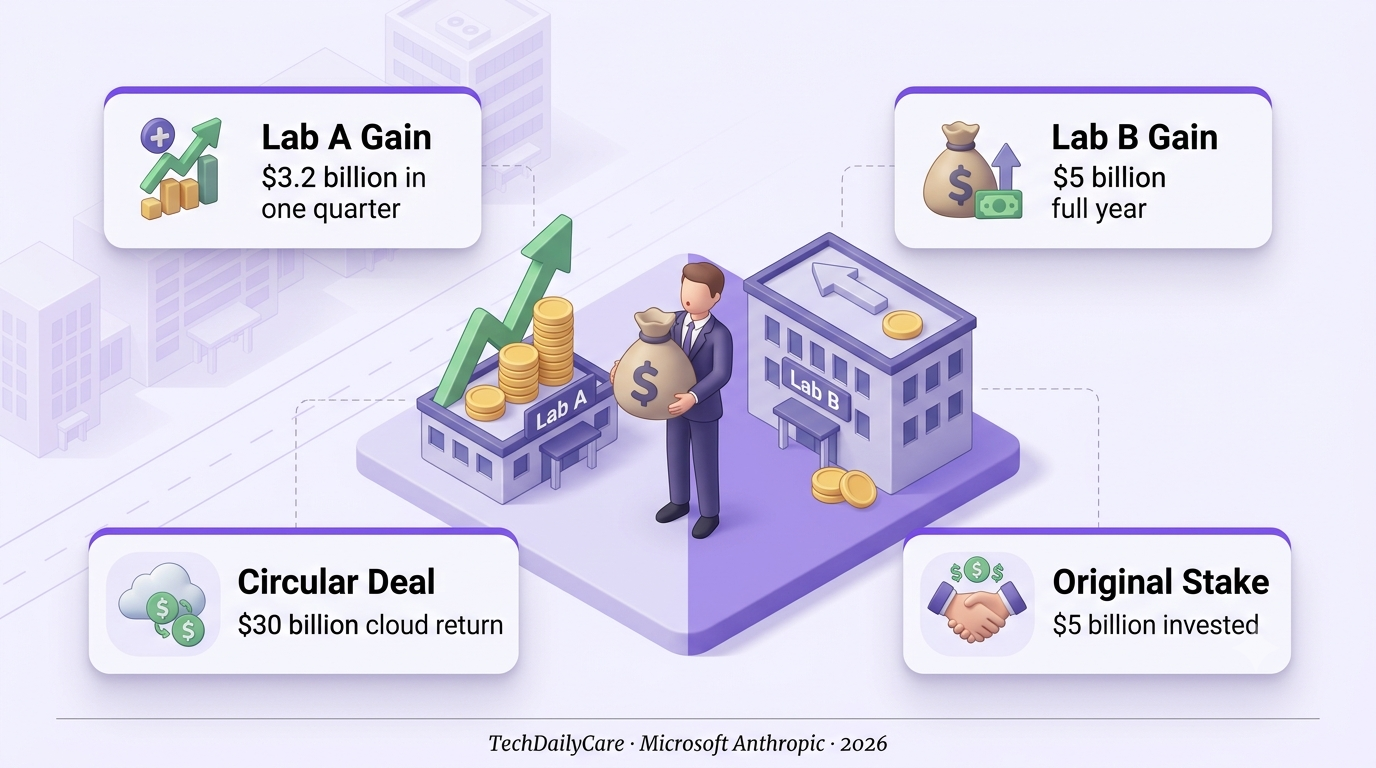
The eight-month-old $5B stake in Anthropic returned $3.2B in Q4 alone. OpenAI added $5B for the full year. Microsoft just showed its second AI hand.
Microsoft just made its most surprising AI disclosure of the year. Buried in the Q4 FY26 earnings release yesterday was a line item that changes how the market has been thinking about Microsoft’s AI portfolio. The company’s investment in Anthropic generated a $3.2 billion gain in a single quarter, boosting diluted EPS by 33 cents. That is roughly half of what Microsoft’s much older, much larger, and much more visible stake in OpenAI added for the entire fiscal year. The Microsoft Anthropic story just went from footnote to headline.
The mechanics matter here. Microsoft invested $5 billion in Anthropic in November 2025 as part of a circular agreement — Anthropic in turn committed to buying $30 billion worth of Azure services. That deal was framed at the time as a strategic hedge, a way for Microsoft to diversify AI exposure beyond OpenAI without upsetting the OpenAI relationship. Eight months later, the hedge is producing per-share returns that make the “hedge” framing look conservative. Anthropic is not a backup plan. It is a second bet paying off faster than the first one did.
The comparison inside Microsoft’s own numbers is striking. OpenAI added $5.0 billion in gains and $0.67 EPS for the full FY26 year, per the company’s non-GAAP breakout. Anthropic added $3.2 billion in Q4 alone. In the same Q4, Microsoft actually marked down its OpenAI stake by roughly $600 million, subtracting $0.07 from EPS. The two AI labs Microsoft is exposed to are on completely different quarterly trajectories, and for the first time the second one is producing more upside than the flagship one.
Layer on the operating numbers and Q4 FY26 is one of the biggest quarters in Microsoft’s history. Azure grew 43% and crossed $100 billion in annual revenue for the first time. Microsoft 365 Copilot hit 30 million paid seats. Commercial remaining performance obligations jumped 84% to $678 billion. Total Q4 revenue was $90.0 billion, up 18%. But the piece that will dominate analyst notes this morning is the Microsoft Anthropic disclosure. Here is what the Microsoft Anthropic gain actually reveals about the state of the AI portfolio bet and why the market is paying more attention to this line than any other in the release.
Why disclose this now?
Microsoft doesn’t routinely mark its Anthropic investment quarterly. Disclosing a $3.2B gain in Q4 signals the position is now material to earnings. That’s a governance and analyst-communication decision, not an accounting one.
How is the deal structured?
Microsoft invested $5B in Anthropic in November 2025. Anthropic agreed to buy $30B of Azure services in return. Circular capital flow — Microsoft equity in, Anthropic compute out — with revenue recognition on both sides.
How does it compare to OpenAI?
OpenAI stake added $5B and $0.67 EPS for FY26. Anthropic added $3.2B and $0.33 EPS in Q4 alone. Q4 OpenAI was actually marked down $600M. Second bet outperforming first bet this quarter.
What does this signal?
Microsoft is not one-hedged on OpenAI. It has two viable AI franchise bets both generating material gains, and Nadella is comfortable being publicly diversified across the two most valuable AI labs.
The $5B Stake Just Returned 64% Of OpenAI’s Full-Year Gain
ReturnMicrosoft’s Anthropic investment closed in November 2025 at $5 billion. Eight months later, the Q4 FY26 disclosure shows the position generated a $3.2 billion gain against that basis. For context, Microsoft’s much older and much larger OpenAI investment added $5 billion in gains for the entire fiscal year. The Anthropic stake produced 64% of the OpenAI full-year figure in a single quarter, on roughly one-tenth of the original commitment size.
What this reflects is not just Anthropic’s valuation trajectory — it is Microsoft’s timing on entry. The November 2025 investment came at a valuation multiple that has since expanded significantly as Anthropic’s Claude Fable and later Opus 4.7 models drove enterprise adoption. Meanwhile OpenAI’s valuation has been more volatile through FY26, with several markup and markdown cycles as the market has re-rated its economics. The mark-to-market difference between the two positions is what produced the divergent quarterly numbers.
The unusual thing about the disclosure is that Microsoft doesn’t normally break out Anthropic every quarter. Per TechCrunch’s read of the release, Microsoft discusses its OpenAI investment quarterly but treats Anthropic as a routine equity holding that only gets disclosed when it moves the earnings needle. The fact that Q4 FY26 was the quarter that changed indicates the position has grown to a size where investors need to see it separately.
The Circular $5B / $30B Deal Structure Explained
MechanicsThe Microsoft Anthropic transaction in November 2025 was not a straight equity investment. It was a circular capital arrangement. Microsoft put $5 billion in equity into Anthropic. Anthropic agreed to spend $30 billion buying Azure services over a multi-year commitment window. Money moves in a loop: Microsoft cash → Anthropic equity → Azure revenue → back to Microsoft.
Circular deals like this are common in the AI infrastructure market right now. Nvidia has similar arrangements with its largest cloud and lab customers. OpenAI’s original Microsoft partnership had a circular element as well. What makes the Microsoft Anthropic version distinctive is the ratio — 6x return commitment on the equity stake, structured as multi-year Azure consumption rather than a one-time revenue recognition event.
The accounting treatment matters. Microsoft records the equity investment on its balance sheet and marks it to market. The $30B Azure commitment gets recognized as revenue as Anthropic actually consumes the compute. So Microsoft is booking both the mark-to-market gain on the equity position and the operational revenue from the Azure services, effectively getting two lines of upside from one strategic transaction.
OpenAI Just Got Marked Down $600M In The Same Quarter
DivergenceThe Anthropic story would be interesting in isolation. Set next to what happened to Microsoft’s OpenAI position in the same quarter, it becomes structural. Microsoft marked its OpenAI investment down by roughly $600 million in Q4 FY26, subtracting $0.07 from diluted EPS. On the full-year basis OpenAI still generated a $5B gain and $0.67 EPS boost, but the quarterly direction reversed.
What drove the OpenAI markdown is not fully broken out in the release, but two factors are visible in the wider market. First, competitive pressure — Anthropic’s Claude family and Google’s Gemini have both taken enterprise share from OpenAI over the last two quarters. Second, OpenAI’s own economics — the company has been aggressively repricing its API tiers and adding new pricing complexity that has slowed monetization at the enterprise level.
The FY25 comparable makes the reversal more striking. In fiscal 2025, Microsoft’s OpenAI investment produced a $3.6 billion loss and subtracted $0.49 from EPS. FY26 flipped that to +$5B and +$0.67. The volatility in Microsoft’s OpenAI mark is now a defining feature of the quarterly earnings pattern. Adding a second, uncorrelated AI lab position — Anthropic — dampens that volatility at the portfolio level.
Azure Just Crossed $100B, But Google Cloud Grew Twice As Fast
OperatingAlongside the Microsoft Anthropic disclosure, Q4 FY26 confirmed Azure crossed $100 billion in annual revenue for the first time. Q4 Azure growth was 43%, above the 39-40% Amy Hood guided in April and well above Wall Street expectations. Intelligent Cloud revenue was $39.3 billion, up 32%. Microsoft Cloud in aggregate was $59.3 billion, up 27%.
The Azure numbers are the operational backdrop for why the Microsoft Anthropic hedge matters strategically. Google Cloud grew 82% last quarter to $24.8 billion — nearly double Azure’s growth rate. Microsoft needs a second AI franchise to complement the Azure/OpenAI stack because the Google Cloud/Gemini stack is compounding faster on the top line. Anthropic, distributed largely on AWS but with a $30 billion Azure commitment, is Microsoft’s way of ensuring Azure captures Anthropic’s growth even if the model itself runs partially on competitor clouds.
Commercial remaining performance obligations grew 84% to $678 billion. That backlog is the visibility signal enterprise investors care about. Google Cloud’s comparable RPO figure is $514 billion. Azure has more total backlog by dollar amount, though Google Cloud’s percentage growth of RPO is higher. The Microsoft Anthropic deal contributes to Azure’s RPO figure through Anthropic’s multi-year commitment — the $30 billion converts to backlog and then to recognized revenue as consumption occurs.
Copilot Reached 30M Paid Seats, First Time Disclosed
MilestoneMicrosoft has been deliberately opaque about Copilot seat counts for two years. Q4 FY26 changed that. Satya Nadella disclosed that Microsoft 365 Copilot has passed 30 million paid seats. That number contextualizes the enterprise AI adoption story: 30 million paid Copilot seats represents about 6.7% of the estimated 450 million Microsoft 365 commercial customer base.
The Register noted that 6.7% is “not an overwhelming vote of confidence” given Microsoft’s aggressive push and the two years since Copilot launched. Fair. But it is a meaningful number in absolute terms. GitHub Copilot alone was well under 3 million paid seats a year ago. Google’s Antigravity has 2.4 million weekly active users per last week’s Alphabet disclosure. 30 million is now the benchmark other AI productivity tools get compared against — Microsoft has effectively set the ceiling.
The pricing model shift is worth noting too. Microsoft imposed usage-based billing on top of seat-based charges earlier this year, meaning the 30 million paid seats produce variable revenue depending on token consumption rather than pure per-seat economics. This is the same structural repricing that has been eating traditional per-seat SaaS vendors. Microsoft is doing the pivot on its own terms with 30 million seats already committed.
Stock Jumped 7% After Hours On A Mixed Print
MarketMicrosoft stock jumped 7% in extended trading on July 29 after the earnings release, per CNBC. That is a meaningful move for a stock that had been down 19% YTD heading into the print — the biggest laggard among the mega-cap software names inside this year’s Software Selloff. The rebound came before the market has fully digested the Microsoft Anthropic disclosure, and after the operating beats and Azure milestone drove immediate coverage.
The market’s read is that Microsoft delivered a rare “clean” print in a quarter where investors had assumed the worst. Azure growth beat guidance. Copilot seats confirmed the enterprise attach. Anthropic gains gave the EPS an unexpected lift. Capex plan was reiterated at $175 billion for FY27 with a mechanical accounting change (data center useful life extending from 15 to 25 years) that reduces reported depreciation without changing actual spending. Free cash flow was down 23% to $19.6 billion, but Amy Hood guided to positive FCF for FY27.
The 7% pop puts Microsoft back near $420 in extended trading, above the $400 breakpoint that dominated the Software Selloff coverage last week. Whether the rebound holds through today’s session depends on how the analyst desks parse the useful-life accounting change and the ongoing $175B capex line. But the Microsoft Anthropic disclosure specifically has changed the AI-portfolio narrative around Microsoft in a way that will persist beyond one earnings cycle.
Azure revenue surpassed $100 billion for the first time,
and Microsoft 365 Copilot reached over 30 million paid seats.
- Anthropic quarterly disclosure cadence — Q4 FY26 was the first quarter Microsoft broke out the Anthropic mark. If Microsoft starts reporting it every quarter, the position has become a permanent line in the earnings story.
- OpenAI mark direction in Q1 FY27 — After a Q4 markdown, if OpenAI returns to gains it validates the portfolio-hedge thesis. If OpenAI marks down again, the Anthropic position becomes even more strategically important.
- Anthropic $30B Azure consumption pace — Watch Azure segment growth and remaining performance obligations for the pace at which Anthropic’s committed spending is converting to Microsoft’s cloud revenue.
- Copilot seat trajectory beyond 30M — 40-50M by year-end would confirm enterprise Copilot as a durable seat-plus-usage franchise. Flat 30-33M would deflate the AI productivity attach story.
- Google Cloud vs Azure growth spread — Azure 43% vs Google Cloud 82% is a 39-point gap. If the gap narrows in Q1, Azure regains competitive standing. If it widens, Microsoft’s Anthropic hedge becomes essential.
- Microsoft capex guidance discipline — Amy Hood held the line at $175B for FY27 with a useful-life adjustment. Watch for whether the actual capex outlays follow that guidance or drift higher.
- Regulatory scrutiny of circular AI deals — Antitrust and audit bodies are watching Microsoft/Anthropic-style circular arrangements. Any formal inquiry would be material to how these deals are reported going forward.
⚠️ Four Microsoft Anthropic Reading Traps
1. Confusing mark-to-market gains with operating income. The $3.2B Anthropic gain is a non-cash accounting adjustment reflecting the change in fair value of Microsoft’s equity stake. It is real EPS but not real cash flow, and it can reverse in future quarters if Anthropic’s valuation compresses.
2. Treating circular AI deals as pure revenue. The $30B Azure commitment from Anthropic is contingent on actual consumption over multiple years. Framing it as $30B of guaranteed revenue misreads how the recognition works and overstates the near-term impact.
3. Assuming Microsoft can keep marking Anthropic up. The $3.2B gain reflects Anthropic’s valuation trajectory through Q4. If Anthropic hits a fundraising or performance snag, Microsoft would have to mark the position down. The line item works both directions.
4. Missing the Xbox impairment. Q4 also included an Xbox impairment charge that partially offset the Anthropic gain. Microsoft’s gaming segment is still shrinking, and the impairment signals the write-down is real. Don’t read only the AI wins in isolation.
Microsoft recorded nearly as much gain on Anthropic in one quarter
as it did on OpenAI for the entire year.