
RAM Prices, Why DDR5 Now
Costs 5x More Than Last Year
A German retail tracker puts DDR5 pricing at 486% of last year’s level, and SK Hynix’s CEO says real relief may not arrive until 2030
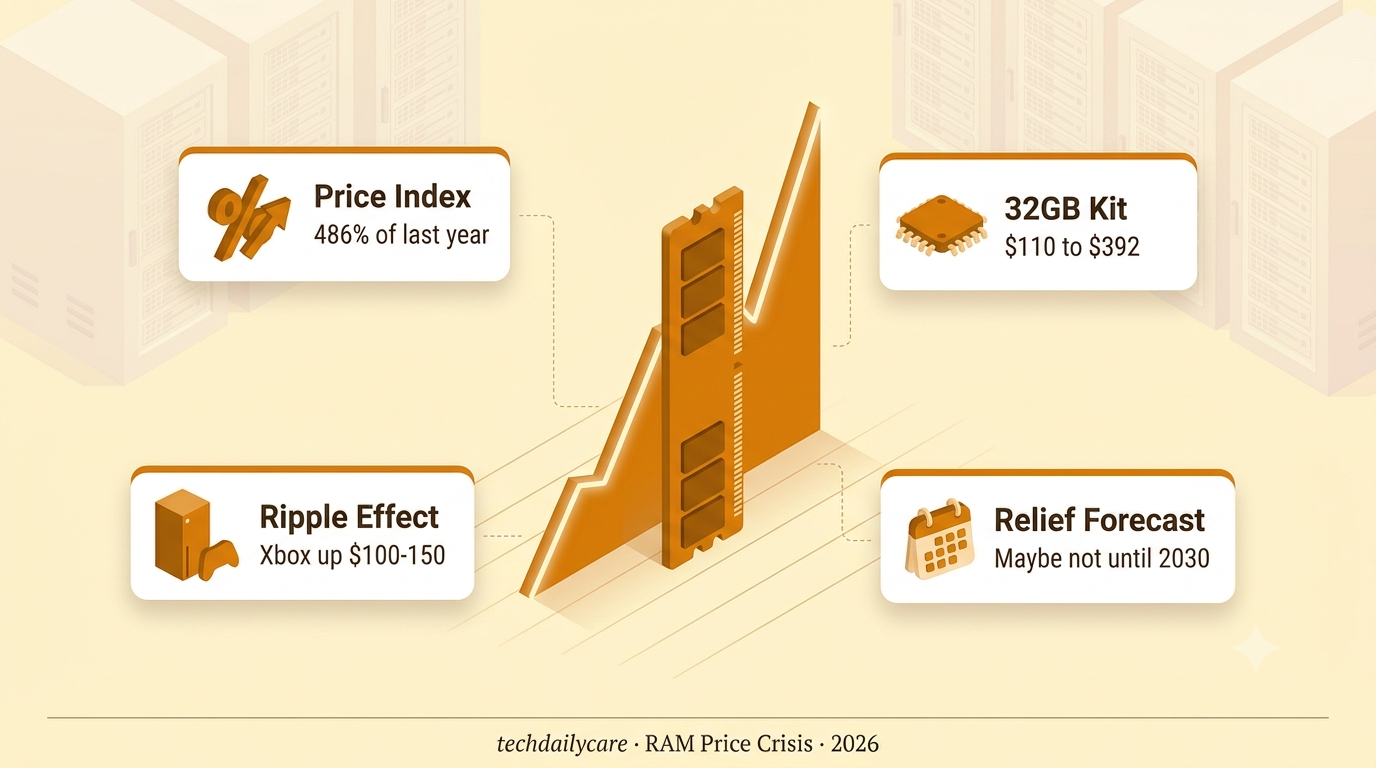
If you’ve priced out RAM recently, the RAM prices you’re seeing aren’t a glitch, they’re the new normal. A monthly tracker from Germany’s 3D Center, spotted by Wccftech, shows DDR5 pricing in the German retail market hit 486% of its July 2025 level as of mid-August 2026. In plain terms, DDR5 memory is now roughly five times more expensive than it was a year ago, and the climb accelerated through the summer after a relatively flat start to the year.
US data tells the same story. Tom’s Hardware’s RAM price index put a mainstream 32GB DDR5-6000 kit at $392 in August 2026, up from just $110 to $140 as recently as Q3 2025. A 2×32GB 6000 MT/s kit rose from $222 to $1,272, a 473% jump. SSDs are caught in the same squeeze: internal drives in the German market are now 2.2 times their pre-crisis price, and a 2TB NVMe SSD that cost $120–$150 a year ago now runs $300–$480.
The cause isn’t a factory breaking down, it’s a deliberate reallocation. Memory makers are shifting wafer capacity toward high-bandwidth memory (HBM) for AI data centers, which is far more profitable per wafer than consumer DDR5. TrendForce estimates that producing just one gigabyte of HBM consumes roughly four gigabytes’ worth of standard DRAM wafer capacity, and AI-related demand could absorb close to 20% of the industry’s total DRAM wafer output in 2026.
AI ate the wafer capacity
Memory makers shifted production toward high-margin HBM for AI data centers, starving the consumer DDR5 and NAND supply left for everyone else.
DDR5 up to 486%
German retail tracking shows DDR5 at nearly five times its July 2025 price, with US kit prices climbing in parallel through 2026.
It’s hitting finished products
Every current Xbox Series console rose $100 to $150 on August 1, 2026, pushing the Series X to $799.99, largely on memory cost alone.
No quick fix in sight
SK Hynix’s CEO has warned the shortage could persist toward 2030, with most analysts seeing no real PC-market relief inside 2026 or 2027.
The AI Demand Behind It
The CauseHigh-bandwidth memory, the stacked DRAM used alongside AI accelerators, is far more wafer-intensive and profitable than standard consumer DDR5, roughly two to three times the margin, according to industry estimates. That’s exactly why memory makers keep prioritizing it. RAM Prices for ordinary PCs are a direct casualty of that reallocation, not a raw materials shortage.
What It’s Doing to RAM Specifically
The Numbers3D Center’s tracker put DDR5 at 486% of its July 2025 baseline by mid-August 2026, up from 445% the month before. Tom’s Hardware’s US index shows a similar climb: a 6000 MT/s 2×16GB kit rose from $108 to $572, up 429%, while desktop DDR5 modules now average $15.27 per gigabyte across 193 tracked kits, roughly double the DDR4 average.
It’s Not Just RAM Anymore
The Ripple EffectNAND flash, the memory type used in SSDs, faces the same fab-capacity pressure, though the increases have been somewhat less extreme in percentage terms. Samsung’s 990 Pro line is up 252% to 268% from its 2023 lows. The squeeze has already reached finished hardware too: every current Xbox Series console rose $100 to $150 on August 1, 2026, pushing the Series X to $799.99, and Tom’s Hardware’s flagship $4,000 PC build has ballooned to $7,407.
When It Might Actually Get Better
The OutlookSK Hynix’s CEO has warned the shortage could persist toward 2030, and TrendForce’s outlook has the DRAM supply gap widening through 2027, with NAND (and therefore SSDs) expected to ease first. New fab capacity takes years to come online, so this isn’t a problem that resolves with a single good quarter of production.
Memory has quietly become one of the most
expensive line items on the parts list.
- Need a system in the next quarter or two? Buying now is generally the safer bet, since every forecast points to higher prices ahead, not lower.
- Sizing a new kit? Buy the minimum capacity you’ll actually use, 32GB rather than 64GB, to cap how much of the price spike you’re exposed to.
- Upgrading an existing PC? Pull the RAM and boot drive from your old machine first. A DDR5 kit you already bought at 2024 prices is the cheapest memory you’ll find in 2026.
- Machine still running fine? If the upgrade is purely discretionary, waiting is defensible, but don’t expect meaningful relief before 2027 at the earliest.