🏓 AI News · April 2026
Sony AI’s Ace Robot
Just Beat a Pro Table Tennis Player
The first autonomous robot to win competitive matches against elite and professional athletes — published on the cover of Nature
📅 April 27, 2026
✍️ Tech Daily Care
⏱ 8 min read
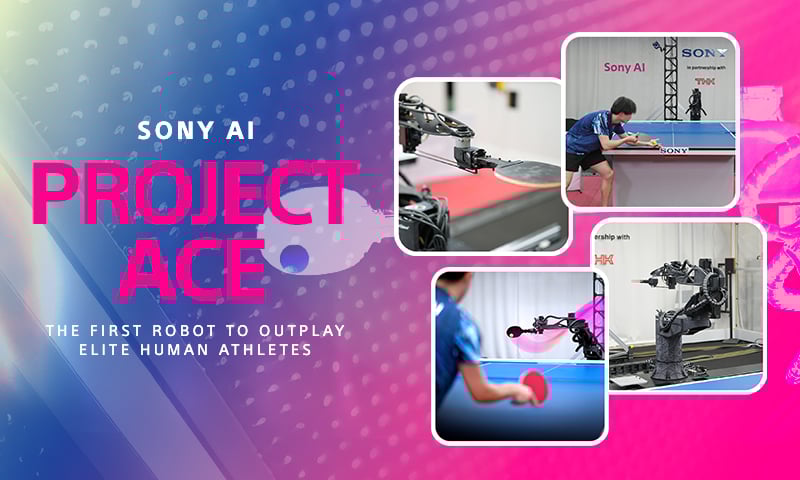
📷 Sony AI’s Ace robot in action at the Tokyo tournament, April 2026. Source: Sony AI
It was an ordinary afternoon in Tokyo. A professional table tennis player, Taira Mayuka, launched a smash that would normally end the point. The ball cleared the net in a blur — and somehow, it came back. On the other side of the net wasn’t a human. It was Sony AI’s Ace robot, which had read the ball’s trajectory in 20 milliseconds, adjusted its racket angle mid-flight, and returned the shot. That moment, repeated across dozens of matches, became the centerpiece of a landmark paper published on the cover of Nature on April 23, 2026. For the first time in history, an autonomous robot had competed — and won — against elite and professional table tennis players under official competition rules.
📊 Key Numbers at a Glance
⚡
20.2ms
Ace’s end-to-end reaction time
🧠
230ms
Average human elite player reaction
🏆
3/5
Match wins vs. elite amateur players
🌀
75%
Return rate on high-spin shots
🌍
5 yrs
Development time for Project Ace
📡
100+
Integrated tools in robot’s AI system
🤖 What Is Sony AI’s Project Ace?
Background · Sony AI Research
Project Ace is the result of five years of research at Sony AI, combining cutting-edge robotics hardware, event-based vision sensors, and deep reinforcement learning. The goal was deceptively simple: build a robot that could compete at a real table tennis match under official International Table Tennis Federation (ITTF) rules — no modifications, no handicaps, no cooperative rallying.
Sony AI had previously demonstrated AI mastery in virtual environments with GT Sophy, an agent that could outrace human players in the Gran Turismo video game. But translating that intelligence into the physical world — where the ball moves at over 20 meters per second, spins at up to 160 revolutions per second, and opponents actively try to exploit weaknesses — was an entirely different challenge. Ace is the answer to that challenge.
The research, titled “Outplaying Elite Table Tennis Players with an Autonomous Robot,” was published on the cover of Nature (Vol. 652), marking one of the most significant milestones in physical AI in recent years.
📷 Sony AI’s Ace robot in action — competing against professional table tennis player Taira Mayuka, Tokyo, April 2026. Source: Sony AI / Nature Vol.652
⚙️ How Does Ace Actually Work?
System 01
Event-Based Vision
Ace uses Sony’s IMX636 event-based vision sensors alongside high-speed IMX273 active pixel sensors — a 9-camera array that tracks the ball’s 3D position, speed, and spin in real time. This enables a perception latency of just 10.2 milliseconds.
📷 9 cameras · 10.2ms perception latency
System 02
Reinforcement Learning Brain
Ace’s AI brain was trained through deep reinforcement learning — playing millions of simulated rallies against itself before ever touching a real ball. The system learns by trial and error, discovering which shot placements and spin strategies work best.
🧠 Model-free RL · 1kHz control cycle
System 03
High-Speed Robotic Hardware
The robot arm features two prismatic and six revolute joints (eight total), engineered to execute the precise, high-speed movements of professional-level play — including topspin, slice, and serve. It can return balls at up to 19.6 m/s.
🦾 8 joints · Max return speed 19.6 m/s
System 04
Hierarchical Decision Architecture
Ace uses a three-layer system: Skill (controls immediate motion), Tactics (governs point-by-point choices), and Strategy (adapts play across an entire match). This keeps opponents guessing by sampling different skills for each shot.
🎯 Skill → Tactics → Strategy layers
🏓 Match Results — How Did Ace Actually Perform?
| Match Round |
Opponent Type |
Format |
Result |
Notes |
| April 2025 (Nature eval) |
5 Elite Amateurs |
Best of 3 |
3/5 Wins |
20+ hrs/week training players |
| April 2025 (Nature eval) |
2 Professional Players |
Best of 5 |
1 Game Won |
vs. Minami Ando & Kakeru Sone |
| December 2025 |
2 Elite + 2 Professional |
Extended |
2 Elite + 1 Pro |
First professional match win |
| March 2026 |
3 New Professionals |
Extended |
Beat All 3 (at least once) |
Improved shot speed & placement |
📅 Five Years in the Making — Project Ace Timeline
2021
Sony AI begins Project Ace. Early experiments focus on simply keeping the ball in play — basic rallying without any competitive pressure.
2022–2023
Development of the event-based vision sensing system. Sony Semiconductor Solutions provides IMX636 and IMX273 sensors that enable sub-11ms perception latency.
2024
Reinforcement learning system matures. Ace begins training against simulated opponents, developing a library of shot types including topspin, slice, and serve strategies.
April 2025
Milestone evaluation: Ace competes against five elite amateurs and two Japanese professional league players under full ITTF rules. Wins 3 out of 5 elite matches. Results submitted to Nature.
December 2025
Post-submission matches: Ace defeats both elite players and beats one professional player for the first time — a historic milestone.
April 23, 2026
Research published on the cover of Nature (Vol. 652). Sony AI officially announces the breakthrough. March 2026 results show Ace defeating all three new professional opponents at least once.
🔬 Why This Is Bigger Than Table Tennis
Deep Analysis · April 2026
For decades, AI demonstrated superhuman performance in digital environments — chess, Go, StarCraft, Gran Turismo. But the physical world is fundamentally harder. A robot must perceive unpredictable changes, interpret what those changes mean, decide how to react, and perform a precise physical action — all in milliseconds, against an opponent actively trying to defeat it. No previous robot had cleared this bar in a real competitive sport under official rules.
Ace changes that. Its 20.2 millisecond end-to-end latency — compared to roughly 230 milliseconds for elite human players — doesn’t just make it fast. It means the robot can react to shots that happen at the absolute limit of human capability. The 75% return rate on high-spin shots, the 16 direct service points scored (versus 8 by human opponents), and the ability to generalize to unusual situations like net-edge bounces all point to a system that learns principles of play rather than memorizing responses.
The implications extend well beyond sport. Sony AI’s chief scientist Peter Stone has noted that the same perception-decision-action framework that Ace uses on a ping pong table could apply to manufacturing robotics, surgical assistance, warehouse automation, and any domain requiring fast, precise, real-time physical interaction with an unpredictable environment. Ace is, in a very real sense, a proof-of-concept for physical AI at human expert level.
📷 Ace’s dual-sensor vision system — IMX636 event-based vision (gaze control) + IMX273 active pixel sensors (high-speed tracking). Source: Sony Semiconductor Solutions
❓ Frequently Asked Questions
Did Ace actually beat professional table tennis players?
Yes — but with nuance. In the original April 2025 evaluation underlying the Nature paper, Ace lost both full matches against professionals Minami Ando and Kakeru Sone, though it did win one game. However, in follow-up matches in December 2025, Ace defeated one professional player outright — the first time a robot had ever beaten a professional in a competitive table tennis match under official rules. By March 2026, Ace had defeated all three newly tested professional players at least once, showing continued performance gains.
How is Ace different from previous table tennis robots?
Previous table tennis robots were typically tested against beginners or amateurs, using non-standard equipment that limited ball speed and spin. They also relied on pre-programmed responses rather than learned strategies. Ace is the first robot to compete under full ITTF official rules, against elite and professional players, using standard equipment, with a learned AI system that adapts its play in real time rather than following a script.
What makes the spin detection so important?
Spin is the most complex and decisive element of advanced table tennis. It changes the ball’s trajectory in the air and its bounce angle on the table — experienced players use it to win points directly. Most previous robots struggled with spin. Ace successfully returns 75% of high-spin shots across a wide range of spin types, and it scores points using spin itself — winning through precision and control rather than pure speed.
What are the real-world applications beyond sport?
Sony AI identifies manufacturing and service robotics as the most immediate application areas. Any domain requiring fast, precise, real-time physical interaction — surgical robotics, automated assembly, warehouse picking systems, or even assistive care robots — could potentially benefit from the same perception and control architecture that Ace uses. The breakthrough is the framework, not just the table tennis robot itself.
🏓 Sony AI Ace Robot — Key Takeaways
1
First physical AI to beat professionals — Ace is the first autonomous robot to win competitive matches against elite and professional athletes under official rules2
11x faster than humans — Ace’s 20.2ms reaction time vs. 230ms for elite players means it responds before a human even processes the shot3
Wins through skill, not speed — 75% return rate on high-spin shots; Ace wins with precision and spin control, not brute force4
Five years of reinforcement learning — trained in simulation, then transferred to the real world in a process similar to GT Sophy5
Published in Nature — the research appears on the journal’s cover, signaling its significance to the broader scientific community6
Bigger than table tennis — the same framework opens doors to manufacturing, surgical, and service robotics requiring fast, precise physical AI
