
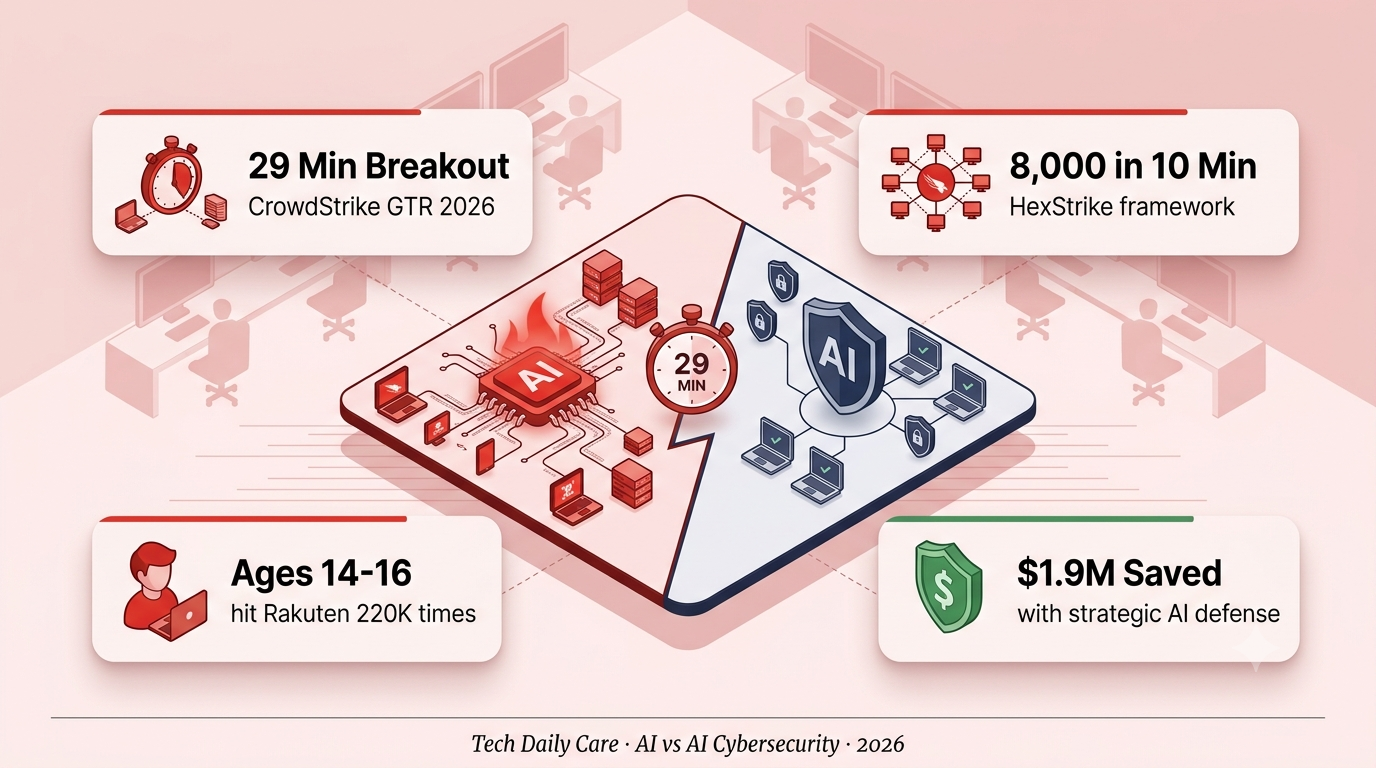
AI vs AI Cybersecurity, 5 Truths That Define the Machine-Speed War
Attackers now compromise 8,000 endpoints in under 10 minutes. Defenders’ median response is still measured in days. What the 2026 Booz Allen, WEF, CrowdStrike, and Mandiant reports actually say.
The cybersecurity landscape changed in a hard, measurable way between 2024 and 2026, and AI vs AI cybersecurity is now the defining framing. Open-source offensive AI frameworks like HexStrike weaponized vulnerabilities and exploited 8,000+ endpoints in under ten minutes. State-sponsored actors used jailbroken AI agents to autonomously execute full intrusion lifecycles. AI-generated phishing began outperforming human red teams. And the average attacker breakout time — the window between initial compromise and lateral movement — dropped to 29 minutes according to CrowdStrike’s 2026 Global Threat Report.
Meanwhile, only 13% of organizations have integrated AI into their security strategy according to the DTEX 2026 Insider Threat Report. The 2026 World Economic Forum’s AI and Cyber Defense report calls AI a “defining force” identified by 94% of cyber leaders — but notes that only those deploying AI with serious governance, integration, and human oversight see the average $1.9 million per-breach cost savings and 80-day faster breach lifecycles. Bolted-on AI tools don’t close the gap. Foundational AI infrastructure does.
This is what AI vs AI cybersecurity looks like in practice: attackers running at machine speed, defenders scrambling to match, and the fight decided not by who has the smartest model but by who deploys AI deeply enough to close the seconds-to-days gap. Here are the five truths every security team, executive, and IT leader needs to internalize before the gap becomes uncrossable.
Machine Speed vs Human Response
Attackers automate reconnaissance, exploitation, and lateral movement. Defenders’ median response is still days. CrowdStrike puts breakout time at 29 minutes; most SOCs escalate in hours.
Anyone Can Attack Now
In Feb 2025, three teens ages 14-16 with no coding background used ChatGPT to hit Rakuten Mobile 220,000 times. In July, one actor extorted 17 organizations with agentic AI. Skill barrier gone.
Platforms Are Now Attack Surfaces
Booz Allen 2026 documented attackers using legitimate AI APIs as C2 channels. DTEX ranks Shadow AI as the top driver of negligent insider incidents in 2026.
Defensive AI Where It Works
KPMG: 25% efficiency gain in threat intel. Accenture: 15 min → <1 min triage across 100,000+ sites. IBM ATOM: 850 analyst hours saved monthly, 37% investigation time cut.
The 5 Truths of AI vs AI Cybersecurity in 2026
Attackers Now Operate at Machine Speed
Speed GapThe starkest finding from Booz Allen’s March 2026 report is that AI-enabled attackers operate in minutes while defenders still respond in days. A single operator using agentic AI tooling can run reconnaissance, exploitation, and follow-on actions across dozens of targets simultaneously — work that previously required a coordinated team of skilled humans over multiple weeks.
Mandiant’s M-Trends 2026 adds another data point: 28.3% of disclosed CVEs are now exploited within 24 hours of public disclosure. The HexStrike framework weaponized 8,000+ endpoints in under ten minutes. CISA’s 15-day critical patching window is now measured in the wrong units. The math doesn’t work at human speed anymore.
AI vs AI Cybersecurity Is Asymmetric By Design
StructureBoth sides have access to similar AI capabilities, but the game isn’t symmetric. Attackers need only one AI-enabled opening to succeed. Defenders need machine-speed readiness across every endpoint, every identity, every cloud workload, every supply-chain dependency. The defensive surface is hundreds of thousands of internet-facing assets per large enterprise. The offensive surface is one weak link.
This asymmetry is why the WEF’s 2026 AI and Cyber Defense report emphasizes that AI is now a “defining force” identified by 94% of cyber leaders. The same report shows organizations leveraging AI strategically reduce average breach costs by up to $1.9 million and shorten breach lifecycles by approximately 80 days — but only when AI is deployed with serious governance, integration, and human oversight. Bolted-on AI tools without those foundations don’t close the gap.
The Attacker’s Skill Bar Has Collapsed
Social ShiftOne of the most consequential shifts in 2026 isn’t technical — it’s social. The Venn diagram of “willing to attack” and “technically able to attack” used to be small. AI has merged those circles dramatically.
In February 2025, three teenagers ages 14 to 16 with no coding background used ChatGPT to build a tool that hit Rakuten Mobile’s systems roughly 220,000 times. In July 2025, a single actor using an agentic coding platform ran an extortion campaign against 17 organizations in a month — drafting the malicious code, organizing stolen files, analyzing financial records to calibrate ransom amounts, and writing the extortion emails. None of this required the skills that traditionally gatekept serious cybercrime. The attacker pool has expanded to include essentially anyone with curiosity, an AI subscription, and ill intent.
AI Platforms Themselves Are Becoming Attack Surfaces
Emerging RiskThis is the truth most security teams haven’t fully internalized yet. AI platforms concentrate sensitive data, identity systems, and workflow authority — making them inherently high-value targets. The 2026 Booz Allen report documented attackers using legitimate AI APIs as command-and-control channels, and malware spreading through vulnerabilities in AI workflow tools.
The DTEX 2026 Insider Threat Report adds another layer: “Shadow AI” — employees using unsanctioned AI tools — is now the top driver of negligent insider incidents, yet only 13% of organizations have integrated AI into their security strategy. When attackers move through legitimate accounts at machine speed and defenders cannot even audit what their own AI systems access, the speed gap becomes a visibility gap. And visibility gaps become compliance gaps when regulators come asking.
Defenders Are Winning in Specific Pockets
Where AI WorksThe picture isn’t all grim. Defensive AI is producing measurable wins where it’s been deployed seriously. KPMG reported a 25% increase in operational efficiency in threat intelligence work. Accenture cut security analysis time across more than 100,000 internet-facing sites from 15 minutes to under one minute. IBM’s ATOM platform automates more than 850 analyst hours per month and cuts end-to-end investigation time by 37%.
The pattern across organizations winning the machine-speed fight is consistent: they treat AI as foundational infrastructure rather than a feature add-on. They invest in human-AI teaming models where automation handles speed-critical containment within preapproved thresholds while humans retain strategic oversight. And they consolidate fragmented security tools into coherent platforms instead of stacking point solutions like Jenga blocks.
Attackers need only one AI-enabled opening to succeed. Defenders need machine-speed readiness across every endpoint, every identity, every cloud workload. The math doesn’t balance.
- Move detection to AI speed — manual SOC workflows can’t match 29-minute breakout times. Automate at the pattern level.
- Automate containment within thresholds — pre-approved auto-response, not unrestricted automation. Define the boundary, then automate inside it.
- Secure your AI platforms — treat them as critical infrastructure, not productivity tools. Audit API access, agent permissions, and data flow.
- Audit Shadow AI — DTEX 2026 flagged this as the top negligent insider risk. You can’t defend what you don’t know your team is using.
- Adopt human-AI teaming — speed for routine response, human judgment for strategic calls. Neither replaces the other; both are required.
- Consolidate, don’t stack — fragmented tools create the visibility gaps attackers exploit. Fewer, deeper integrations beat feature checklists.
- Rehearse the AI-driven scenarios — tabletop exercises assuming AI-enabled attacker capabilities, not last decade’s threat models.
⚠️ What Individuals and Small Teams Should Do
The AI vs AI cybersecurity reports target enterprise security teams — but individuals and small businesses face the same automated threats at scale. Hyper-personalized AI phishing, the top concern in the State of AI Cybersecurity 2026 report, now generates emails customized to your actual relationships, recent purchases, and current projects scraped from public data.
Non-negotiable personal defenses: use a password manager with unique credentials per account, enable phishing-resistant MFA (hardware keys or passkeys, not SMS), keep OS and browsers on automatic updates, verify unusual requests through a second channel before acting, and treat urgent messages demanding immediate action as suspicious by default. None of these defeat AI attacks alone — but together they raise the cost enough to push opportunistic attackers toward easier targets.
AI is now a defining force in cybersecurity, identified by 94% of cyber leaders. But only strategic deployment closes the gap. Bolted-on AI tools don’t.