
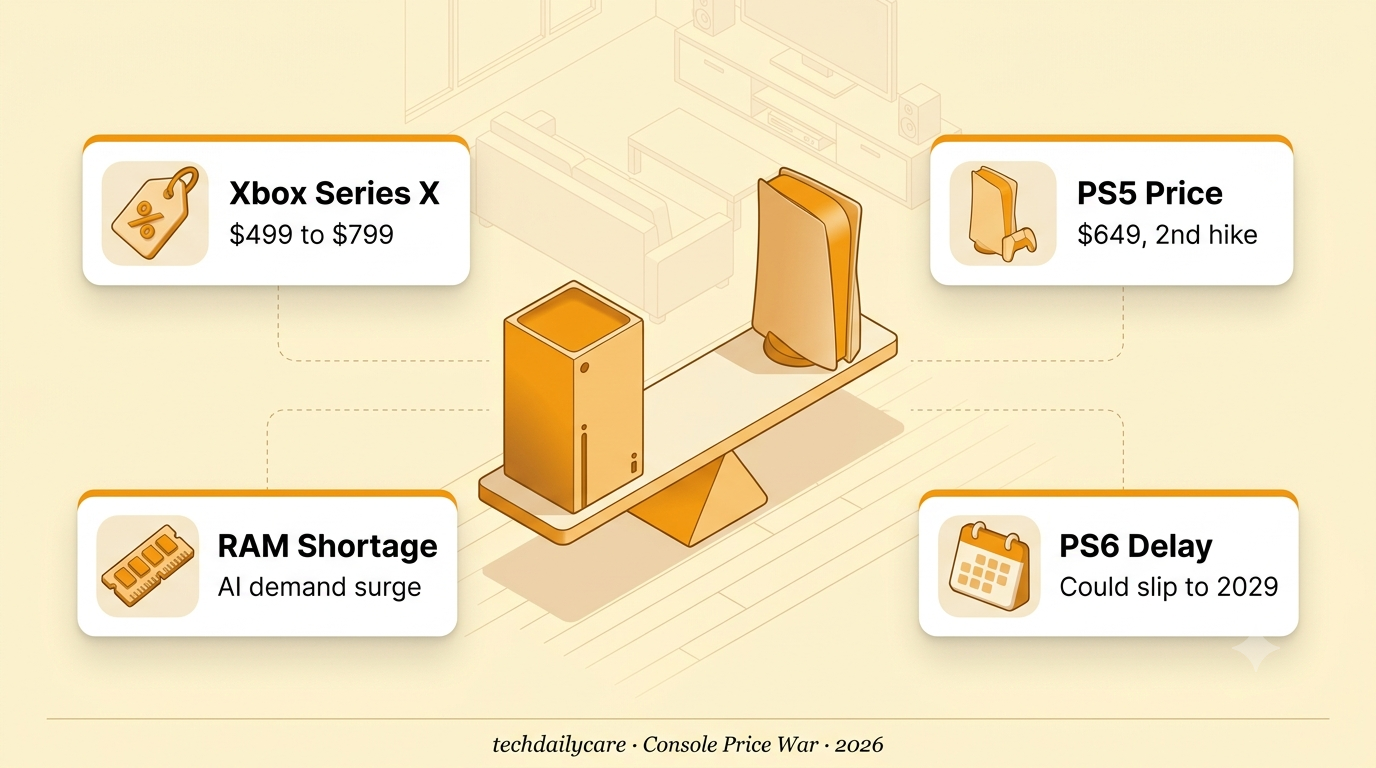
Xbox Series X Price Hits $799,
Why PS5 Suddenly Looks Cheap
Microsoft just raised console prices for the third time in 15 months — and this time, Xbox costs more than Sony’s base PS5
The Xbox Series X price just crossed a line nobody expected a six-year-old console to cross: it’s now more expensive than Sony’s base PlayStation 5. Effective August 1, 2026, Microsoft raised the price of the Xbox Series X disc console from $649.99 to $799.99, part of a worldwide update that also pushed the Xbox Series S up to $499.99 and quietly discontinued the 2TB Galaxy Black model entirely. It’s the third Xbox price increase in roughly 15 months, and this time Microsoft didn’t hide behind vague “market conditions” language — it named memory chips as the exact cause.
The number that makes this sting is the comparison, not just the price tag. A standard PS5 with a disc drive now costs $649.99 — which means, for the first time in this console generation, buying an Xbox costs more than buying a PlayStation. Six years ago, the opposite was true: the Xbox Series X launched at $499.99, matching the PS5 exactly, and Microsoft spent years positioning Xbox hardware as the more accessible choice. That positioning is gone.
And according to industry reporting, Microsoft still isn’t making money on the hardware even at $799.99. Windows Central’s Jez Corden reported that Xbox is losing roughly $150 per Series X|S console sold, even after this price hike — meaning Microsoft raised prices and is still selling every console at a loss. That detail says more about how bad the memory shortage has gotten than the sticker price alone ever could.
Console pricing has followed one rule since the industry began: hardware gets cheaper as a generation matures, not more expensive. The original Xbox, the PS3, the Wii, every major console before this one eventually dropped in price to chase a wider audience. 2026 is the first year that pattern has broken across every major platform simultaneously, and the Xbox Series X price hitting $799.99 is the clearest single data point in that reversal.
Xbox Now Costs More Than PS5
Xbox Series X at $799.99 is $150 more than a standard PS5 disc console at $649.99 — a full reversal of where the two brands sat at launch in 2020.
Microsoft Still Loses Money
Even after this hike, reports peg Microsoft’s loss at roughly $150 per Xbox console sold, driven entirely by memory and storage costs.
Memory Costs Up 2.5x
Microsoft says console storage and memory prices have more than doubled since late 2025, with another doubling expected by fall 2027.
Next-Gen Consoles at Risk
Project Helix and the PS6 are both rumored to launch above $1,000, with PS6 potentially delayed to 2028 or 2029 over chip supply.
The entire consumer electronics industry is struggling —
but the effects are particularly hard on consoles.
The August 1 Jump, Model By Model
The NumbersMicrosoft confirmed the new pricing on Xbox Wire on June 25, 2026, giving buyers a five-week runway before it took effect on August 1. The 512GB Xbox Series S rose from $399.99 to $499.99, a $100 increase. The 1TB Xbox Series X Digital Edition rose from $599.99 to $749.99, and the 1TB Xbox Series X disc console — the flagship model most people mean when they say “Xbox” — rose from $649.99 to $799.99. Both 1TB models absorbed a $150 hike, while 512GB models took a $100 hit.
The 2TB Galaxy Black Special Edition, previously the most expensive Xbox on the market, was discontinued outright rather than repriced — a quiet admission that a $900-plus Xbox at launch-generation specs was no longer a configuration Microsoft wanted to sell. Buyers who want more storage now have to add their own external drive instead.
Microsoft was also unusually specific about how it got here. Last October, the company raised US Xbox prices by $20 to $70 depending on the model — a comparatively modest adjustment that, in hindsight, looks like an early warning sign rather than a one-off correction. Between that October move and this August increase, the flagship Xbox Series X has now absorbed $150 in hikes twice within a single year, on top of an earlier 2025 adjustment that most casual shoppers never noticed.
Microsoft Is Still Losing Money on Every Console
The TwistHere’s the detail that actually makes this story strange: raising the price wasn’t enough. Windows Central’s Jez Corden, reporting on the economics behind Project Helix, cited sources claiming Xbox is losing roughly $150 on every Series X or Series S sold — even at the new, higher prices. Consoles have historically been sold near or below cost, with the money made back through games and subscriptions, but a $150-per-unit loss after three price hikes suggests memory costs have outrun that model entirely.
Microsoft’s own language backs this up. In its Xbox Wire post announcing the hike, the company said it’s now paying more than 2.5 times what it paid for console storage and memory in late 2025, and it expects those costs to roughly double again by the fall of 2027. That’s not a company padding margins — that’s a company trying to slow the bleeding.
How PlayStation Stacks Up Right Now
The ComparisonSony hasn’t been spared either, but its timeline looks different. The standard PS5 disc console rose from its $499.99 launch price to $549.99 in August 2025, then to $649.99 in a second hike that took effect April 2, 2026 — a cumulative 30% increase. The PS5 Digital Edition now sits at $599.99, and the PlayStation Portal remote player climbed to $249.99. The PS5 Pro, Sony’s premium model, has had the roughest ride: it launched at $699.99 in November 2024 and now costs $899.99 after two increases, a jump of nearly 29% in under two years. When the PS5 Pro first launched, it was already a $200 premium over the standard console; today that gap has widened to $250 against the disc PS5 and $300 against the Digital Edition.
Sony has been more transparent than most about the reasoning. Its official pricing announcements have specifically cited a shortage of memory chips and, more recently, tariff adjustments on imported semiconductor components — language that’s noticeably more direct than the vague “market conditions” phrasing companies used for price increases in past years. It’s also worth noting Sony raised prices twice within about eight months, meaning PlayStation buyers absorbed two separate hikes in roughly the same window Xbox needed three.
What matters for shoppers is the crossover point this creates. Before August 1, an Xbox Series X and a PS5 disc console were priced close enough that the decision came down to games and ecosystem. Now there’s a genuine $150 gap, with Xbox on the expensive side — a dynamic almost nobody following this console generation from its 2020 launch would have predicted.
Nintendo’s Smaller, First-Ever Increase
The OutlierNintendo has taken a noticeably different approach. The Switch 2, which launched June 5, 2025 at $449.99 and became the fastest-selling console in company history, will rise to $499.99 on September 1, 2026 — an 11% increase, and the smallest percentage hike of any major console this cycle. It’s also notable for being the first price change of any kind since the Switch 2 launched, while Xbox and PlayStation have each raised prices multiple times over the same window.
Nintendo President Shuntaro Furukawa was unusually direct about the cause, citing permanent increases in memory component costs alongside exchange rates and oil prices. Nintendo’s own forecast expects the hike to slow Switch 2 sales to around 16.5 million units in its next fiscal year, down from nearly 19.9 million in the year that just ended — a sign the company expects the price change to cost it real volume, not just absorb costs quietly.
That forecast is notable because it shows Nintendo treating the price hike as a genuine trade-off rather than a costless pass-through. Sony and Microsoft haven’t published equivalent sales projections tied to their own increases, which makes Nintendo’s public acknowledgment that pricing power has limits — even during a supply crunch every competitor is also facing — one of the more candid moments in this entire pricing cycle.
The Real Cause, In One Component
Root CauseEvery console maker is pointing at the same part: DRAM and NAND flash memory, the chips that handle a console’s active memory and storage. AI data centers are buying this memory at a pace consumer electronics manufacturers simply can’t match on price, and console makers sit near the bottom of the priority list when supply gets tight, well behind cloud providers and AI chipmakers placing far larger, far more lucrative orders. Counterpoint Research has tracked memory pricing climbing by as much as 600% over the past year in some categories, while TrendForce has projected DRAM contract prices could double again within a single quarter.
Micron, one of the largest memory suppliers in the world, has reportedly told its biggest customers it can currently fulfill only 50% to two-thirds of their orders — a shortfall that trickles all the way down to smaller buyers like Sony, Microsoft, and Nintendo, none of whom carry the purchasing weight of a hyperscale AI data center operator. That imbalance, more than any single company’s pricing strategy, is the actual story behind every console price increase in 2026.
What makes this shortage different from past ones is where the competing demand comes from. Previous chip shortages, like the one during the pandemic console launches in 2020, were about factory capacity and shipping — problems that eventually resolved as production ramped back up. This one is about a permanently larger buyer entering the market. AI data centers don’t need memory chips for a single product cycle; they need them continuously, at a scale that keeps growing, which is why analysts increasingly describe this less as a shortage that will end and more as a new, higher price floor that console makers will have to build around.
What This Means for the Next Generation
What’s NextIf current-generation hardware is losing money at $799.99, the console after this one has a real pricing problem to solve. Microsoft’s Project Helix, expected to reach developers with early hardware next year and built around a custom AMD chip, is now widely rumored to launch above $1,000 — a price point unthinkable for a mainstream console just a few years ago. Sony’s PS6 faces an even more direct threat: reports citing the ongoing chip shortage suggest its launch could slip to 2028 or as late as 2029, well beyond Sony’s earlier internal timelines.
Industry analysts increasingly describe this as a structural shift rather than a temporary shortage. Consoles have gotten cheaper over time in every previous generation; 2026 is the first year in the industry’s history where the opposite has happened across every major platform at once. Whatever Project Helix and the PS6 cost at launch, both companies are now pricing hardware in a world where memory, not manufacturing scale, sets the floor.
There’s also a strategic wrinkle specific to Microsoft. Some reporting suggests Project Helix could function more like an open PC platform than a traditional closed console, competing directly with storefronts like Steam and Epic Games rather than locking players into the Xbox ecosystem exclusively. If that’s the direction Microsoft goes, thinner hardware margins become even harder to offset with exclusive software sales, which only strengthens the case that Helix arrives priced well above what Xbox owners are used to paying.
Xbox Series X Price vs. Everything Else You Could Buy
PerspectivePut next to other tech purchases going through the same memory squeeze, the new Xbox Series X price starts to look less like an isolated console decision and more like one data point in a much bigger trend. Apple raised Mac and iPad prices by up to $300 that same week in June. Valve’s Steam Machine launched already priced higher than early leaks suggested, with Valve telling reporters it can’t even lock in a fixed memory contract from month to month. PC makers including Dell, Lenovo, and HP have signaled 15% to 20% price increases heading into the back half of 2026.
Retailers are already bracing for the knock-on effect. Ahead of the 2026 holiday season, at least one major games retailer has privately warned that PS5 and Xbox Series X|S supply could tighten further, with demand expected to outstrip what console makers can build at current chip allocations. That’s a very different kind of shortage than the launch-week scarcity gamers remember from 2020 — this one is about the cost of components, not manufacturing capacity or shipping delays.
If you’re shopping for a console this year, here’s the short version of everything above — the numbers that matter most, pulled out of the six sections you just read.
📋 Xbox Series X Price, Key Facts To Remember
- $799.99 — new Xbox Series X price, effective August 1, 2026
- $649.99 — current PS5 disc console price, now $150 cheaper than Xbox
- $899.99 — PS5 Pro price, still the most expensive mainstream console
- $499.99 — Nintendo Switch 2 price starting September 1, its first-ever hike
- 2.5x — how much more Microsoft now pays for console memory versus late 2025
- $150 — the amount Microsoft reportedly still loses per Xbox sold, even after the hike
⚠️ What This Means If You’re Buying a Console Soon
None of this history matters much unless you’re actually deciding what to buy right now — so here’s the practical takeaway.
1. Prices are very unlikely to drop. Microsoft has explicitly told investors and customers it expects memory costs to double again by fall 2027, which points toward more hikes, not fewer.
2. The Xbox-vs-PS5 math has flipped. If price alone is your deciding factor, a standard PS5 disc console is now $150 cheaper than an Xbox Series X — the opposite of the situation in 2020.
3. Certified refurbished and financing options exist. Microsoft is promoting refurbished consoles and new interest-free financing to soften the new prices — worth checking before paying full sticker price.
4. Waiting for next-gen won’t necessarily help. Both Project Helix and the PS6 are rumored to launch above $1,000, so “waiting for the next console” is not obviously the cheaper path.
5. Holiday supply is a wildcard. If retailer warnings about tighter PS5 and Xbox stock hold up, buying earlier in the year may be safer than waiting for a holiday sale that might not materialize the way it has in past years.