
Meta Open Sources Muse Spark, Zuckerberg Says Distribute Superintelligence
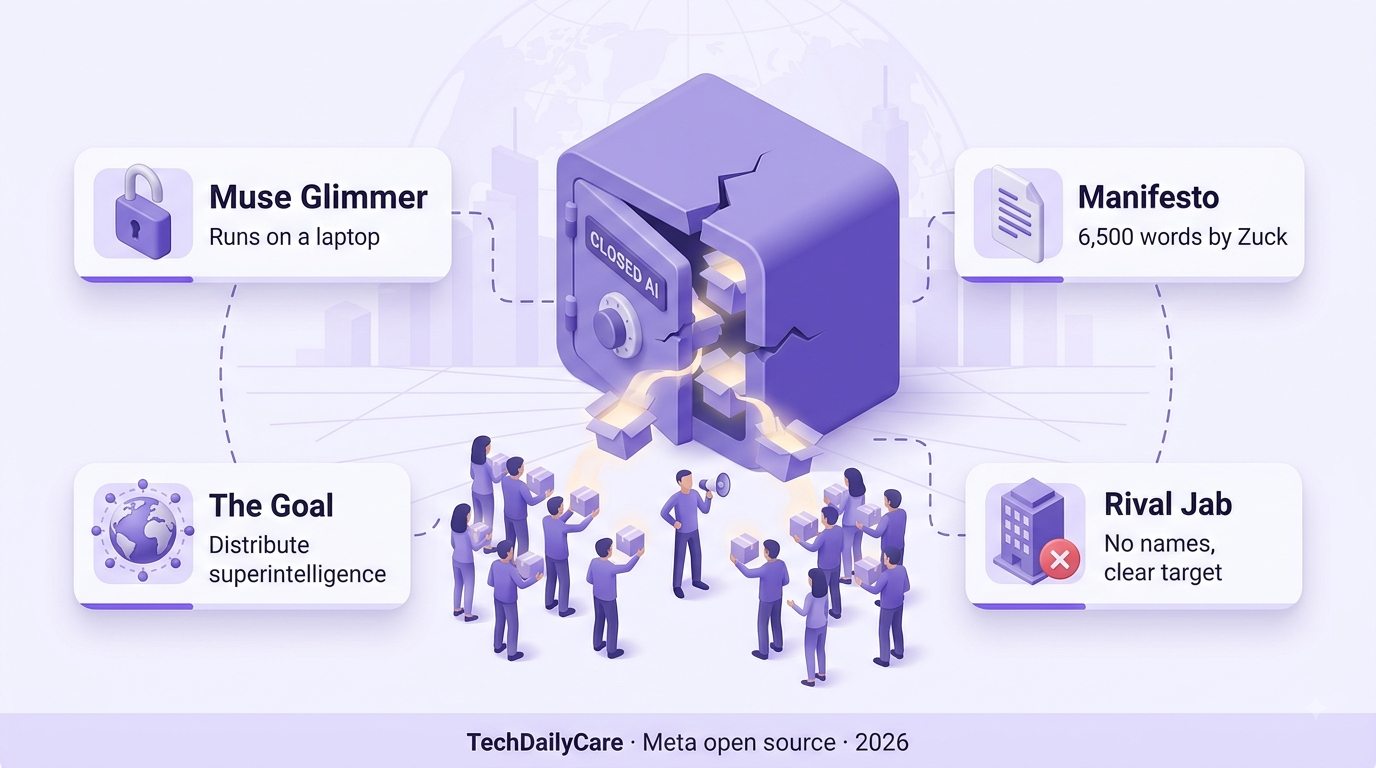
Muse Spark 1.2 weights go public. Muse Glimmer runs on a laptop. A 6,500-word manifesto names no rivals but targets all of them.
The Meta open source strategy just went from a talking point to a product launch. On August 10, 2026, Zuckerberg announced two things simultaneously: the Meta open source release of Muse Glimmer, a new family of open-weight models designed to run on a personal computer, and the open-weighting of Muse Spark 1.2 — Meta’s most powerful closed model to date, which debuted in July. Alongside the two model releases came a 6,500-word essay titled “The Future Is for Everyone,” in which Zuckerberg argued that concentrating control of advanced AI in the hands of a few companies is hazardous, and that distributing superintelligence broadly is the right path. Without naming OpenAI or Anthropic, he made his targets obvious.
The Meta open source move has a clear strategic logic. Meta’s Superintelligence Labs, formed last year, has been under investor scrutiny all year. Meta stock was down roughly 10% year to date heading into Monday, as investors questioned whether the company’s $130-145 billion 2026 capex commitment would produce competitive AI rather than just burning cash. Opening the weights of Muse Spark 1.2 and launching Muse Glimmer as a laptop-class model is Zuckerberg’s answer to that skepticism. The message: Meta is not falling behind the closed labs; it is choosing a different distribution strategy that it claims is both more powerful and more defensible long-term.
The competitive framing is the sharpest part of the announcement. Zuckerberg positioned the Meta open source approach as a direct counter to Chinese open-source models from DeepSeek, Moonshot, and Alibaba’s Qwen, which have been getting uncomfortably close to American frontier models. He urged Washington to support American open-source AI as a geopolitical imperative. He argued that closed models from US companies actually help Chinese rivals — because closed weights can be stolen, while open weights create a US-anchored ecosystem that is harder for foreign adversaries to dominate.
Whether that geopolitical argument lands in Washington is uncertain. What is certain is that the Meta open source release changes the practical calculus for every enterprise developer who was evaluating whether to build on Muse Spark API or wait for an open-weights alternative. The wait is over. Here is what Muse Glimmer and Muse Spark 1.2 open weights actually offer, why Zuckerberg chose this moment to release them, and what the manifesto really says between the lines.
What exactly did Meta release?
The Meta open source release includes Muse Glimmer (laptop-class, permissive license) and Muse Spark 1.2 open weights (frontier-class, publicly available). Muse Spark itself remains closed and paid — only the 1.2 version weights are open.
Who is Zuckerberg actually attacking?
OpenAI and Anthropic, without naming them. The essay argues concentrating AI in a few companies is hazardous and that closed models help Chinese rivals. The framing positions Meta open source as both ethically superior and strategically smarter than the closed-model approach.
Why invoke China?
DeepSeek, Moonshot, and Alibaba Qwen are all competitive open-weight models from Chinese labs. Zuckerberg argues American open-source is a better counter than American closed-source — because closed weights can be stolen while open creates a US-anchored ecosystem.
What does Meta get out of this?
Credibility with developers skeptical of the $145B capex. A narrative counter to investor concerns about Meta’s AI lag. And open-source adoption that creates a moat — every developer who builds on Meta’s open stack is a potential future Meta infrastructure customer.
Muse Glimmer Is The Laptop Model That Changes Developer Access
ModelThe most practically significant thing about Monday’s release is not the Muse Spark 1.2 open-weighting — it is Muse Glimmer, the new model family Meta is launching alongside it. Muse Glimmer runs on a personal computer, under a permissive open-source license that allows modification and commercial use. A frontier-adjacent model that fits on a consumer device without API costs, rate limits, or data-sharing agreements is a materially different developer offer than anything the closed-model labs have made.
The practical implications are large. Developers working on applications where data privacy is a hard requirement — healthcare, legal, financial services, government — have historically been forced to choose between capability (use the frontier API, accept data terms) or privacy (run open-weight models, accept quality gap). Muse Glimmer is Meta’s argument that the quality gap has closed enough to make the local option credible for a meaningful set of use cases. If that is true — and Muse Glimmer’s benchmarks will be stress-tested by the community within days — it breaks one of the last remaining moats that closed API providers have held.
The laptop form factor also matters for Meta’s own product strategy. Meta distributes AI through WhatsApp, Messenger, and Instagram — consumer applications with a combined user base measured in billions. A model that runs on device rather than on server infrastructure changes the latency, cost, and privacy profile of every AI-assisted feature Meta ships. Muse Glimmer is both a developer release and an internal infrastructure option that has a very different cost structure than running the same workloads on data center hardware at $145 billion per year.
Muse Spark 1.2 Open Weights Is The Frontier Concession
WeightsMuse Spark launched in July 2026 as a closed model — people pay to access it through Meta’s API. On August 10, Zuckerberg announced that Muse Spark 1.2, an updated version, would have its weights made public. The distinction between “open weights” and “open source” matters here: Meta is releasing the trained parameters that determine how the model behaves, but not necessarily the full training code and data pipeline. Open weights means anyone can download the model, run it, and fine-tune it. It is not the same as releasing everything under a full open-source license, but for most developer and enterprise use cases, it is functionally equivalent.
The timing of the open-weighting is not coincidental. Meta just reported Q2 earnings where free cash flow collapsed to $784 million despite $31.1 billion in capex. Investors are demanding evidence that the AI buildout is producing competitive output. Opening the weights of the frontier model is Zuckerberg’s public evidence submission: here is what $145 billion in annual capex can produce, and it is good enough that we are comfortable releasing it openly rather than keeping it locked behind an API.
The precedent this sets for the industry is also worth noting. If Muse Spark 1.2 open weights generate significant developer adoption — and community fine-tunes, integrations, and third-party applications built on the weights — Meta gains an ecosystem network effect that partially offsets the revenue it foregoes by not charging API access. Llama 4 proved this model works at an earlier capability tier. Muse Spark 1.2 tests whether it works at the frontier tier, where the capability gap to closed models like GPT-5 and Claude Fable 5 is narrower.
The 6,500-Word Manifesto, Decoded
EssayZuckerberg has written long-form AI manifestos before. This one is different in scope and specificity. “The Future Is for Everyone” makes four main arguments. First: powerful AI should not be controlled by a handful of companies, institutions, or governments — a direct reference to the concentration of AI capability at OpenAI, Anthropic, and Google. Second: open-source AI makes the technology safer, not more dangerous, because wider scrutiny finds and fixes issues faster than closed internal review. Third: American open-source is a geopolitical imperative against Chinese open-source rivals. Fourth: distributing AI broadly creates more economic value than hoarding it.
The China framing is the new element. Zuckerberg specifically called out DeepSeek, Moonshot, and Chinese AI labs as the competitive threat that makes the US open-source position urgent. His argument: if American labs stay closed and Chinese labs go open, the global developer community will build on Chinese infrastructure. The way to counter that is not to close faster but to open more effectively. This reframes the open-versus-closed debate from a domestic AI-safety argument into a US-China technology competition argument — a frame that has considerably more political traction in Washington right now.
The jab at closed competitors is the most quoted part of the essay, but it is also the most carefully worded. Zuckerberg does not name OpenAI or Anthropic. He argues against “a small number of companies” controlling AI. Anthropic has publicly supported AI regulations that some critics have interpreted as incumbent protection. OpenAI has evolved from its original open-source roots to a fully closed commercial model. Zuckerberg is calling both of those trajectories wrong, without naming them — a rhetorical choice that lets him claim the moral high ground while avoiding the appearance of a direct corporate attack.
Why DeepSeek Is The Real Catalyst For This Timing
ContextThe story of Meta’s open source push cannot be separated from DeepSeek. When DeepSeek R1 launched in late 2025, it demonstrated that a Chinese AI lab could produce models matching or exceeding Western frontier performance at a fraction of the training cost. DeepSeek’s open-weight release generated millions of downloads within days and put American frontier labs on notice that the capability advantage they had assumed was structural could erode quickly through Chinese research efficiency.
Alibaba’s Qwen 3.8 Max followed with a 2.4-trillion-parameter model in August 2026, targeting long-horizon coding and agentic workflows. Moonshot has been releasing competitive open-weight models throughout the year. The pattern Zuckerberg is describing is real and accelerating: Chinese labs are releasing open-weight models that are competitive with American frontier capabilities, and every developer who adopts a Chinese open-weight model is a developer who is not in the American AI ecosystem.
The geopolitical argument that American open-source is more trustworthy than Chinese open-source — and that building on Meta’s stack rather than DeepSeek’s stack is the right call for an American or allied developer — is doing significant work in the manifesto. It is not purely a competitive argument. It is an appeal to a developer’s sense of where they want their technology infrastructure anchored. Zuckerberg knows that “trust the American open-source model over the Chinese one” is a message that lands well with enterprise buyers in regulated industries, government contractors, and allied markets in Europe and Asia that are explicitly de-risking Chinese technology dependencies.
The Investor Read: Reassurance Through Release
MarketMeta stock opened Monday morning up 2.1% in premarket trading — a modest positive reaction to a major product announcement. Context matters: the stock is down roughly 10% year to date and the Q2 earnings print sent shares down 9.64% after hours on the capex and FCF story. Zuckerberg needs to demonstrate that the $130-145 billion in 2026 capital expenditure is producing AI that is worth owning, and opening the weights of the frontier model is the most direct demonstration available.
The investor argument is: Meta’s AI is good enough to give away, which means it is good enough to compete. The alternative interpretation — that Meta is opening weights because it cannot monetize them as a paid API against OpenAI and Anthropic — is a real risk, and some analysts will read the open-weighting that way. But Zuckerberg’s framing makes the first interpretation the default: this is a strategic choice driven by conviction, not an admission of competitive weakness.
The Meta Superintelligence Labs, formed last year when Meta poached key talent from Google Brain, OpenAI, and Anthropic, is the organizational bet behind this release. Investors skeptical of whether the talent acquisition and capex commitment have produced anything competitive now have a public artifact to evaluate. Muse Spark 1.2 weights will be on Hugging Face within hours of the announcement. The community benchmark cycle typically produces a clear read within 72-96 hours. If Muse Spark 1.2 holds up competitively on evals, the investor narrative around Meta’s AI capability changes meaningfully by the end of the week.
What Open Weights Actually Mean For Enterprise Builders
PracticalThe developer and enterprise implications of Muse Spark 1.2 open weights and Muse Glimmer are concrete and immediate. For enterprise teams evaluating AI infrastructure, the Meta open source release changes the build-versus-buy calculus in at least three ways. First, it reduces vendor lock-in risk: a team that builds on open weights is not dependent on a single API provider’s pricing or availability decisions. Second, it enables fine-tuning on proprietary data without sending that data to a third-party API. Third, it allows on-premise deployment for organizations with data residency requirements that prohibit cloud API usage.
The license terms matter significantly here. Meta included a “permissive” open-source license for Muse Glimmer — permissive typically means allowing commercial use, modification, and distribution without requiring derivative works to be open-sourced. If the license terms match the Llama 4 commercial license structure, enterprises can build production applications on Muse Glimmer without revenue-sharing or usage-restriction concerns. Legal teams will be reading the license within hours of this article publishing.
The fine-tuning opportunity is probably the highest-value immediate use case for enterprise adopters. Taking Muse Spark 1.2 weights and fine-tuning them on proprietary data — internal documents, customer interaction logs, domain-specific knowledge bases — produces specialized models that outperform the general-purpose frontier API on narrow tasks. This is the same workflow that produced significant value on top of Llama 4 Maverick for healthcare documentation, legal contract review, and financial analysis teams over the past year. Muse Spark 1.2 gives the same workflow a higher capability ceiling to start from.
Rather than centralizing superintelligence,
we should distribute it.
- Muse Spark 1.2 community benchmarks (72-96 hours) — The Hugging Face Open LLM Leaderboard and community eval runs will produce comparative scores within days. Performance versus DeepSeek V3.2, Qwen 3.8 Max, and GPT-5 derivatives is what determines whether the release is a capability story or a PR story.
- Muse Glimmer hardware requirements — “Runs on a laptop” needs a specific VRAM and compute spec. If it requires a high-end gaming laptop with 64GB RAM, the addressable market is narrower than the headline implies. If it runs on a standard 16GB M4 MacBook, the adoption curve is immediate and broad.
- License terms — Meta’s Llama licenses have historically included commercial use provisions with revenue thresholds. Whether Muse Glimmer’s “permissive” license matches Llama 4’s commercial terms, is more permissive, or includes new restrictions will be the first thing enterprise legal teams check.
- Washington response to the China framing — Zuckerberg explicitly urged US government support for American open-source AI. Whether the White House, NIST, or Congress picks up the geopolitical argument and incorporates it into AI policy will shape the regulatory environment for both Meta open source and its closed-model competitors.
- OpenAI and Anthropic response — Both companies have so far maintained closed-model strategies. If Muse Spark 1.2 evals show competitive or superior performance, the pressure on both to release open-weight versions of their flagship models increases materially.
- Enterprise adoption velocity — Watch Hugging Face download counts for Muse Spark 1.2 and Muse Glimmer over the next 30 days. Llama 4 Maverick hit 1 billion total downloads across its lifetime. A comparable ramp for Muse Spark 1.2 within 30 days would validate the open-weighting strategy at the frontier tier.
- Meta Q3 capex guidance — Zuckerberg used the open-source announcement partly to reassure investors about the $145B capex commitment. Q3 earnings will tell whether the FY26 capex holds at the upper end of guidance or gets revised upward again — the number that worried markets most after Q2.
⚠️ Four Meta Open Source Reading Traps
1. Treating “open weights” as “open source.” Meta is releasing the trained model parameters for Muse Spark 1.2 and Muse Glimmer. This is not the same as releasing the full training code, dataset, and infrastructure configurations. Open weights gives developers what they need to run and fine-tune the model. It does not give them what they would need to reproduce the training process from scratch.
2. Assuming community benchmarks will match Meta’s internal evaluations. Model releases consistently show larger gaps between vendor-reported benchmarks and independent community evals than vendors acknowledge. The 72-96 hour community eval cycle will be the honest performance assessment.
3. Reading the manifesto as purely ideological. Zuckerberg’s open-source conviction is real, but the timing is also strategic — releasing ahead of Q3 earnings to reset the AI-capability narrative, competing with Chinese labs for developer ecosystem share, and applying pressure to OpenAI and Anthropic in a regulatory environment where their closed-model approach faces increasing scrutiny.
4. Ignoring the remaining closed layer. Muse Spark 1.2 open weights is a significant release. But Muse Spark itself (the version people pay to access) remains closed. Meta is releasing last month’s frontier model, not today’s frontier model. The gap between the closed paid version and the open-weighted version is where Meta preserves its commercial API advantage.
Open source will ensure that more people have access
to AI, and power isn’t concentrated in a small number of companies.