
Demis Hassabis Just Stepped Down, and Google’s Biggest AI Crisis Has a Name
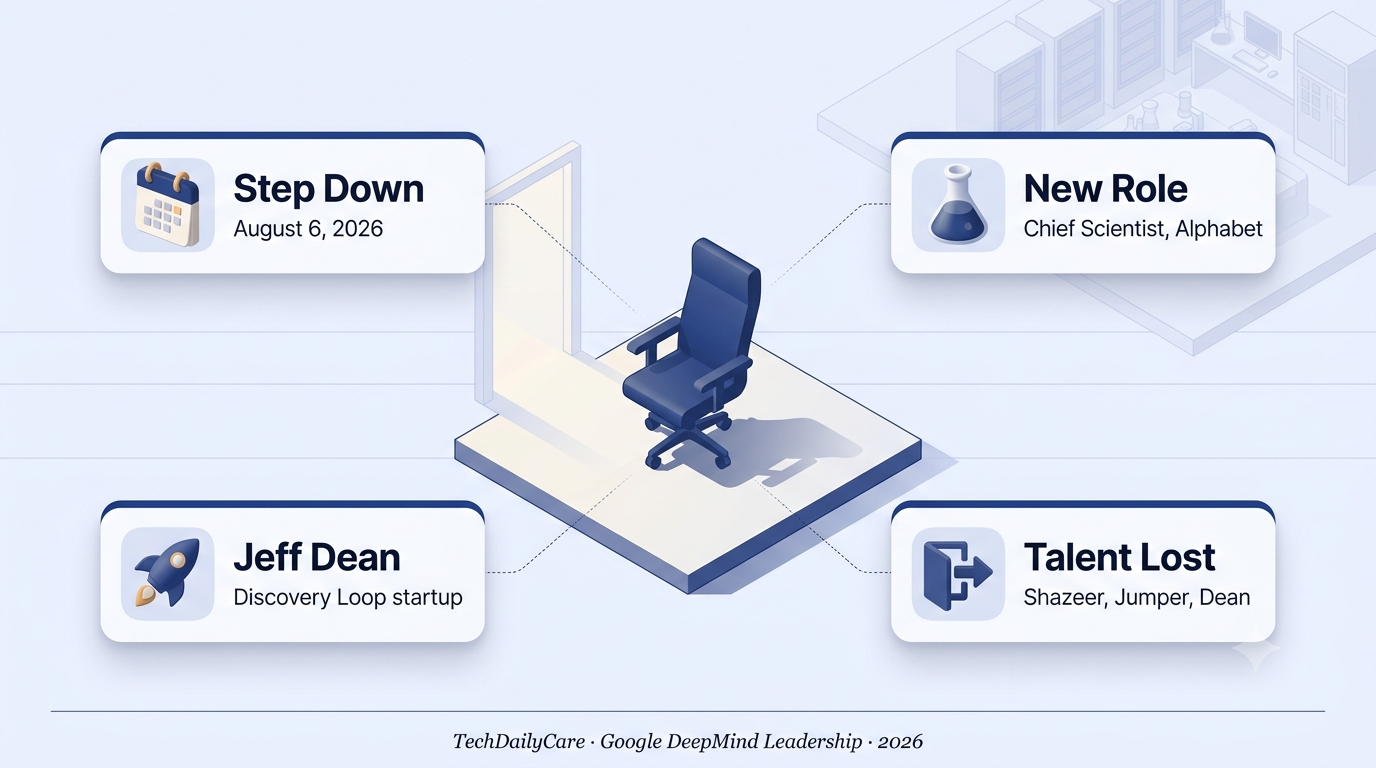
The DeepMind co-founder leaves day-to-day control on August 5. Jeff Dean exits after 27 years with four colleagues. Alphabet falls 5%. And Gemini 3.5 Pro is still not out. Here’s what the Demis Hassabis departure actually signals.
Google lost its two most important AI figures on the same morning. On August 5, 2026, Sundar Pichai posted a staff memo confirming that Demis Hassabis was stepping down as CEO of Google DeepMind and that Jeff Dean — 27-year Google veteran, Google Brain co-founder, employee number 30, one of the most influential engineers in the history of computing — was leaving to co-found a new startup. The announcement was simultaneous, coordinated, and clearly not accidental. Alphabet stock fell approximately 5% on the day, erasing tens of billions in market value. The Demis Hassabis departure is framed in every official communication as a step up to a broader strategic role. The Jeff Dean departure has no such framing available: he is leaving after 27 years to build something that is explicitly not part of Google.
The official version of what happened is straightforward. Hassabis becomes Chair of Google DeepMind and Chief Scientist of Alphabet, stepping back from day-to-day operations to focus on long-term AGI strategy and Isomorphic Labs, his AI drug discovery unit. Koray Kavukcuoglu — DeepMind’s CTO for 13 years, who built DeepMind’s deep learning team and drove breakthroughs including WaveNet and DQN — takes over as SVP of Google DeepMind, reporting directly to Pichai and inheriting the Gemini 4 roadmap. Dean leaves with Sanjay Ghemawat, Oriol Vinyals, and Quoc Le to launch Discovery Loop, a public benefit corporation that Google is funding as an investor and cloud partner. Four of the people most responsible for building Google’s AI advantage are launching a company that is explicitly designed to pursue goals “not necessarily in the company’s purist financial interests,” as Dean told the New York Times.
The unofficial version is harder for Google to spin. Demis Hassabis wrote to staff that he believes AGI is “close at hand” and that he wanted more time to focus on “the big picture.” The timing places that message directly alongside the longest Gemini delay in the product’s history — Gemini 3.5 Pro was promised at I/O on May 19, still has not shipped, and internal sources told Axios that low morale is a contributing factor. Noam Shazeer left for OpenAI in June. Nobel laureate John Jumper left for Anthropic. Jeff Dean is now gone. Alphabet is the world’s third-most-valuable company and it has just lost the founding CEO of DeepMind and its most senior technical executive on the same day. That is the crisis with a name, and the name is not “strategic restructuring.”
CEO → Chair + Chief Scientist
Steps back from day-to-day DeepMind operations. Becomes Chair of Google DeepMind and Chief Scientist of Alphabet. Continues leading Isomorphic Labs. Said in staff note that AGI is “close at hand.”
27 years → Discovery Loop
Jeff Dean, Sanjay Ghemawat, Oriol Vinyals, and Quoc Le leave Google for Discovery Loop — a public benefit corporation focused on automating scientific discovery. Google is a founding investor and cloud partner.
CTO → SVP, reporting to Pichai
Koray Kavukcuoglu, 13-year DeepMind veteran, takes over daily operations as SVP of Google DeepMind. Reports directly to Sundar Pichai — not a CEO title. Owns the Gemini 4 roadmap.
Alphabet -5% on announcement day
The stock move reflects not just the departures but the broader context: Gemini 3.5 Pro still delayed, morale issues reported internally, and a talent exodus that has accelerated through the second half of 2026.
Inside the Demis Hassabis departure and the crisis behind it
What “stepping up” actually means for Hassabis
LeadershipPichai’s announcement described the Demis Hassabis transition as “stepping up” to a broader role, and that framing is technically defensible. Chief Scientist of Alphabet is a title with cross-company scope; Hassabis now has formal advisory authority over Alphabet’s entire AI direction rather than just DeepMind’s product pipeline. He retains his DeepMind chairmanship and continues running Isomorphic Labs, the pharmaceutical AI spinoff he views as the most impactful near-term application of frontier AI. In his staff note, Hassabis said he had spent his career working toward AGI and now believes it is “close at hand” — a signal that he is moving toward what he considers more historically important work than Gemini product management.
The honest read of the same facts looks different. DeepMind’s job is Gemini. Gemini 3.5 Pro, promised at Google I/O on May 19, is more than two months delayed with internal sources attributing part of the delay to low morale among the engineering team. Hassabis built DeepMind from a London research lab into a 4,000-person organization. When the organization he built is producing its most significant product failures and he steps back from operational control of it simultaneously, the “stepping up” framing is not the most credible available interpretation. Kavukcuoglu does not get a CEO title — he is an SVP reporting to Pichai. That structural choice tells you something about where Google thinks accountability for the current Gemini situation actually lives.
Jeff Dean’s departure and what it means to lose employee #30
DepartureIf the Demis Hassabis transition is framed as a promotion, Jeff Dean’s departure has no available euphemism. Dean joined Google in 1999 as roughly its 30th employee. He co-designed the MapReduce and BigTable systems that underpin most of modern distributed computing. He co-created the Transformer architecture in the landmark 2017 “Attention Is All You Need” paper. He built TensorFlow. He founded Google Brain. He has been on the team that built virtually every consequential AI system Google has shipped in the past fifteen years. He is leaving after 27 years because, as he told the New York Times, he wants to make decisions that are “not necessarily in the company’s purist financial interests.”
That sentence is the most important thing Dean said publicly about the departure. Discovery Loop is structured as a public benefit corporation — a legal entity type that explicitly allows prioritizing public benefit over shareholder profit. Dean said the startup will focus on automating large-scale machine learning experiments and scientific discovery across medicine, clean energy, and engineering challenges. Radical Ventures and Khosla Ventures lead the seed round, with Lightspeed, Kleiner Perkins, Doerr Capital, and Alphabet participating. The four co-founders — Dean, Ghemawat, Vinyals, and Le — collectively helped build Google Search, MapReduce, AlphaStar, and the foundational layer of Google Brain. They are leaving to build what they could not build inside Google as a public company.
The Gemini delay that created the conditions for departure
ContextNeither the Demis Hassabis transition nor Dean’s departure exists in isolation. They are the two largest events in a talent and product crisis that has been developing since at least May 2026. At Google I/O on May 19, Pichai promised Gemini 3.5 Pro — the flagship model intended to close the performance gap with Claude Fable 5 and GPT-5.6 Sol — would follow “next month.” It did not. DeepMind internally scrapped the first version and restarted pretraining on a native Gemini 3 foundation, extending the delay by at least six weeks. As of August 10, Gemini 3.5 Pro has still not shipped.
Axios’s August 5 coverage added the detail that internal sources had cited low morale as a contributing factor in the delays. That reporting places a causal link — however speculative — between the talent losses and the product failures. Noam Shazeer left in June for OpenAI; he co-designed the original Transformer’s attention mechanism. John Jumper left for Anthropic; his AlphaFold co-leadership won Google a Nobel Prize. The engineers who remained at DeepMind after those departures were building a flagship model under growing performance pressure while watching their most senior colleagues leave for competitors or start companies. The Demis Hassabis announcement and the Dean departure are the latest chapters in that accumulating story, not the beginning of it.
Six named senior exits in under three months.
One flagship model still unshipped.
That is the crisis with a name.
What the Demis Hassabis departure means for Google’s AI future
Kavukcuoglu inherits Gemini 4 — and the accountability for 3.5 Pro
SuccessorKoray Kavukcuoglu is not a name that generates headlines, which is partly why he is the right choice for the role Pichai is asking him to play. He joined DeepMind in its early days and worked alongside Demis Hassabis for more than 13 years. He built DeepMind’s deep learning team, drove the technical architecture of WaveNet, and has been Google’s Chief AI Architect since 2022. He is, by every account, a technically credible operator. The fact that he is given the title of SVP rather than CEO, and reports directly to Pichai rather than holding the same organizational authority Hassabis held, is the structural tell about how Google views the current situation: Kavukcuoglu is running DeepMind under tighter central supervision, not inheriting the same degree of independence Hassabis had built over a decade.
His most immediate task is Gemini 4 — the next-generation flagship that Hassabis mentioned by name in his staff note as evidence of “great progress.” Hassabis’s reference to an unreleased model was itself unusual and reads as an attempt to pre-position the successor model as compensation for 3.5 Pro’s continued absence. Kavukcuoglu now owns the delivery of Gemini 4 against a competitive field where OpenAI, Anthropic, and Meta have all shipped production-ready flagship models in the period Gemini 3.5 Pro was supposed to occupy. The clock that matters is not when Gemini 4 arrives. It is whether Kavukcuoglu can ship 3.5 Pro first, and whether it performs well enough to justify the wait.
Discovery Loop and what it signals for AI research independence
IndustryDiscovery Loop is the second major dimension of the August 5 announcement, and in some ways the more consequential one for the industry’s long arc. Four of Google’s most accomplished AI researchers — Demis Hassabis‘s most senior technical colleagues — are building a public benefit corporation specifically because the PBC legal structure allows them to make decisions that a public company’s fiduciary duty would block. They chose Radical Ventures and Khosla as lead investors; both have backed multiple frontier AI companies and understand what “public benefit corporation” means in practical governance terms. Alphabet is a founding investor and cloud provider — which means Google chose to fund the entity that is pulling its best researchers out rather than try to retain them through competing offers.
That choice is itself revealing. Google concluded that the right move was to maintain a financial relationship with Discovery Loop rather than a personnel relationship. The company will benefit from any commercial breakthroughs Discovery Loop produces through its investor stake and cloud revenue; it will not benefit from the research direction. Dean told the Times that Discovery Loop will try to automate machine learning experiments at scale and eventually apply that infrastructure to medicine, clean energy, water, and engineering challenges. That is the agenda that Jeff Dean believes is most important and that he could not pursue “in the company’s purist financial interests.” It is also, not coincidentally, the agenda that Hassabis has described as his own motivation for shifting to a more strategic role focused on AGI and Isomorphic Labs.
⚠️ What the Demis Hassabis announcement does not resolve
1. Gemini 3.5 Pro has no confirmed new launch date. Despite the leadership restructuring, Google has not announced a revised date for Gemini 3.5 Pro. Pichai’s reference to Gemini 4 in the transition announcement suggests the company is increasingly focused on the successor rather than the delayed current model.
2. The governance change at DeepMind is ambiguous. By removing the CEO title from the DeepMind lead position, Google has made DeepMind more directly answerable to Pichai. A former DeepMind employee writing on FutureSearch argued this means “less governance for Google models than even OpenAI has” — a significant concern given current AI safety debates.
3. Morale data is anecdotal, not official. Axios’s report that low morale contributed to Gemini delays draws on internal sources who cannot be verified. The causal link between departures and product delays is plausible but not proven by public evidence.
4. Discovery Loop has no products or published research yet. The company has assembled an extraordinary founding team and substantial backing, but has not announced a product, demonstrated a scientific breakthrough, or published research. Seed financing was still closing as of the announcement date.
Why the Demis Hassabis crisis is bigger than one company
The talent war is now a talent rout in one direction
IndustryThe Demis Hassabis departure and the Dean exit are the capstone events in a talent movement that has been running in one direction for most of 2026. Noam Shazeer — co-author of “Attention Is All You Need,” co-founder of Character.AI, acqui-hired back to Google in 2024 — left for OpenAI in June. John Jumper — Nobel laureate, AlphaFold co-lead — left for Anthropic in June. Now Hassabis, Dean, Ghemawat, Vinyals, and Le have all exited in the same week. Every significant departure has gone to an organization that is either a direct competitor (OpenAI, Anthropic) or a new entity that Google cannot control (Discovery Loop). None have gone to Microsoft, Amazon, or Meta, which suggests the gravitational pull is toward research freedom rather than toward higher compensation from a rival hyperscaler.
The practical implication for the AI competitive landscape is that Google’s advantage in research talent — which was arguably its strongest strategic asset entering 2026 — has been materially degraded in a period when the frontier models that talent produces are increasingly the commercial differentiator. OpenAI has Shazeer. Anthropic has Jumper. Discovery Loop has Dean, Ghemawat, Vinyals, and Le. Kavukcuoglu leads what remains of DeepMind. The question that Alphabet investors will be asking over the next two quarters is whether the talent that stayed — and there is still a very large organization of highly capable researchers remaining — can deliver Gemini at a competitive level without the people who left. That question cannot be answered in August 2026. It will be answered when Gemini 3.5 Pro ships and when Gemini 4 benchmarks land.
What Sundar Pichai is actually signaling
StrategyPichai’s handling of the Demis Hassabis transition reveals something about how he views Google’s current AI position. He wrote in the staff memo that Google has “amazing talent, world-class compute, and products that bring AI to more people than any other company.” That framing — emphasizing distribution and compute over research capability — is the clearest signal of where Pichai believes Google’s durable advantage lies now that the research talent advantage has been compromised. Google’s distribution through Android, Chrome, and Search still reaches more people than any frontier lab’s product. Its compute advantage — through TPUs, Google Cloud, and TSMC allocation — is real. These are the assets that Kavukcuoglu will be asked to leverage under tighter Pichai supervision.
The choice to make the DeepMind lead role an SVP position reporting directly to Pichai rather than a CEO role with independent authority is also a governance decision with safety implications. Google DeepMind’s independent authority under Hassabis created a structure where research priorities could be set with some distance from Alphabet’s quarterly revenue pressure. Removing that distance means Gemini’s development will now be more directly influenced by commercial timelines. The FutureSearch analysis noted this bluntly: “I think this means less governance for Google models than even OpenAI has.” That observation will be tested against every future Gemini product decision Kavukcuoglu makes under Pichai’s direct supervision.