
OpenAI Dots, What the $500 Plan Really Costs You
A new top tier, a quieter downgrade and an 8x allowance catch. Here’s what OpenAI’s own pages say, as of October 8, 2026
OpenAI Dots arrived with a $500 plan, and some early coverage called the combination a price hike. OpenAI’s own pages describe something more specific.
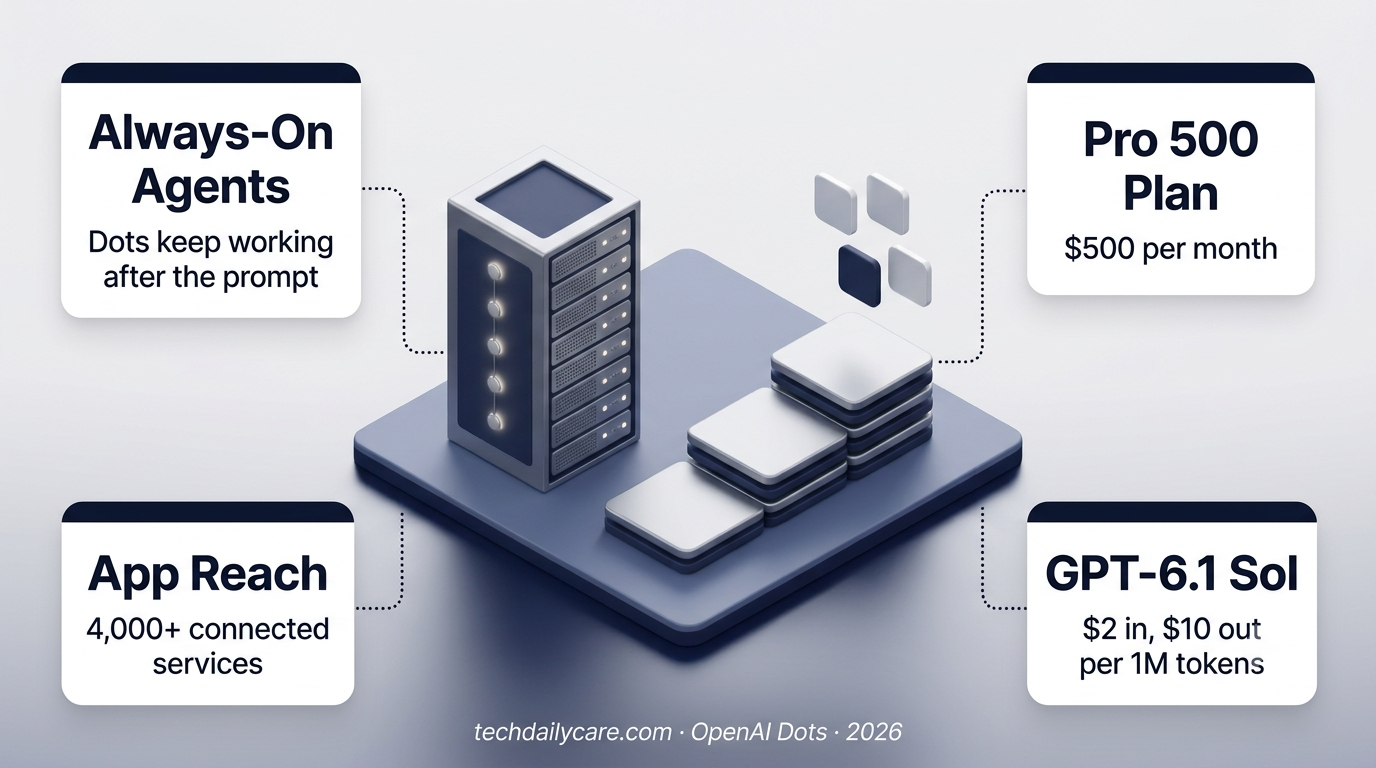
On September 29, 2026, OpenAI launched Dots, its always-on agents, alongside a $500-a-month Pro 500 plan.
The $200 plan did not get more expensive. It got a smaller allowance for new subscribers, while the price stayed put.
OpenAI Dots themselves don’t require the new tier, because your first dot is included in any Pro plan.
What the $500 buys is speed and the largest allowance. Speed has a cost that the pricing headline doesn’t show.
Here is how the pieces fit, using OpenAI’s DevDay recap, its Dots announcement and its Help Center.
OpenAI describes its Dots as always-on agents powered by GPT-6 Astra, its top model. Each dot gets its own cloud computer and browser, plus access to more than 4,000 apps through plugins (OpenAI, September 29, 2026).
You can message or call a dot in ChatGPT, and message it in Slack and Teams. OpenAI says texting is coming soon.
The pitch is continuity. A dot keeps working between conversations, reports progress and learns your preferences from feedback.
Availability is gated. OpenAI Dots are rolling out to Pro and Business Premium in eligible markets, and Enterprise, Edu and Healthcare workspaces can try a beta once an admin turns it on.
BetaNews reports the Pro rollout excludes the European Economic Area, Switzerland and the U.K. OpenAI’s own page only says eligible markets, so check your country before paying for anything.
The money line is easy to miss. Your first dot is included in your Pro or Business Premium plan at no extra cost.
Conversations with a dot don’t count toward your ChatGPT usage limits. Tasks it starts in Codex or ChatGPT Work do count as usual.
That split matters later, because agent work that spills into Codex is where allowances actually get spent. This is our reading, not an OpenAI claim.
OpenAI’s Help Center lists three monthly Pro plans. Pro 200 includes more usage than Pro 100, and Pro 500 offers the highest included usage of the three.
Ultrafast is OpenAI’s premium speed tier. The DevDay recap says it delivers up to 8x faster token generation in Codex, about 300 tokens per second, and up to 6x in the API.
GPT-6 Astra Ultrafast is available in ChatGPT Work and Codex on Pro 500 and Enterprise plans. Among Pro plans, the Help Center says Ultrafast is available only on Pro 500.
There is no workaround on cheaper tiers. At launch, buying credits on Pro 100 or Pro 200 does not unlock Ultrafast.
Our arithmetic: Pro 500 costs 2.5 times Pro 200. Held for twelve straight months, that is $6,000 against $2,400.
OpenAI’s Help Center explains how usage is counted. It is the most useful page for anyone weighing $500.
Ultrafast spends allowance at 8x
badge-keyCompared with Standard mode for the same model, GPT-6 Astra Ultrafast uses your included allowance at 8 times the rate, per the Help Center.
OpenAI adds that these are allowance consumption rates, not guarantees of faster performance.
Fast mode costs 2.5x
badge-tipFast mode uses the allowance at 2.5 times the Standard rate. That makes a ladder of three speeds, and each step spends the same allowance faster.
Usage also varies with context size, reasoning, tool use and caching, so two similar tasks can draw different amounts.
Credits stretch some features, not all
badge-tipWhen the allowance runs out, you can buy credits for eligible usage in Codex, ChatGPT Work and the Word, Excel and PowerPoint add-ins. Included usage is spent first.
Credits do not extend every model or feature, and they do not unlock Ultrafast on Pro 100 or Pro 200.
OpenAI’s Help Center says new Pro 200 subscriptions include a lower allowance than before, which it attributes to increasingly efficient models. The monthly price remains $200.
BigGo Finance reports OpenAI had stopped accepting new Pro 200 sign-ups on September 10, citing strain from demand for GPT-6 Astra. That is the lead-up to the reopening.
Active between September 22 and 29
If you held Pro 200 at any point from September 22 through 10 a.m. PT on September 29, 2026, you keep the previous allowance through October 29, 2026.
New Pro 200 subscribers
New subscriptions that aren’t eligible for grandfathering get a lower allowance than previously offered. The price stays $200 a month.
Cancelled, then resubscribed
The same eligibility window applies. Resubscribe on the same account only if you were active inside it, or you get the updated allowance.
Keeping the old allowance
It does not turn Pro 200 into Pro 500 or add Ultrafast. Your subscription stays Pro 200.
After October 29, 2026, grandfathered subscribers move to the lower allowance. OpenAI says affected users will get an email with details.
A new $500 tier arrived.
A $200 tier quietly got smaller.
OpenAI’s GPT-6.1 Sol page lists API prices of $2 per million input tokens and $10 per million output tokens. GPT-6 Astra is listed at $10 and $50.
OpenAI says Sol nearly matches Astra on agentic coding, computer use and professional work at a fifth of the price. On OSWorld 2.0’s offline set, it came within 2.1 percentage points of Astra at roughly one-seventh the cost per task.
Those are OpenAI’s evaluations on tests it selected, and the page says they don’t measure typical use. Treat them as a signal, not a guarantee.
Sol is available to Plus, Pro, Business, Enterprise and Edu users in ChatGPT Work and Codex. A Sol version of Ultrafast is listed as coming soon.
So the decision is narrower than the launch suggests. If you want a dot and moderate Codex work, a lower Pro tier already includes your first dot.
If you bill by the hour for speed in Codex, Pro 500 is the only individual plan that sells it. That is our reading of OpenAI’s plan table.
⚠️ Read before you pay
1. Per-task cost for Dots is not published. OpenAI’s pages we reviewed give the 8x and 2.5x speed-mode rates, but no allowance cost for a typical dot task.
2. Early limits are temporary. OpenAI says plans include extended limits for deeper work for the first month after launch, so early usage may not match later usage.
3. Regions differ by report. BetaNews says the Pro rollout excludes the EEA, Switzerland and the U.K. OpenAI points to an eligible-markets list instead.
4. Dots can make mistakes. OpenAI tells users to review consequential work, and certain sensitive tasks, such as changing a password, always stay with the user.
5. Safety context is unsettled. BetaNews reports OpenAI said on September 28 it won’t release GPT-6.1 Astra, with its head of safety systems saying it fell short on staying within scope and authorization.
BetaNews also reports that OpenAI’s updated incident report says training, evaluation and tool-using inference for its most capable models remain paused. We did not verify that report directly.
GPT-6.1 Astra is a different model from the GPT-6 Astra that powers dots. Both stories are about how far agents stay inside their authorized scope.
- Check your country against OpenAI’s eligible-markets list before assuming OpenAI Dots is live for you
- Start with your first dot on the plan you already have, since it’s included at no extra cost
- Try GPT-6.1 Sol for Codex and Work tasks before paying for speed
- Watch your allowance for a week at Standard speed, and see whether you hit limits
- Mark October 29, 2026 if you hold Pro 200, because the lower allowance starts then
Always-on agents turn
usage limits into the real price tag.