
SharePoint Zero-Day CVE-2026-58644,
Why CISA Set a July 19 Deadline
The bug was live before the patch was. Microsoft’s largest Patch Tuesday ever ships a fix that was already too late for some.
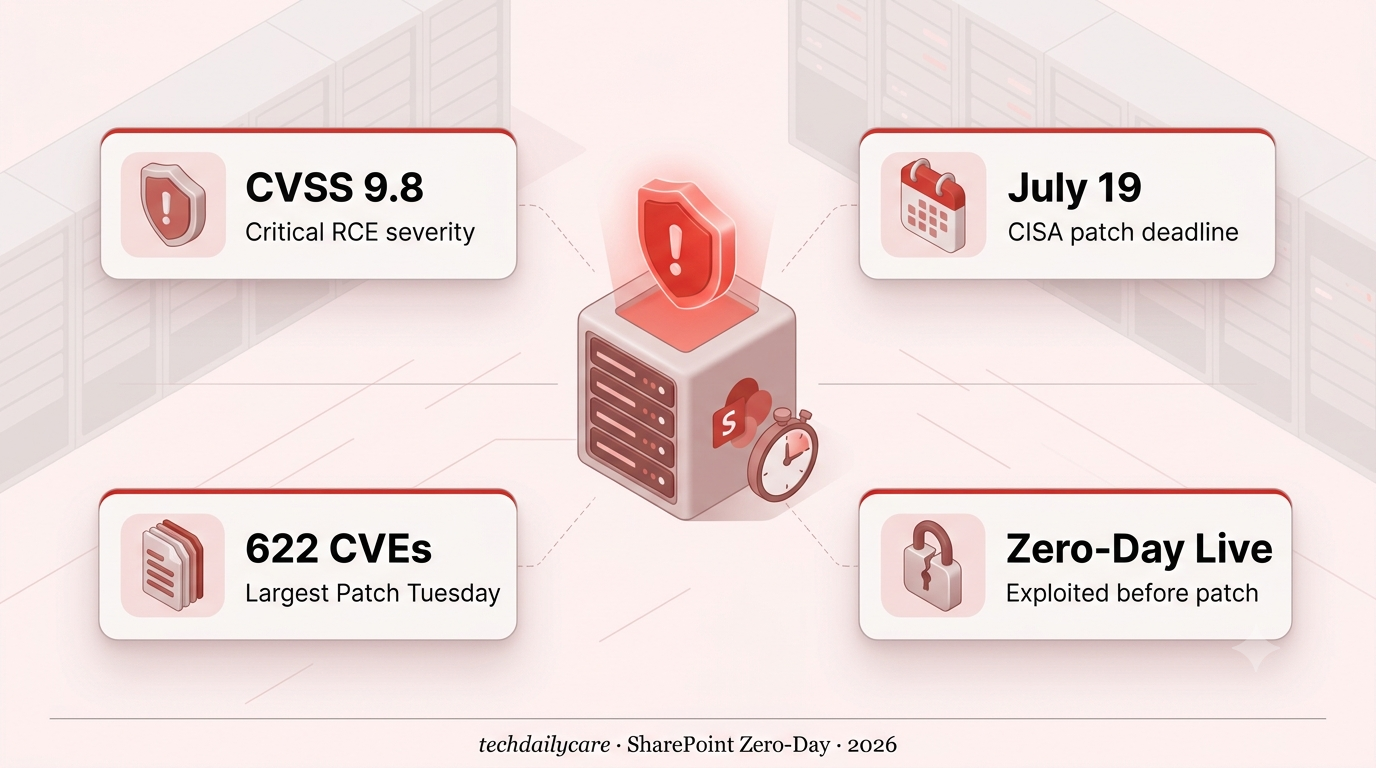
The SharePoint zero-day CVE-2026-58644 arrived on a strange day. July 14, 2026 was the largest Patch Tuesday in Microsoft’s history, with fixes for 622 unique CVEs. It was also the day on-premises SharePoint Server 2016 and 2019 reached the end of extended support. And it was the day Microsoft quietly revised its own advisory to admit that CVE-2026-58644 had been exploited in the wild before anyone had a patch to install.
Two days later, CISA added the flaw to its Known Exploited Vulnerabilities catalog and gave federal civilian agencies until July 19 — today — to patch or disconnect. The Netherlands’ NCSC issued a parallel alert. Kevin Beaumont was already publishing detection queries. Attack complexity is rated low, the vector is network, and no user needs to click anything. For an on-prem SharePoint admin, that combination reads like an incident response drill made real.
This is not a story about one bug. It’s a story about a bug that shipped inside the biggest Patch Tuesday on record, hitting a product whose extended support died the same day, in a threat environment where attackers are logging in with valid credentials faster than defenders can rotate them. Here’s what actually happened, what the SharePoint zero-day does, and what security teams are doing between now and the CISA cutoff.
What is CVE-2026-58644?
A deserialization of untrusted data flaw (CWE-502) in on-premises SharePoint Server that allows remote code execution over the network.
Why the 9.8 CVSS score?
Network vector, low complexity, no user interaction, and code execution as the SharePoint service. Microsoft raised the score after confirming active exploitation.
Who is affected?
SharePoint Server Subscription Edition, 2019, and 2016 — all supported on-prem builds. SharePoint Online (Microsoft 365) is not listed as affected.
What patches this SharePoint zero-day?
Microsoft’s July 14 Patch Tuesday build, followed by running the SharePoint Products Configuration Wizard. CISA’s July 19 KEV deadline applies to federal civilian agencies.
How the SharePoint Zero-Day Actually Works
Deserialization of untrusted data (CWE-502)
Root causeCVE-2026-58644 is a deserialization vulnerability, which means SharePoint accepts serialized data from a network request and turns it back into an in-memory object without proving the data is trustworthy. When an attacker sends a crafted payload, SharePoint reconstructs an object graph that includes attacker-controlled code paths. The server then executes those paths as itself, with whatever privileges the SharePoint service account holds on the underlying Windows box.
The CWE-502 classification is important context. That category has consistently produced some of the most reliable remote code execution bugs in enterprise software over the last decade, from legacy .NET viewstate flaws to modern gadget chains. The pattern keeps recurring because deserialization is inherently a form of code execution — the payload includes instructions for reconstructing an object, and any gap between what the deserializer expects and what an attacker can supply becomes a code execution primitive that defenders have to close case by case.
Authenticated as Site Owner is enough
PrerequisiteMicrosoft’s advisory clarifies that CVE-2026-58644 requires an attacker “authenticated as at least a Site Owner.” That sounds like a limitation, but in practice most enterprise SharePoint deployments have hundreds or thousands of accounts that meet this bar — every project workspace typically hands out Site Owner rights to lead contributors, and legacy migrations often preserve those permissions for years without review. Combine that surface area with credential stuffing against reused passwords, session cookie theft from compromised endpoints, or the well-documented ShinyHunters vishing playbook that impersonates IT support at corporate helpdesks, and Site Owner access is not a wall — it’s a routine outcome of any modestly successful phishing campaign.
The Klue supply-chain incident that dominated cybersecurity news in June 2026 offers a direct parallel. A single stale OAuth credential — issued in 2022 for a limited pilot and never decommissioned — became the entry point that cascaded into Salesforce data theft across nearly 200 companies. The same access-hygiene gap that made Klue’s four-year-old token dangerous applies to every long-lived Site Owner account on an on-prem SharePoint tenant.
Chained with sibling CVEs for full compromise
Attack chainCISA’s warning does not describe CVE-2026-58644 in isolation. The agency lists it alongside CVE-2026-32201, CVE-2026-45659, and CVE-2026-56164 as a cluster being used together to establish remote code execution and post-exploitation persistence on on-premises SharePoint. Reporting from analysts including the team behind the Netherlands NCSC advisory notes that CVE-2026-58644 provides the entry point while CVE-2026-56164 escalates permissions, and the wider chain enables machine-key theft that cements attacker persistence.
The chained-exploit pattern matters for how defenders should scope the incident. Patching only CVE-2026-58644 in a hurry, then declaring the incident closed, misses the point of a cluster advisory. If an attacker chained the four bugs successfully during the exposure window, the resulting foothold does not disappear when the patch installs. That is why CISA’s guidance and every reputable incident-response firm covering this SharePoint zero-day emphasize hunting alongside patching, not one instead of the other.
Network vector, no user interaction
DeliveryThe SharePoint zero-day is exploitable over any network path that reaches the SharePoint web endpoint. There is no email lure to click, no attachment to open, no macro to enable. If the server is internet-facing and unpatched, a valid Site Owner credential plus one HTTP request is the entire attack. This is why Microsoft rates attack complexity as low and why CISA’s warning explicitly calls out organizations that expose on-premises SharePoint to the internet.
That framing changes the calculus for hybrid deployments. Many organizations sit somewhere between pure on-prem and pure SharePoint Online, keeping an internal server for legacy content while pushing new collaboration to Microsoft 365. In those hybrid setups, the on-prem server is often quietly reachable through a partner-facing subdomain or a legacy VPN split-tunnel path. That’s exactly the configuration attackers look for — a server that shows up in Shodan or Censys scans but whose owner assumes it’s still “internal.”
Patched, then confirmed exploited
Timeline twistMicrosoft shipped the fix as part of the July 14 Patch Tuesday but did not initially flag CVE-2026-58644 as actively exploited. Within days, Redmond revised its bulletin to confirm that the flaw had been weaponized in the wild before the patch was available — meeting the technical definition of a zero-day. CISA added it to the KEV catalog on July 16, setting the July 19 deadline that arrives today. That reversal is why SharePoint teams that skipped the initial patch cycle are now working weekends.
The disclosure timing has a second consequence that matters for anyone doing forensics now. Because Microsoft’s initial advisory did not label the SharePoint zero-day as exploited, many organizations that follow a “critical-and-actively-exploited only” triage rule deprioritized the patch on July 14 and 15. Those are exactly the servers that had the largest exposure window before the revised advisory forced a re-triage. The compromised set, if there is one at your organization, is disproportionately concentrated in that group.
The patch was not late.
The disclosure was.
Why the SharePoint Zero-Day Landed at the Worst Possible Time
SharePoint 2016 and 2019 hit end of support the same day
EOL trapThe extended support lifecycle for SharePoint Server 2016 and SharePoint Server 2019 ended on July 14, 2026 — the exact date the SharePoint zero-day patch shipped. Organizations still running either version can apply the July fix, but continuing to operate those products from tomorrow onward is officially unsupported. That combination puts admins in a bind: patch now, then start a migration to Subscription Edition or SharePoint Online with a deadline measured in months, not years.
The awkward alignment of the patch date and the EOL date is not accidental. Microsoft has been publicly signaling the 2016 and 2019 sunset for two years, and the July 2026 Patch Tuesday was always going to be the last full security update for those SKUs. Landing an actively exploited zero-day inside that final update forces every remaining 2016 or 2019 customer to make an immediate decision — apply the fix and start migration, or accept that any new SharePoint bug from here forward may never see a public patch.
622 CVEs is not a manageable triage volume
Volume shockMicrosoft’s July 2026 Patch Tuesday is the largest ever, with fixes for 622 unique CVEs across Windows, Office, Edge, SharePoint, and developer tools. Three of them are zero-days, two of which are already exploited. Sixty-plus are rated critical. Dark Reading analysts have called this a preview of the AI-driven vulnerability volume that patching programs will need to handle every month going forward. When a single Patch Tuesday contains this much material, prioritization stops being optional and starts being the entire strategy.
The AI angle is worth taking seriously. Automated vulnerability discovery tools have accelerated in the last eighteen months to the point where researchers and internal Microsoft teams are surfacing bugs faster than triage bandwidth can absorb them. A monthly Patch Tuesday north of 600 CVEs was hypothetical two years ago and is routine now. Security programs built around a fixed-headcount patching cadence are running into a math problem they cannot brute-force their way out of — they have to shift to risk-scored automation or accept that a growing tail of exposure will go unpatched.
The SharePoint zero-day is one of four in the same product
Cluster riskCVE-2026-58644 is not alone. CISA’s advisory names CVE-2026-32201, CVE-2026-45659, and CVE-2026-56164 as part of the same active exploitation surge against on-premises SharePoint. CVE-2026-56164 was previously flagged as a zero-day exploited in the wild. CVE-2026-55040, another critical security bypass patched in the same July release, could allow attackers to disclose files and modify data. For SharePoint admins, treating CVE-2026-58644 as an isolated ticket misses the point — the entire cluster is the incident, and the July 2026 SharePoint update as a whole should be treated as an emergency patch rollup rather than a routine cycle.
Reporting from BleepingComputer and Dark Reading during the disclosure window confirms that attackers are moving through this cluster methodically, with clear evidence of shared tooling across the CVEs. That coordinated pattern is what CISA is reacting to when it treats the July SharePoint updates as one advisory event instead of four separate ones.
Same week, another Windows zero-day drops with no patch
Parallel dramaHours after Microsoft’s July 14 Patch Tuesday shipped, the security researcher Nightmare Eclipse — also known as Chaotic Eclipse — published LegacyHive, a proof-of-concept privilege escalation exploit targeting the Windows User Profile Service on fully patched systems. It works on Windows 10, 11, and Server through 2022 with July updates applied. There is no CVE, no advisory, and no fix. This is the sixth in a series of Windows zero-days the researcher has dropped since April in what press coverage has framed as a public dispute with Microsoft Security Response Center over bounty handling.
The prior drops in the series — BlueHammer, RedSun, UnDefend, YellowKey, GreenPlasma, RoguePlanet, and GreatXML — all followed the same pattern: proof-of-concept code published without coordinated disclosure, patched later, and in three cases documented in real intrusions before the fix arrived. Kevin Beaumont has already confirmed LegacyHive works and published detection queries for Microsoft Defender for Endpoint. Whether the stripped PoC materially slows weaponization is being actively tested by red teams right now.
- Apply the July 14 Patch Tuesday build to every on-prem SharePoint Server 2016, 2019, and Subscription Edition instance — no exceptions
- Run the SharePoint Products Configuration Wizard after patching, which the CISA advisory calls out explicitly as a required post-step
- Hunt for IIS machine-key theft in the same window — assume compromise if the server was internet-facing and unpatched between July 14 and today
- Rotate any Site Owner credentials used from unknown IPs during the exposure window; disable session tokens that predate the patch
- Take internet-facing SharePoint offline if patching cannot be completed today — CISA’s guidance to federal agencies applies as a defensible standard for anyone
- Start the SharePoint 2016 or 2019 migration path — those versions are now past extended support and cannot rely on future security fixes
⚠️ What Patching Alone Does Not Solve
1. The SharePoint zero-day fix does not evict active intruders. If the server was reachable and vulnerable between July 14 and now, patching closes the entry point but leaves any planted webshells, scheduled tasks, or stolen machine keys in place. Full incident response is required, not just a Windows Update run.
2. Related SharePoint CVEs need the same attention. CVE-2026-32201, CVE-2026-45659, and CVE-2026-56164 are being exploited alongside CVE-2026-58644. Selective patching of only the highlighted CVE leaves the cluster half-open.
3. SharePoint 2016 and 2019 have no runway left. Applying today’s fix keeps those versions safe from this SharePoint zero-day, but extended support ended July 14. Any future flaw discovered in these products will not be patched under standard licensing.
KEV means exploitation has crossed
from plausible to observed.