
Google Play Rival Stores Launch July 22, How Google Caved
Google withdrew its settlement bid, leaving Judge Donato’s 2024 injunction in force. Third-party stores get inside Play starting next week.
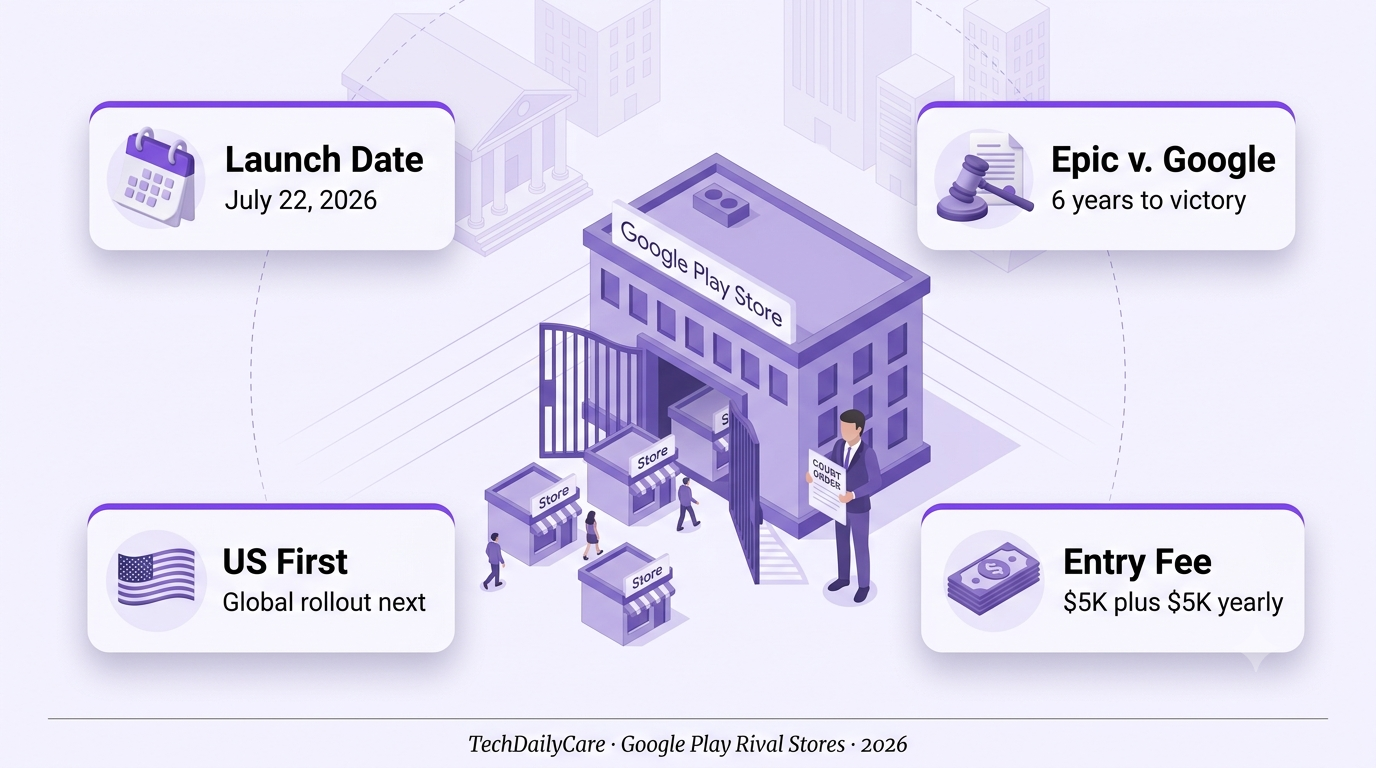
Google Play Rival Stores are finally happening. On July 22, 2026, US Android users will be able to download third-party app stores directly from inside the Google Play Store, ending six years of legal fighting between Google and Epic Games. This isn’t a demo, a preview, or a limited pilot — Google confirmed in a July 15 court filing that it will begin enrollment through what it calls the Play Catalog Access Program on that date. The floodgate that Android has been trying to keep closed since 2020 opens next week.
The trigger was a joint move by Google and Epic to withdraw their previously proposed settlement, leaving Judge James Donato’s original October 2024 permanent injunction in force. Google had spent more than a year trying to modify that order into a less-invasive alternative. The Verge broke the news on Wednesday. Google spokesperson Dan Jackson framed the retreat as focus on “our recently announced global business model evolution,” a corporate-speak way of saying the company decided further litigation was not worth it.
The mechanics matter as much as the news itself. Rival stores must pay Google a $5,000 onboarding fee plus $5,000 annually to access the Play Store’s full catalog. They must target US users only. They cannot bypass Google Play for actual downloads — Google Play still processes every install and still collects service fees. In parallel with the antitrust order, Google has already reduced the commission on app purchases from 30% to 10%. That’s the piece the coverage this week has largely under-reported.
What happens next will reshape Android app distribution in ways that stretch far beyond the immediate July 22 launch. Epic and Aptoide, both already available via sideload in the US, are the obvious day-one candidates for inside-Play enrollment. Google’s parallel Registered App Stores program, aimed at the rest of the world, hints that this US-only opening is just the first chapter. Here is what the Google Play Rival Stores launch actually looks like on day one, how the six-year legal fight ended, and who wins as this ecosystem finally cracks open.
Why is Google opening the doors now?
Google withdrew its motion to modify Judge Donato’s 2024 injunction on July 15. Continuing litigation created ecosystem uncertainty, and Google shifted focus to a broader global business model evolution instead.
What does it cost to run a rival store?
Third-party stores pay a $5,000 upfront onboarding fee for security review, plus $5,000 annually to maintain Play Catalog access. Malware install attempts must stay under 1%.
Who can actually participate?
US-only. Rival stores must target US users exclusively, function as legitimate marketplaces open to all eligible developers, and have app discovery as their primary purpose.
Who actually wins from this?
Developers get a lower 10% commission and can offer alternative billing. Users get more app-store choice inside Play. Epic, Aptoide, and other stored-in-Play candidates get catalog reach they never had before.
The July 22 Launch Date Is Real This Time
ConfirmedGoogle confirmed the launch date in a July 15 court filing, per Bloomberg reporting picked up by MacRumors and The Verge. Starting July 22, 2026, third-party US Android app stores that complete enrollment in the Play Catalog Access Program will be discoverable and downloadable directly from inside Google Play. This replaces the previous model where users had to sideload rival stores through Android’s more complicated developer-mode process.
The timing is unusually tight. Google filed its notice on Wednesday and told developers their US listings would be shared with enrolled third-party stores by default one week later. Developers who want their apps kept out of the shared catalog have until July 22 to opt out. That leaves the entire Android developer ecosystem with roughly a week to make a decision on where their apps get distributed.
The court filing also confirmed Google would drop its motion to modify the injunction. This is the piece that changes the story from “eventual compliance” to “next-week compliance.” Judge Donato’s 2024 remedies now govern the rollout in full, without the negotiated modifications Google spent months trying to secure.
The $5,000 + $5,000 Fee Structure
MoneyThe Play Catalog Access Program is not free entry. Rival stores must pay Google a $5,000 upfront onboarding fee to cover the initial security and policy review, and then $5,000 every year to maintain that access. The fees are framed as covering ongoing security reviews and policy enforcement across the apps distributed through third-party marketplaces.
There is some ambiguity in the coverage this week about whether the upfront fee and the annual fee are additive or one and the same. Ars Technica describes the $5,000 as an annual security and compliance review fee. Engadget describes it as separate onboarding plus annual charges. Google’s own Play Console Help page describes an upfront service fee plus a recurring annual maintenance fee, which aligns with the Engadget interpretation. Either way, this is not a barrier meant to keep large rival stores out.
For context: Epic Games earns billions annually from Fortnite in-app spending. Aptoide has raised tens of millions in venture funding. A $5,000 or $10,000 line item is essentially rounding error for both. What the fee structure does is filter out low-effort or malicious operators. Combined with the requirement that malware installs stay below 1% of total install attempts, it’s a light gate rather than a moat.
Six Years of Epic v. Google, In Brief
BackstoryThe fight that produced today’s Google Play Rival Stores launch started in August 2020, when Epic Games filed antitrust suits against both Apple and Google over app-store commissions and payment restrictions. Apple mostly won in court. Google mostly lost. In December 2023, a California jury unanimously found Google had unlawfully maintained monopoly power in Android app distribution, where the Play Store was generating a 71% operating profit margin.
US District Judge James Donato issued a permanent injunction in October 2024 requiring Google to allow rival app stores inside Google Play and share the Play catalog. Google spent 2025 fighting the ruling: the Ninth Circuit affirmed the verdict in August 2025, then Google and Epic reached a settlement in November 2025 that would have replaced the original remedies with less drastic requirements — a move that came alongside an $800 million surprise partnership between the two companies.
That settlement collapsed on July 14–15, 2026. Both parties jointly withdrew the motion. Now the original injunction governs the rollout in full, and Google has committed to complying starting July 22. The takeaway: after almost exactly six years, Epic got what it originally asked for, and the Google Play Rival Stores program is a direct consequence of a plaintiff refusing to accept a negotiated compromise.
Compared to how quickly other antitrust remedies have played out in tech, this is fast. Microsoft’s browser bundling case took most of a decade to reach effective remedies. The Google Search text ads case is still working through appeal. The Epic-Google case moved from complaint to enforced structural change in six years, which is unusually short for antitrust of this scope, and the Google Play Rival Stores program is the visible payoff.
The Requirements Are Strict But Beatable
RulesGoogle’s Play Console Help page lays out the eligibility requirements. Participating stores must have their app store available and targeting users in the US, be registered as an organization, and function as a legitimate marketplace. They must operate as an “Open Access” marketplace for all eligible third-party developers, with clear non-discriminatory policies. IP compliance and transparent user experience are also required.
The safety bar has one specific number attached. Malware install attempts must account for less than 1% of total install attempts across the rival store. That’s a meaningful metric for a store hoping to enroll — it filters out marketplaces where sideloaded threat vectors have historically been common, but any serious rival store has better numbers than that already.
Developer authorization is the piece that could get messy. Rival stores need written authorization from developers and all license rights necessary to distribute their apps, including the content of those apps. This is where opt-out mechanics come in. US developers with apps on Play are opted in by default starting July 22, and must actively opt out if they want to prevent their apps from appearing in third-party catalogs.
Epic and Aptoide Are The Day-One Names To Watch
CandidatesProMarket noted in January 2026 that Epic Games and Aptoide were already accessible via sideload in the US at the end of 2025. Both are the obvious candidates for enrollment in the Play Catalog Access Program on day one. Neither has publicly confirmed a listing inside Google Play as of this week’s reporting, but the pieces are lined up for a fast move.
For Epic, the appeal is straightforward: Fortnite has been fighting for years to reach Android users without paying Google’s commission. Being inside Play with catalog access and a 10% commission — rather than 30% — is exactly the outcome Epic was suing for. Whether Epic actually launches its store inside Play or continues to pressure for further concessions is a strategic question, not a technical one.
Aptoide is the more interesting case. As a European-founded rival store with tens of millions of users globally, its business model has been sideload-first for over a decade. Getting inside Play Store gives Aptoide catalog access and discoverability it never had. Smaller storefronts like Amazon Appstore and Samsung’s Galaxy Store already have their own device-preinstalled distribution, so the Play Catalog Access Program mostly matters for third parties that never got that OEM deal.
The Global Rollout Is Coming Next
What’s NextThe July 22 Google Play Rival Stores launch is US-only. But Google is running the Registered App Stores program in parallel for the rest of the world, and the company has signaled this is part of what it calls its “global business model evolution.” Meaning: this framework — third-party stores enrolled through a paid program, with Google Play still running the download pipe — is likely to expand internationally over the next 12 to 18 months.
Regulatory pressure will accelerate that timeline. Swiss authorities opened an antitrust probe into Google’s Android search choice screen this month. The EU’s Digital Markets Act has already forced similar changes in Europe. India, Brazil, and Australia have active competition inquiries that could produce region-specific injunctions similar in effect to Judge Donato’s. Google’s move to a single global framework is easier to defend than a patchwork of country-specific compliance builds.
For developers and users outside the US, the practical answer is: not yet, but soon. The specific US launch date matters because it establishes the template. Fee amounts, security review structure, and download-through-Play mechanics that Google settles on for the Google Play Rival Stores program on July 22 are the ones likely to appear in international rollouts, with local modifications to fit each jurisdiction’s competition laws.
South Korea is a special case worth watching. Korea’s Telecommunications Business Act already forbids app-store operators from forcing developers into a single payment system, and enforcement has been uneven. A Google rollout of a Play Catalog Access Program-style framework in Korea would align existing Korean regulations with structural remedies rather than the current fine-based enforcement model, which has produced limited real-world change so far.
We’ve agreed with Epic to withdraw our motion rather than prolonging
this process which creates uncertainty for the ecosystem.
- US targeting only — App store must be available to and target users in the United States. Distribution outside the US is prohibited under this program.
- Registered organization — Must be a formally registered business, not an individual developer or informal team.
- Legitimate marketplace — Primary purpose of the store must be discovery, installation, and management of apps, not aggregation, gambling, or other adjacent services.
- Open access — Marketplace must be open to all eligible third-party developers with clear, non-discriminatory policies.
- Developer authorization — Written authorization from developers plus all license rights and permissions needed to distribute the apps and their content.
- Malware under 1% — Malware install attempts must stay below 1% of total install attempts across the store.
- Review submissions — Updated versions of the app store itself must be submitted for security review before distribution to users.
⚠️ Four Google Play Rival Stores Traps To Watch
1. Google still owns the download pipe. Rival stores get catalog access and storefront visibility, but every actual app install still runs through Google Play’s infrastructure. Google’s service fee applies to every download made this way, regardless of which store discovered it.
2. Fee ambiguity is unresolved. Ars Technica reports a single $5,000 annual security review fee. Engadget reports a $5,000 onboarding fee plus $5,000 annually. Google’s Play Console Help page currently reads closer to the Engadget structure. Enrolling stores should confirm the number in writing.
3. Opt-out is one-way. Developers get automatically opted into third-party catalog sharing on July 22 unless they act first. Opting back in after the fact is possible, but any lost distribution during the opt-out window is not recoverable.
4. Global timing is not guaranteed. Google’s Registered App Stores program for markets outside the US does not yet have a launch date. Non-US users and developers should assume nothing about their local timing based on the US July 22 rollout.
Google unlawfully maintained monopoly power
in Android app distribution.