
Huawei Atlas 950 Debuts at Xi’s Keynote, No Nvidia Chips
8,192 Ascend NPUs, 6.7x the compute of Nvidia’s NVL144, and a Shanghai stage that turned a product demo into a governance signal. Here’s what the Huawei Atlas 950 SuperPoD really means.
Here’s what actually happened this morning in Shanghai. Xi Jinping walked onto the opening stage of the 2026 World Artificial Intelligence Conference — his first in-person appearance at the event since it began in 2018 — and delivered a keynote framing AI governance as a top-tier national priority for China. On the exhibition floor a few halls away, Huawei rolled out the first full public demonstration of the Huawei Atlas 950 SuperPoD, the same rack-scale AI system Rotating Chairman Xu Zhijun first unveiled at Huawei Connect in September 2025 with a Q4 2026 delivery target. The Shanghai debut, five months ahead of general availability, is a demo. It is also a governance signal.
The specifications are the reason Nvidia should be paying attention. The Huawei Atlas 950 SuperPoD packs up to 8,192 Ascend 950DT NPUs into 160 cabinets — 128 compute cabinets plus 32 for communications — deployed across roughly 1,000 square meters and stitched together with all-optical interconnect. Peak compute reaches 8 EFLOPS in FP8 and 16 EFLOPS in FP4. Interconnect bandwidth hits 16 PB/s — over ten times the peak bandwidth of the entire global internet today. Compared to Nvidia’s forthcoming NVL144 rack, Huawei claims 56.8x the scale, 6.7x the total compute, and 15x the memory capacity at 1,152 TB. Every chip in the system is Chinese-made. Zero Nvidia parts.
The subtext is the point. Every hyperscaler in the world is currently rationing GPUs, and the same week the Huawei Atlas 950 lands on stage in Shanghai, reporting confirmed Google capped Meta’s Gemini access due to compute constraints. The United States is short of compute, allocating it to preferred customers. China is publicly demonstrating a domestically-built rack-scale system that outscales what Nvidia has announced for 2026 — and shipping the underlying Ascend 950 chips into hyperscaler production. This is what a functional response to export controls looks like when it works, and this morning was the day it became impossible to ignore.
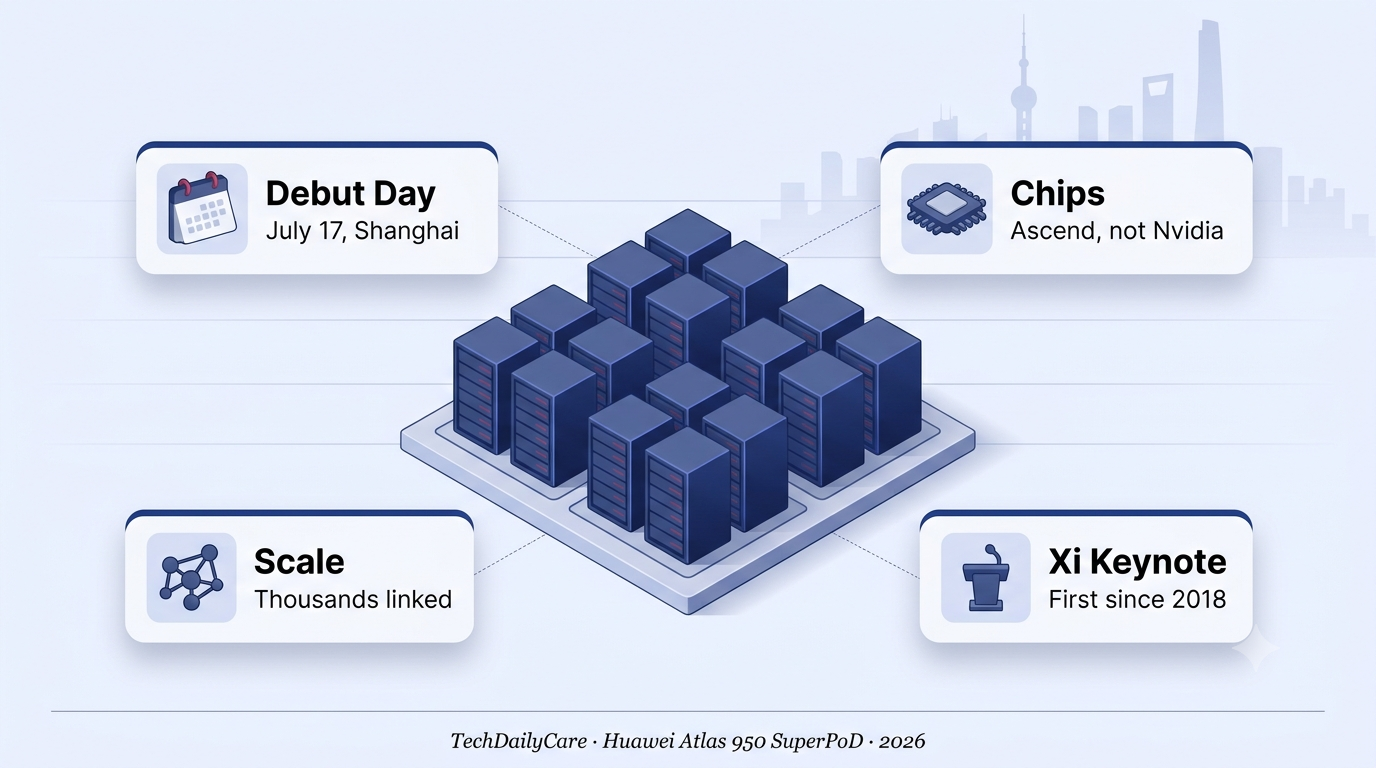
July 17 · Shanghai WAIC floor
Public demonstration during the 2026 World AI Conference, running July 17-20. Xi Jinping’s first in-person WAIC keynote since 2018 opened the same event. General availability targets Q4 2026.
8,192 Ascend 950DT NPUs
All-Chinese silicon. Ascend 950 series with Huawei’s self-developed HiBL/HiZQ HBM. 1 PFLOPS FP8 per chip, 2 PFLOPS FP4. Alibaba, Baidu, Tencent among first customers for the underlying chip.
160 cabinets, ~1,000 m²
128 compute cabinets plus 32 for communications. All-optical interconnect between cabinets. 16 PB/s aggregate bandwidth — more than 10x the current peak of the global internet.
6.7x NVL144 compute
Huawei’s stated comparison: 56.8x scale, 6.7x total compute, 15x memory (1,152 TB), 62x interconnect bandwidth over Nvidia’s forthcoming NVL144. Also claimed superior to 2027’s NVL576.
Why Huawei Atlas 950 landed on Xi’s day, not Huawei’s
The Shanghai debut versus the September announcement
TimelineThe Huawei Atlas 950 SuperPoD was not announced today. Huawei Rotating Chairman Xu Zhijun first unveiled it at the Huawei Connect 2025 conference on September 18, 2025 — held, notably, at the same Shanghai World Expo Exhibition Center that hosts WAIC — as the centerpiece of a three-year Ascend chip roadmap. Delivery was pegged at Q4 2026. What changed today is stagecraft: the July 17 Shanghai debut is the first public demonstration to a global audience that has just been told, by Xi in person, that AI is one of Beijing’s top strategic priorities.
The two events sharing a calendar day is not accidental. The 2026 WAIC runs July 17-20 under the theme “AI Partnership for a Brighter Future,” with more than 140 forums and 1,100 exhibitors. Xi’s opening keynote setting out China’s positions on AI development and governance was scheduled for this morning. Huawei’s rollout of a rack-scale AI system that outscales anything Nvidia has publicly announced through 2027 lands within the same news cycle, in the same city, on the same day. Coincidence is not a reasonable reading.
The chip that makes it possible
HardwareThe Huawei Atlas 950 SuperPoD runs on the Ascend 950DT NPU, a chip Huawei has been shipping in staged form since Q1 2026. The Ascend 950PR — the volume-shipping variant — hit customer data centers in March 2026, delivering 1.56 PFLOPS of FP4 compute in the Atlas 350 accelerator card, paired with 112 GB of Huawei’s self-developed HiBL memory at 1.4 TB/s bandwidth. EE Times China independently confirmed the Atlas 350’s throughput at 2.8x that of Nvidia’s China-market H20.
The point of the “self-developed HBM” line is that Huawei is not waiting on SK Hynix or Micron. HiBL 1.0 and HiZQ 2.0 are Huawei’s own high-bandwidth memory packages, co-designed with the Ascend 950 die. This is the part of the semiconductor stack most exposed to US export controls, and Huawei has been quietly assembling a domestic answer to it for three years. The Ascend 960 series, doubling FP4 and FP8 throughput per chip, is scheduled for Q4 2027. Ascend 970 is in planning.
The all-optical interconnect nobody else has at scale
ArchitectureHuawei’s stated pitch for the Huawei Atlas 950 is that individual Ascend chips are weaker than Nvidia’s flagship — Xu Zhijun said so on stage in September — but that system-level performance is what customers actually buy, and system-level performance is where Huawei believes it wins. The mechanism is optical interconnect. Rather than trying to pack more compute dies into a single rack the way Nvidia’s chiplet designs do, Huawei links racks together with all-optical fabric to build supernodes that behave, from software’s perspective, as one machine.
The numbers behind that architectural choice: 16 PB/s of aggregate interconnect bandwidth, distributed across 160 cabinets in a single SuperPoD. That is more than ten times the peak bandwidth of the current global internet. Training performance on the full SuperPoD reaches 4.91 million tokens per second. Inference performance with FP4 hits 19.6 million TPS. Independent verification against Huawei’s own claims will land only once real customer workloads run on the system — most likely from Alibaba, Baidu, or Tencent, all of whom have been named as launch customers for the Ascend 950 line.
Every chip in the system is Chinese-made.
Zero Nvidia parts.
That is the announcement.
The Huawei Atlas 950 news cycle nobody in Washington wanted
Xi’s keynote reframes the announcement
PoliticsXi Jinping has skipped the World AI Conference every year since it began in 2018, sending premiers or vice-premiers to represent Beijing. Attending in person in 2026 — and delivering the opening keynote himself — is a top-line signal that AI has moved from “important sector” to “presidential priority” in Chinese governance. Coming in the same week South Korea announced an $880 billion AI plan, Goldman Sachs formally recommended Chinese AI models to Wall Street clients, and ByteDance released its frontier-quality Seedream 5.0 Pro image model, the timing tells a coordinated story about Beijing wanting the world’s largest AI-governance audience to see, hear, and touch Chinese-built frontier capability in one visit.
Read against that backdrop, the Shanghai demonstration stops being a product event. It becomes the industrial exhibit at a governance moment: the tangible proof that China’s declared AI ambitions are matched by rack-scale hardware China can build without US components. Every diplomat, regulator, and enterprise buyer in the WAIC exhibition halls this week will see the same system running the same demonstration workloads. The conference itself features more than 140 forums and 1,100 exhibitors, running July 17 through 20 under the theme “AI Partnership for a Brighter Future” — a phrase whose subtext, in the same news cycle as the SuperPoD debut, is that Chinese AI infrastructure is now something the world builds partnerships with, not around. That was the point.
US compute rationing is the perfect backdrop
ContrastThe Huawei Atlas 950 debut lands in the same week Bloomberg reported Google had capped Meta’s Gemini API access due to internal compute shortages — Google, running short of compute for its own partners, rationing access to Meta specifically. It is the same month AWS announced a $1 billion internal AI deployment team, Microsoft expanded its Frontier Company enterprise capacity, and TSMC posted record revenue driven entirely by AI hardware demand. Every US-facing story this quarter has been about compute scarcity, hyperscaler rationing, and the queue for the next chip generation. Sequoia’s David Cahn recently sized the AI industry’s “missing revenue” at roughly $2.9 trillion — arguing that $1.5 trillion of 2026 infrastructure spend needs $3 trillion in sales to pencil, but Anthropic and OpenAI combined generate only around $80 billion in annualized revenue.
In that context, a Chinese vendor publicly demonstrating a working rack-scale system that outscales anything Nvidia has announced through 2027 — and doing it on the day the Chinese president speaks about AI governance — is the news cycle Washington did not want. Export controls are supposed to slow Chinese AI capability. Today’s debut argues, in production hardware rather than a policy paper, that they have not. Alibaba, Baidu, and Tencent will be the first customers running frontier workloads on the Ascend 950 line. None of them need Nvidia to do it, none of them are permitted to buy Nvidia flagship silicon anyway under current export rules, and all three now have a domestic alternative that scales past the Nvidia systems US hyperscalers themselves are waiting in line for.
⚠️ Huawei Atlas 950 SuperPoD claims that still need independent verification
1. Q4 2026 delivery timeline. The system was announced in September 2025 with a Q4 2026 target. Today’s Shanghai debut is a demonstration and staged rollout, not final customer shipment. Timeline slippage is common in first-generation rack-scale hardware.
2. Chip-count comparisons with Nvidia are not apples-to-apples. Ascend 950DT delivers roughly 1 PFLOPS FP8 per chip. Nvidia’s GB300 delivers ~5 PFLOPS FP8 per chip. Comparing raw chip counts inflates Huawei’s scale advantage relative to real compute-per-watt or compute-per-cabinet numbers.
3. Real-workload benchmarks are the only honest test. Peak FLOPS and interconnect bandwidth are vendor claims. Independent benchmarks running frontier training and inference workloads on the Atlas 950 SuperPoD — the kind Alibaba, Baidu, or Tencent would publish — do not exist yet.
4. Software stack maturity is unknown. Huawei’s MindSpore framework, CANN compiler, and model porting toolchain are still developing. A hardware system this scale is only useful if the software layer above it runs modern training runs efficiently, and that side of the stack is what analysts have historically flagged.
Why the Huawei Atlas 950 story matters beyond this week
The SuperCluster roadmap behind the debut
RoadmapA single Huawei Atlas 950 SuperPoD, at 8,192 chips, is the building block for something larger. Huawei has already announced the Atlas 950 SuperCluster — 64 SuperPoDs linked together into a system running 524,288 Ascend 950DT NPUs across more than 10,000 cabinets, occupying roughly 64,000 square meters (comparable to 150 basketball courts). Aggregate compute reaches 524 EFLOPS in FP8 and 1 FP4 ZettaFLOPS. Huawei claims 6.7x the compute of Nvidia’s NVL144 rack at Cluster scale, and 1.3x the total capability of Elon Musk’s xAI Colossus supercomputer.
Beyond that, the roadmap runs into 2027-2028: Ascend 960 chips doubling FP4 and FP8 throughput per die, Atlas 960 SuperPoD supporting 15,488 chips, and the Atlas 960 SuperCluster targeting over 1 million Ascend NPUs. Every step is scheduled, every step is announced, every step is dependent on Huawei’s ability to keep producing Ascend chips at volume without US components. So far, the roadmap has held.
What Nvidia investors should actually track
MarketsThe one thing not to do with today’s news is panic-sell Nvidia. Nvidia’s China revenue line has been under pressure since H20 export restrictions took effect, and Wall Street already prices in some level of Chinese domestic substitution. The near-term risk is not Nvidia losing US or European hyperscaler customers to Huawei. Those customers cannot legally buy Ascend anyway, and would not want to for reasons of software ecosystem alone — CUDA, cuDNN, TensorRT, and the surrounding developer stack remain a genuine moat that Huawei’s MindSpore framework has not matched, and porting a mature CUDA codebase to MindSpore is measured in engineer-years, not weeks.
The measurable risk is Nvidia’s growth-rate ceiling in China, which now has a credible domestic ceiling of its own. Every Alibaba, Baidu, and Tencent training run that migrates onto the Ascend 950 line is a training run Nvidia will not sell H20 or downgraded flagship silicon to serve. That number will move slowly at first — software porting friction is real, framework maturity is real, model-parallelism tuning for a new architecture is real — but the direction of travel is set. Nvidia’s most recent quarter posted $81.6 billion in revenue with $91 billion guidance for the next, and China segment has been the most volatile line item. Nvidia’s next earnings guidance is where analysts will price today’s development in. The number to watch is the China segment revenue trajectory over the next four quarters, and specifically how much of Nvidia’s stated H20 backlog actually converts to shipments versus quietly disappearing into Ascend deployments.