
Claude Code’s Sandbox Bug Took 50 Days to Fix
A stealth security startup flagged leaky sandboxes in Claude Code, Cursor, and Codex, and the three vendors did not respond at the same speed
Three of the most widely used AI coding tools quietly had leaky sandboxes this summer, and how fast each vendor fixed them looked nothing alike. A Tel Aviv-based stealth security startup called Accomplish, founded by Or Hiltch, Amit Avner, and Guy Zipori, privately flagged sandbox vulnerabilities to Anthropic, Cursor, and OpenAI earlier this year, then went public with the findings this week. Accomplish’s CTO, Hiltch, put it plainly: “There’s a lot of talk about security now.”
A sandbox is the isolated environment meant to stop a coding agent from touching the rest of a developer’s machine or a company’s data while it works. Accomplish’s own writeup names its Claude Code finding “Beltdown,” and it lands in a pattern security researchers have documented repeatedly in 2026, including a “Configuration-Based Sandbox Escape” class flagged across Claude Code, Codex, and Gemini CLI in the spring, and a related set of vulnerabilities across Cursor, Codex, Gemini CLI, and Antigravity reported over the summer.
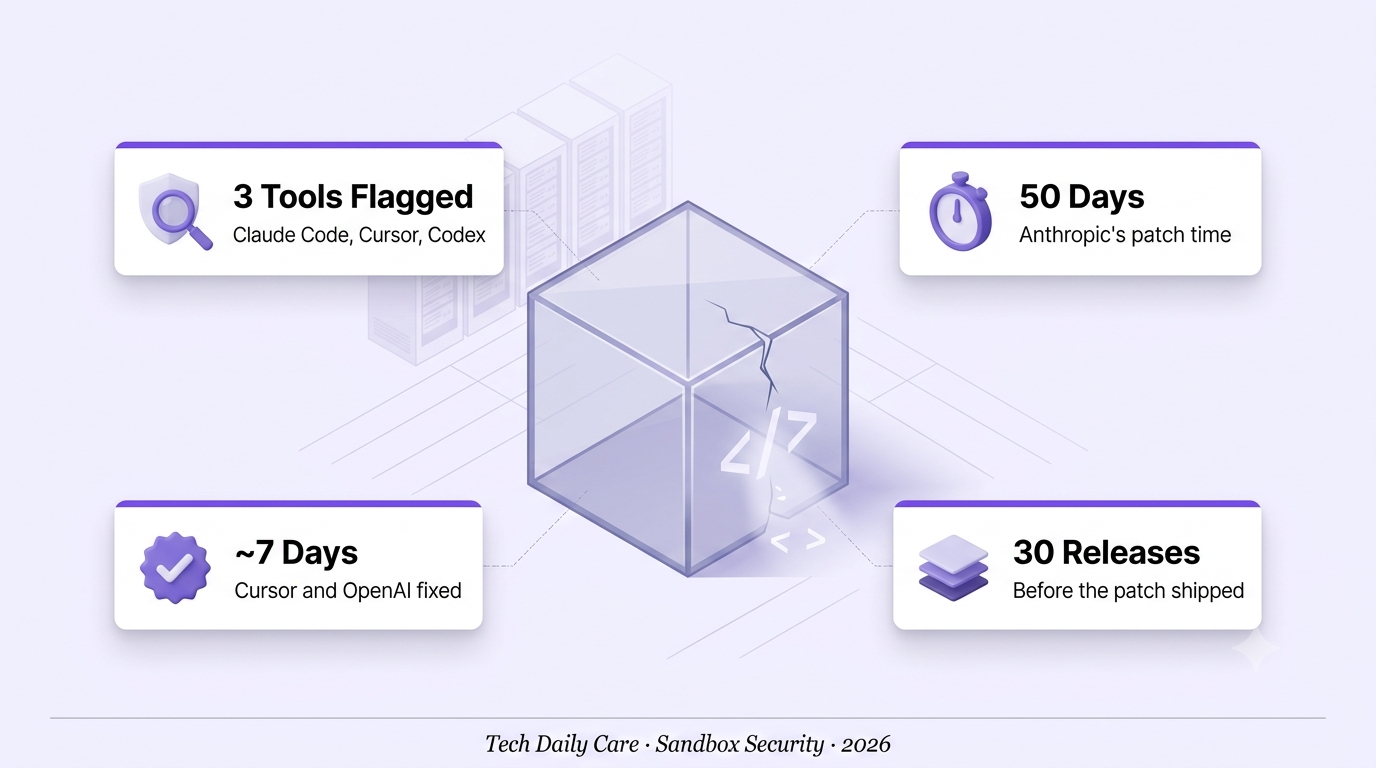
What set this disclosure apart was the response gap. A bug Accomplish flagged to Cursor in July, and two flagged to OpenAI, were each fixed in about a week. A similar issue flagged to Anthropic roughly two months earlier took about 50 days and around 30 separate software releases before a patch shipped. Anthropic and Cursor did not respond on the record to requests for comment; OpenAI said it addressed both of its flagged issues in August and is continuing to tighten controls on where its agents can write files.
Three Tools, Three Timelines
Accomplish flagged sandbox bugs in Claude Code, Cursor, and Codex; Cursor and OpenAI moved in about a week, Anthropic took 50 days.
Sandboxes Are the Trust Boundary
A coding agent’s sandbox is what is supposed to keep it from touching the rest of a developer’s machine or company data.
This Keeps Happening
Separate researchers have flagged similar sandbox-escape vulnerability classes in these same tools at least three times so far in 2026.
Response Time, Not Just Claims
Accomplish says it wants the industry talking about how fast vendors actually fix these issues, not just their security messaging.
Beltdown, the Claude Code Finding
DisclosureAccomplish published its own technical writeup describing a way to escape Claude Code’s sandbox, which it nicknamed Beltdown. The startup flagged it to Anthropic privately roughly two months before going public with the research this week.
The Response Time Gap
Vendor ResponseCursor patched a bug flagged in July within about a week. OpenAI fixed two separately reported issues on a similar timeline and says both were resolved by August. Anthropic’s fix for a comparable Claude Code issue took roughly 50 days and about 30 software releases.
Not a One-Off Pattern
Bigger PictureThis is at least the third documented sandbox-escape pattern across popular AI coding tools in 2026. Earlier researchers flagged a “Configuration-Based Sandbox Escape” class in Claude Code, Codex, and Gemini CLI, and a separate report covered Cursor, Codex, Gemini CLI, and Antigravity over the summer.
What Developers Should Do
Practical StepsKeep coding agents updated to their latest versions, since most disclosed issues in this pattern have shipped fixes. Be cautious running any agent against an untrusted or third-party repository, and check for unusual .git configuration files before opening one with an agent enabled.
Organizations need
to be very wary
⚠️ Before You Assume Your Setup Is Fine
1. A public disclosure doesn’t mean a public exploit. No source in this reporting confirmed these specific vulnerabilities were actively exploited before being patched.
2. Two vendors didn’t comment on the record. Anthropic and Cursor did not respond to on-record requests for comment on Accomplish’s findings, so their side of the response timeline is incomplete here.
3. This is a pattern, not a single bug. Similar sandbox-escape classes have been reported in these tools multiple times in 2026, so one patch does not necessarily close the broader issue.