
John Ternus Apple CEO Era Begins, Tim Cook’s $109B Send-Off
A record June quarter, a memory chip warning, and what changes for iPhone, Mac, and iPad pricing under Apple’s next chief.
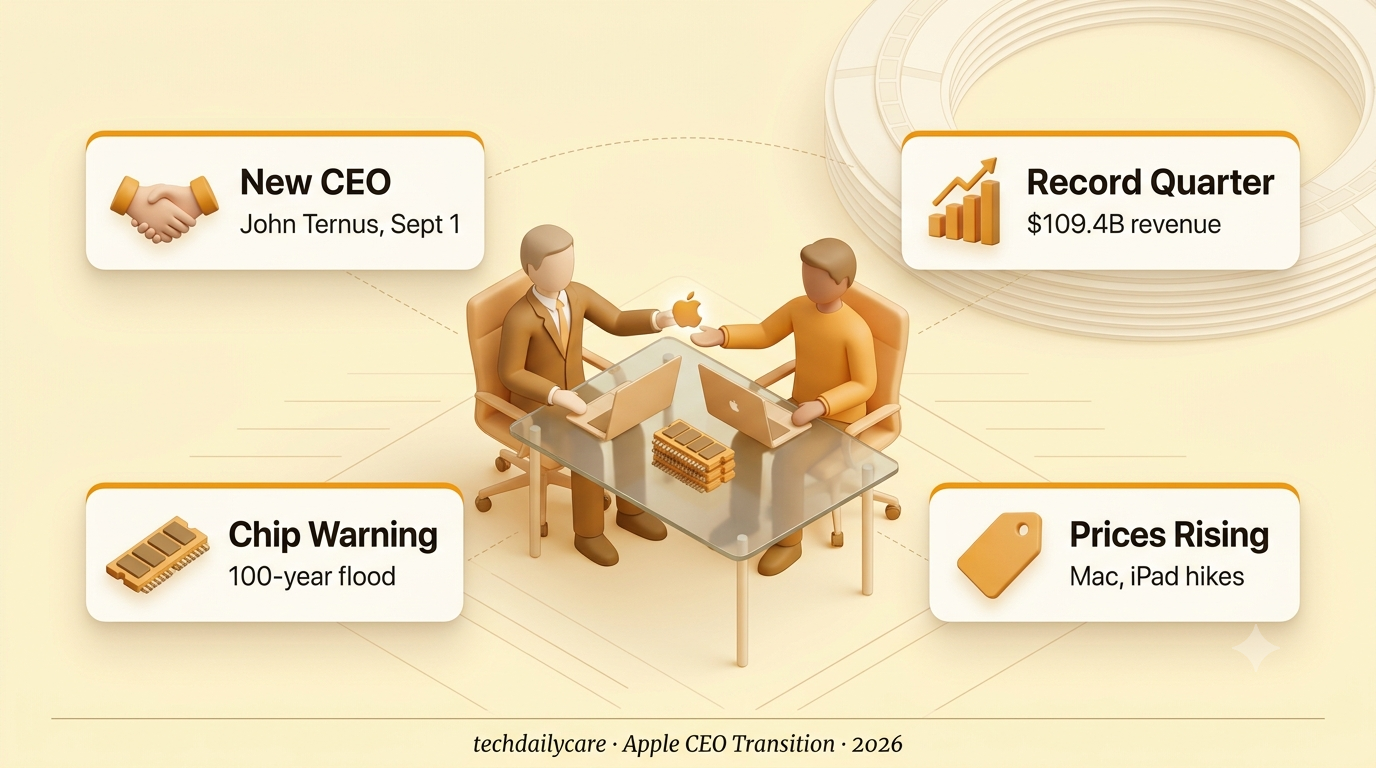
The John Ternus Apple CEO transition officially starts September 1, 2026, and Tim Cook chose his final earnings call to explain exactly why the timing matters. On July 30, Cook closed out 15 years at the helm with a June-quarter record of $109.4 billion in revenue, up 16% from a year ago — his 90th and final earnings call as chief executive. It was the kind of number that, on paper, should have sent the stock soaring into the transition weekend. Instead, shares slid as much as 8% in after-hours trading, immediate proof that Wall Street was weighing far more than just the top-line beat.
Cook used the moment to hand the mic, gently, to his successor. John Ternus joined Apple’s product design team back in 2001, fresh out of a mechanical engineering degree, and spent the next two decades climbing through hardware engineering rather than finance or operations, which is where Cook himself made his name. Ternus became senior vice president of Hardware Engineering in 2021, the executive who has quietly shaped the iPad, iPhone, AirPods, and Apple Watch for years without ever becoming a household name the way Cook or Steve Jobs did. Apple’s board approved his promotion unanimously back in April, and Cook has repeatedly called the handover “seamless,” even as he leans on Ternus, fifteen years his junior, to carry Apple past its recent brush with a $5 trillion market cap.
But the send-off wasn’t all celebration, and that’s the part getting less attention than it deserves. Cook spent a meaningful chunk of the call warning analysts about tight memory chip supply, a squeeze already blamed for June’s Mac and iPad price increases and one he suggested is nowhere near finished. That combination — a record quarter, a generational leadership handoff, and a pricing headache that lands squarely on customers — is exactly why this particular earnings call is being read so closely by anyone who owns, or is about to buy, an Apple product. It is rare for a single 60-minute call to double as both a farewell speech and a profit warning, but that’s precisely what happened on July 30.
For readers outside the finance press, the practical question is simpler than any of the corporate-governance detail: does any of this change what you pay for your next Apple device? The short answer, based on everything Cook and his CFO said on the call, is yes — not dramatically, and not immediately, but the direction of travel on pricing is up rather than flat, and that’s before Ternus has made a single decision of his own.
Why September 1
Apple’s board unanimously approved Ternus back in April after a long internal succession process. September 1 gives him a clean start well before the iPhone 18 launch season ramps up in the fall.
Why the Stock Fell on Record Revenue
Investors priced in supply-chain warnings and leadership-transition uncertainty against the $109.4B beat, sending shares down as much as 8% in after-hours trading the same evening.
What 15 Years Under Cook Built
Apple’s market cap grew from roughly $350B when Cook took over in 2011 to a peak above $5T this year — four separate trillion-dollar milestones inside one tenure.
Why iPad and Mac Cost More Now
A memory chip price surge forced June’s price hikes on Mac and iPad, and Cook signaled the squeeze isn’t over — more increases across the lineup are possible.
Seven threads run through this earnings call, and each one answers a different question — who’s in charge, why the numbers looked the way they did, and what it means for anyone about to open their wallet for a new Apple product. Here’s each one broken down on its own, in the order they matter most to someone deciding whether to buy Apple hardware this year.
The John Ternus Apple CEO Handoff — What Happens September 1
TimelineApple’s board approved the John Ternus Apple CEO succession plan on April 20, unanimously, capping a long-running internal process that insiders had been tracking for years. Cook’s July 30 call was his 90th and final one as chief executive, a milestone he acknowledged directly before shifting into questions from analysts. On September 1, Ternus takes over day-to-day leadership of the company, while Cook moves into the role of Executive Chairman, staying on the board and, by every account so far, remaining close at hand for the first few quarters rather than exiting cleanly the way some predecessors have.
The structure mirrors how Apple has handled every major transition since Jobs stepped aside for Cook in 2011: no outside hire, no interim caretaker, just the next internal candidate who has already spent years running the parts of the business that matter most. That continuity is deliberate. Apple has had only two CEOs this millennium, and the board clearly wants Ternus to have the same kind of runway Cook did.
Who Is John Ternus — The Engineer Who Outlasted Everyone
BackgroundTernus, born in 1975, joined Apple’s product design team in 2001 straight out of a mechanical engineering degree at the University of Pennsylvania, where he also swam competitively for four years. Before Apple, he spent four years as a mechanical engineer at a small virtual-reality device maker called Virtual Research Systems — a first job that couldn’t be further from the trillion-dollar company he now runs. He became vice president of Hardware Engineering in 2013 and was promoted to senior vice president in 2021, taking over from Dan Riccio. Along the way he led engineering on every iPad model, the iPhone 12 line, AirPods, and Apple Watch, and became the public face of the Mac’s multi-year transition to Apple Silicon at keynote after keynote.
Colleagues describe him as an engineer’s engineer rather than a natural showman, and he has said publicly that he considers Cook a mentor. That framing matters for how the market is reading this transition: Apple didn’t reach outside for a growth-focused operator or an AI evangelist. It promoted the person who has spent 25 years obsessing over how the products themselves get built.
It’s also a generational bet in a literal sense. Ternus has been publicly discussed as a likely successor since at least 2021, when reports first flagged him as the youngest member of Apple’s senior leadership team. That long runway of speculation is part of why the September 1 handover feels so unsurprising to anyone who has followed Apple’s executive bench for the past few years — the only real question was ever the exact date, not the name. Even his 2024 commencement speech at Penn’s engineering school leaned into that same identity, with Ternus reflecting on lessons about craftsmanship he picked up watching Steve Jobs inspect the unseen back panel of a piece of furniture — the kind of detail-obsessed story that tells you exactly what kind of CEO Apple just bet on.
The $109.4B Number Wall Street Still Punished
EarningsApple’s fiscal third-quarter revenue of $109.4 billion beat the prior June quarter by 16% year-over-year, and the company’s market cap had briefly touched $5 trillion earlier this year, with shares up roughly 23% year-to-date heading into the report. On paper, that’s about as strong a farewell number as any outgoing CEO could hope to hand off. None of it stopped an after-hours slide of as much as 8%, as investors weighed leadership-transition risk and Cook’s own warnings about supply constraints against the headline beat.
Some of the punishment may also be relative. Apple has actually outperformed several Big Tech peers this year precisely because it avoided the massive AI infrastructure spending race that has hit Meta, Google, and Microsoft’s free cash flow. Alphabet’s stock reportedly dropped sharply after raising its own capital-expenditure forecast past $200 billion, and Meta took a similar hit the same week. Apple’s more conservative approach has, until now, worked in its favor — which makes the post-earnings dip even more notable.
It’s worth remembering that Apple’s stock has historically dipped after earnings even in strong quarters, regardless of who was running the company at the time — a pattern some commentators have called a near-ritual at this point. That context doesn’t erase the transition risk, but it does mean this particular 8% move shouldn’t automatically be read as a verdict on Ternus specifically.
Cook’s Memory Chip Warning, Why Your Next iPhone Costs More
PricingCook told analysts Apple is seeing significant supply constraints and expects a quarter where the company will be scrambling on the supply side. The pressure is concentrated in memory chips — the same shortage Apple cited when it raised Mac and iPad prices in June. Fortune described the situation as a “100-year flood” in memory chip pricing, a way of framing this as a once-in-a-generation squeeze rather than a routine, seasonal blip that eases in a quarter or two.
Cook was unusually candid about the timing, telling investors the company reluctantly raised prices because of exponential increases in memory costs, and specifically flagged Mac and iPad as the products already affected. He stopped short of promising iPhone would be spared, and given that memory is a core component in every device Apple sells, most supply-chain analysts don’t expect it to be. That’s the uncomfortable subtext sitting underneath an otherwise record-setting quarter.
Memory chips — the DRAM and NAND flash that store data and run active tasks on every phone, laptop, and tablet — have seen global pricing spike as demand from AI data centers competes directly with consumer electronics for the same manufacturing capacity. That’s part of why Cook’s language sounded less like a routine supply hiccup and more like a structural shift he expects the whole industry to be living with for a while.
Apple Upgrade — The Leasing Plan That Landed Right Before the Handover
New ProgramDays before the earnings call, Apple quietly rolled out Apple Upgrade, a hardware-leasing program sold through its online store, the Apple Store app, and physical retail locations. iPhone and Apple Watch get 12- or 24-month leasing terms; Mac and iPad get 24- or 36-month terms. Monthly pricing starts at $17.99 for iPhone, $11.99 for Apple Watch or iPad, and $24.99 for Mac. The program builds on Apple’s existing trade-in and financing options rather than replacing them, giving buyers one more path to a new device without a large upfront payment. It’s the kind of low-key product launch that would barely register in a normal quarter, but landing it the same week as a pricing warning turned it into a talking point almost by accident.
Why the John Ternus Apple CEO Bet Still Excites Wall Street
OutlookDespite the after-hours dip, most of the long-term commentary around this earnings call has stayed positive, and that’s worth separating from the short-term stock reaction. Apple enters the Ternus era with a market capitalization near $4.9 trillion, shares up roughly 23% this year, and a services business that keeps growing faster than hardware. Unlike several of its Big Tech peers, Apple hasn’t locked itself into the massive AI-infrastructure spending race, which has become a genuine risk factor for companies pouring more than $200 billion into data centers with uncertain near-term payback.
That restraint gives Ternus room to make his own bets on AI-powered features across iPhone, Mac, and Apple Watch without the pressure of matching a rival’s capital-expenditure number for its own sake. It also means the John Ternus Apple CEO story isn’t really a turnaround narrative — it’s a continuity story with one clear open question: whether the incoming chief can manage a memory-driven cost spike as smoothly as his predecessor managed everything else.
Analysts covering the stock have generally framed Apple’s AI caution as a strength rather than a weakness, especially now that some AI-heavy peers are reporting negative free cash flow for the first time. If that pattern holds, Ternus inherits not just a strong balance sheet but a company that hasn’t yet had to defend an AI bet it can’t walk back — a very different starting position than the one his Big Tech counterparts currently occupy.
What Happens to the iPhone 18 Roadmap Now
What’s NextThe single biggest near-term test for the new Apple CEO isn’t a strategy decision at all — it’s execution on a roadmap Cook already locked in. iPhone 18 is expected this fall, arriving within weeks of Ternus’s first full month in charge, which means any supply-chain hiccup or pricing surprise will land on his desk almost immediately rather than giving him a quiet runway. Apple has historically protected iPhone pricing even when it adjusted Mac and iPad, treating the phone line as the one product where sticker shock carries the most reputational risk.
That history is exactly why this quarter’s memory warning matters so much. If Ternus holds iPhone pricing flat despite rising component costs, expect Apple to quietly trim margins instead — a trade-off Cook was willing to make for years and one the market will be watching Ternus repeat, or break from, in his very first product cycle. Either choice sends a signal: absorbing the cost says continuity above all else, while passing it on says the new Apple CEO is willing to prioritize margins from day one.
- Buy before fall if price matters more than timing — memory-driven hikes tend to show up at product refreshes, and iPhone 18 season is the next likely trigger point.
- Compare Apple Upgrade against a straight purchase — $17.99/mo for iPhone can beat paying a lump sum if you tend to upgrade every one to two years anyway, since the plan bundles in the next model.
- Don’t expect a strategy reset from Ternus on day one — near-term product plans were locked in under Cook, so continuity, not disruption, is the realistic base case for at least a year.
- Watch base storage tiers, not just price tags — Apple has quietly trimmed included storage before instead of raising sticker prices outright, which has the same effect on your wallet.
- Track the next earnings call in late October — that will be Ternus’s first full call as CEO and the clearest early signal of how he plans to handle the memory situation long term.
I’ve never been more optimistic
about what comes next.
⚠️ What This Means for Your Next Apple Purchase
1. Prices likely aren’t done rising. Cook flagged ongoing memory constraints heading into the next few quarters on the call, describing limited flexibility in the supply chain rather than a one-time June adjustment that simply works itself out.
2. The roadmap doesn’t reset overnight. Ternus stayed quiet during the Q&A portion of the call and wasn’t made available to analysts directly, and Apple’s near-term product plans — including the iPhone 18 cycle — were already set under Cook well before September 1.
3. Leasing may beat buying outright right now. With Apple Upgrade’s monthly plans launching the same week as the pricing warning, spreading the cost may be the more predictable option while memory prices stay this volatile.
4. This isn’t unique to Apple. The same memory shortage pushing up Mac and iPad prices is squeezing laptop and phone makers across the industry, so switching brands won’t necessarily dodge the increase — it’s a component-level problem, not an Apple-specific decision.