
Lexar Muse, the World’s Thinnest
SSD Skips USB-C Entirely
At 3.8mm thick, the Muse is the slimmest portable drive ever made, but it trades the one port that works with everything else you own
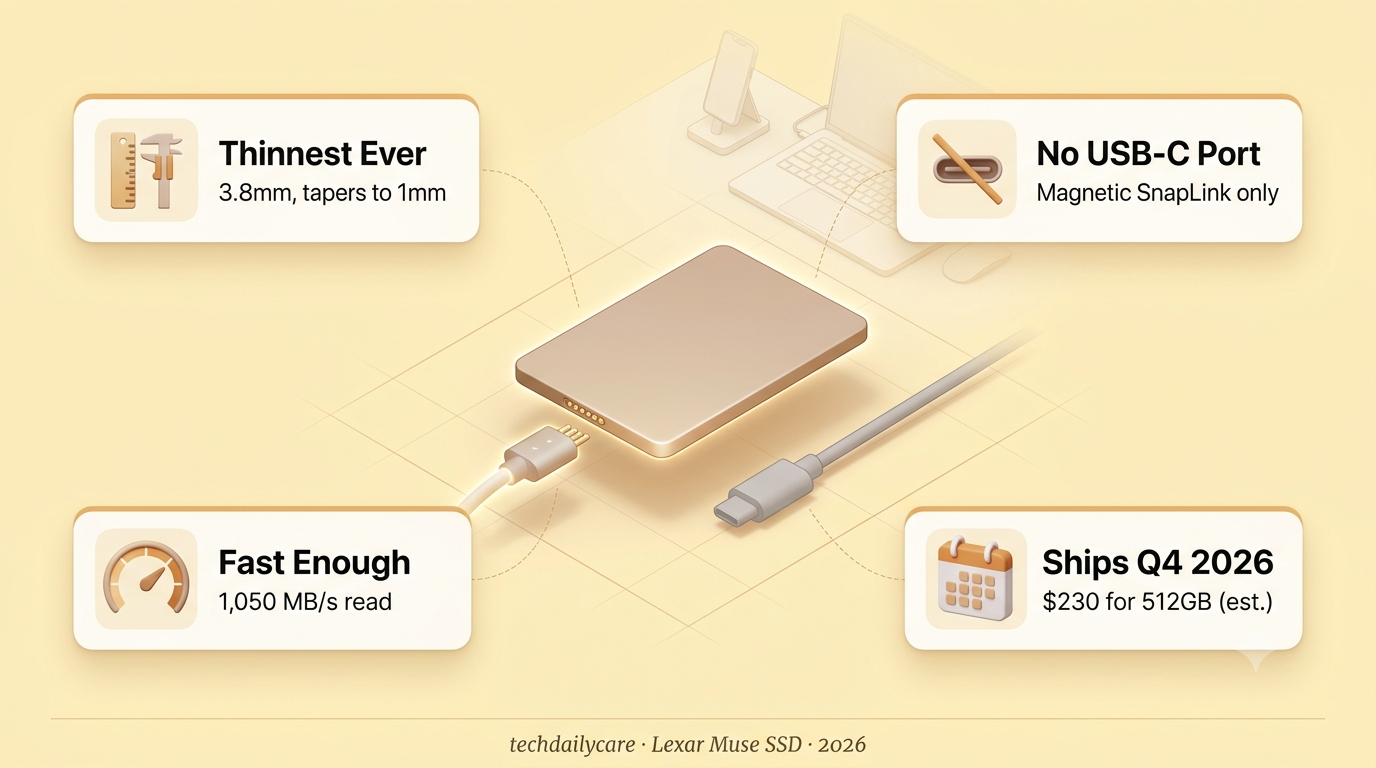
Lexar just unveiled the world’s thinnest portable SSD, and the trade-off it made to get there is the whole story. Announced at IFA 2026 to mark the brand’s 30th anniversary, the Muse measures just 3.8mm at its thickest point and tapers to a razor-thin 1mm at the edges, according to Tom’s Hardware. That’s roughly the footprint of a credit card, not a storage drive.
Here’s how Lexar got there: it skipped the standard USB-C port entirely. Instead, the Muse connects through a proprietary system called SnapLink, a magnetic pogo-pin cable held in place by N52-grade neodymium magnets. The drive doesn’t accept any other cable, and if you lose the one Lexar includes in the box, the SSD is effectively unusable until you track down a replacement.
Lexar is framing this as a feature, not a limitation. An optional magnetic sleeve lets the Muse snap directly onto the back of a MagSafe iPhone, turning it into instant on-device storage for creators shooting 4K ProRes video at up to 120fps. Whether that convenience is worth giving up USB-C, the connector that works with literally everything else in your bag, is the question every buyer will have to answer for themselves.
Why it’s this thin
A full USB-C port needs more internal depth than the Muse’s shell allows, so Lexar removed it and moved to a magnetic pogo-pin connection instead.
One special cable, no backups
The bundled SnapLink cable is the only way to connect the Muse. Lose it, and none of your existing USB-C cables will work as a substitute.
Built for mobile creators
The magnetic sleeve snaps onto MagSafe iPhones, letting the Muse record ProRes 4K at up to 120fps without touching internal phone storage.
A premium for the design
Lexar representatives told press to expect roughly $230 for 512GB and $380 for 1TB, both figures unconfirmed ahead of a Q4 2026 launch.
The Engineering Behind the Thinness
Under the HoodLexar says the Muse relies on an ultra-thin PCB architecture, high-density NAND stacking, and a unibody metal shell formed from a single piece of metal to cut down on internal seams and gaps. Modders-Inc called the 1mm edge taper on a functional SSD “a legitimately hard engineering problem,” not just marketing spin.
SnapLink, the Cable That Replaces USB-C
The CatchInstead of a port, the Muse uses Lexar’s proprietary SnapLink magnetic cable, which connects via spring-loaded pogo pins and N52-grade neodymium magnets. One end is standard USB-C, so it plugs into phones, tablets, and laptops normally, but the drive-side connection is exclusive to this one cable. Every other USB-C cable you own is incompatible with the drive itself.
Built Around the iPhone Workflow
The UpsideLexar is pitching the Muse squarely at mobile filmmakers. A separate magnetic sleeve, which reportedly doubles as a card wallet, lets the drive snap onto the back of compatible MagSafe iPhones. Rated at up to 1,050 MB/s read and 1,000 MB/s write, it’s fast enough to handle direct ProRes 4K recording at 120fps without filling up the phone’s internal storage.
Pricing and When You Can Buy One
Big PictureOfficial pricing hasn’t been locked in, but Lexar representatives at IFA told reporters to expect roughly $230 for the 512GB model and $380 for the 1TB version. Both capacities are expected sometime in the fourth quarter of 2026. As TechRadar noted, products that chase a “world’s thinnest” title tend to carry a price premium over more conventional rivals.
Lexar is asking buyers to carry a special cable
that will not work with any other device.
- Mostly shoot iPhone ProRes video? The MagSafe mounting and 120fps 4K support make the Muse’s trade-offs genuinely useful.
- Need a backup cable option? Skip it for now. Losing the SnapLink cable means the drive is unusable until you buy a replacement.
- Care about raw value? Traditional USB-C drives from Crucial or SanDisk cost far less per gigabyte with none of the compatibility risk.
- Want to future-proof? Wait for real-world reviews. Pricing and Android/laptop compatibility are still unconfirmed ahead of Q4 2026.