
Oura Lawsuit, Why a $16B
IPO Just Got Complicated
A class action says Oura’s 95% sleep-accuracy claim is closer to a coin flip, timed right before its biggest fundraise yet
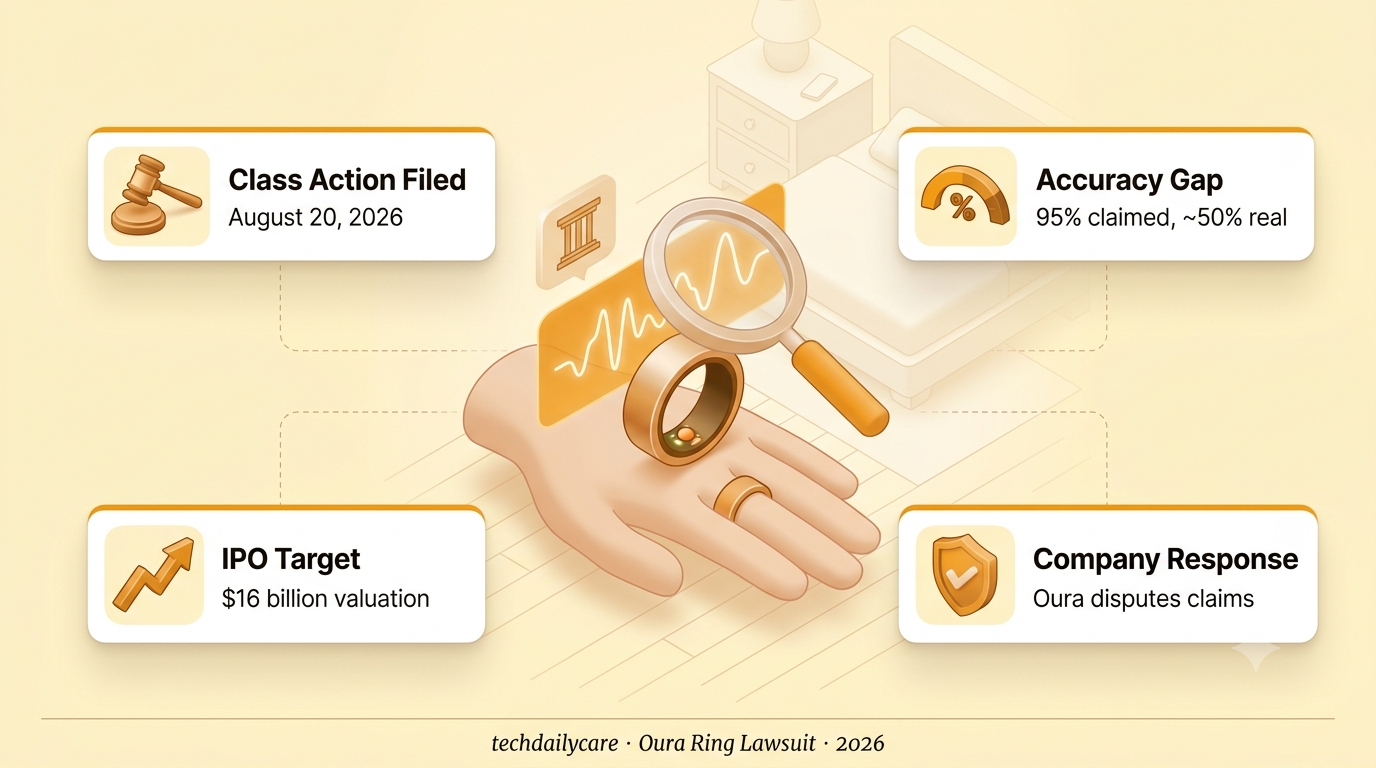
The Oura lawsuit landed at the worst possible moment for the smart ring maker. On August 20, 2026, the Clarkson Law Firm filed a proposed class action in the U.S. District Court for the Northern District of California, accusing Oura of overstating how accurately its ring tracks sleep stages. The plaintiff, California resident Madison Surber, says she paid $513.68 for an Oura Ring 4 Gold in 2025 after seeing marketing that promised “unparalleled accuracy.”
Here’s the problem the complaint raises: identifying sleep stages, like deep sleep, REM, and light sleep, normally requires clinical polysomnography, the electrodes-on-the-scalp, sensors-on-the-eyes setup used in sleep labs. Oura’s ring only reads heart rate, skin temperature, and movement, then runs those signals through an AI model to estimate what stage you’re likely in. The lawsuit calls that estimate no better than a coin flip.
Oura disputes all of it. A company spokesperson told TechCrunch that the ring “is not a medical device or a substitute for a clinical sleep study,” and pointed to independent studies it says validate its sleep-staging approach. But the timing is brutal: Oura confidentially filed for an IPO in May, and reports this week put the target valuation at $16 billion, nearly triple where the company sat less than two years ago.
What the lawsuit alleges
Oura marketed “95% Sleep Staging Accuracy compared to clinical sleep lab,” but the complaint says the ring lacks the hardware to measure real sleep stages.
Surber v. Oura Health
Filed by Clarkson Law Firm on behalf of California resident Madison Surber, seeking class-action status and restitution for purchasers.
Oura pushes back
Oura says multiple third-party studies support its accuracy claims and that the ring was never marketed as a medical device.
A $16B IPO on deck
The Oura lawsuit surfaces just as the company targets a September IPO that could value it at $16 billion, up from $11B last October.
The Marketing Claim at the Center of It
The ClaimOura has advertised its sleep-stage tracking with figures as high as 95% accuracy compared to clinical sleep labs, after an earlier “79%” figure. The complaint argues those numbers can’t be reconciled with what the ring physically measures. Sleep-stage scoring in a real lab relies on brain-wave and eye-movement sensors that a finger-worn ring simply doesn’t have.
How the Ring Actually Works
Under the HoodEvery Oura Ring, including the Ring 4, tracks three raw signals: heart rate, skin temperature, and motion. Those signals feed an AI model that outputs a sleep score and a stage-by-stage breakdown. The lawsuit’s core argument is that this is fundamentally an estimate, not a measurement, and that Oura’s marketing blurred that line for years while users trusted the numbers for real health decisions.
Oura’s Rebuttal
Company ResponseOura isn’t staying quiet. The company told TechCrunch it plans to defend itself “in the appropriate legal forum,” and maintains that its sleep staging has been validated and compared favorably in multiple studies against polysomnography, the clinical gold standard. Oura also stresses the ring was never sold as a medical device or a diagnostic tool.
The IPO Timing Problem
Big MoneyOura filed confidentially for an IPO back in May and is reportedly eyeing a September 2026 listing that could raise up to $3 billion at a valuation north of $16 billion. Any company heading toward Wall Street has to disclose material litigation risk in its prospectus, and a class action questioning the accuracy of its flagship feature is exactly the kind of disclosure that can spook underwriters and investors alike.
Sleep happens in the brain,
not on one’s finger.
⚠️ If You Own an Oura Ring, Here’s the Reality Check
1. Nothing changes today. This is a proposed class action, not a ruling. No recall, refund program, or feature change has been announced.
2. Don’t treat the sleep score as medicine. Even Oura agrees the ring isn’t a diagnostic device, so major health decisions still belong with a doctor and, if needed, an actual sleep study.
3. Trends still matter more than single numbers. Whatever the ring’s precision on any given night, most users get real value from tracking consistency over weeks, not chasing an exact accuracy percentage.