
SaaSpocalypse Is Real, Sanofi Just Ripped 80% of ServiceNow Out
French drugmaker built its own platform with Cursor and Claude Code. Gartner says $234B of enterprise SaaS is next.
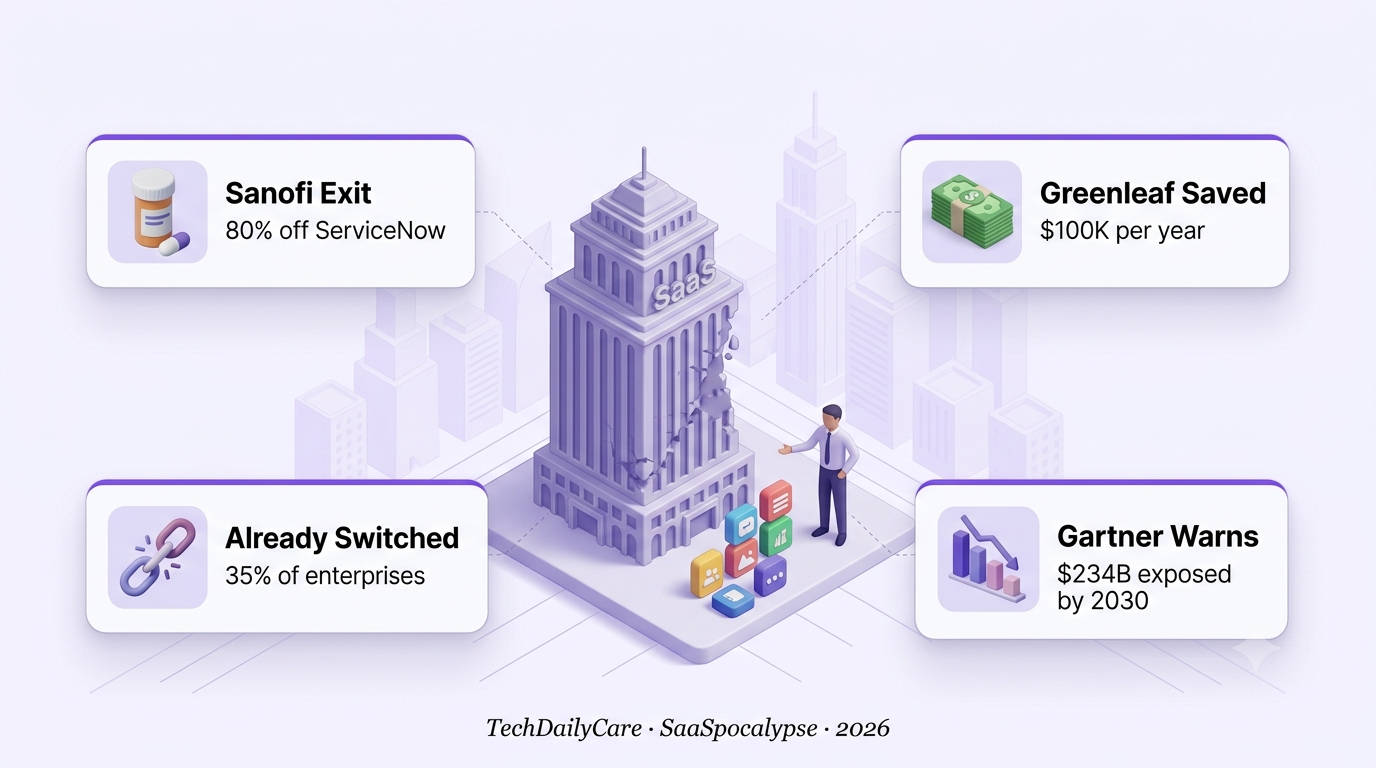
SaaSpocalypse used to be a joke. Not anymore. Sanofi, the French pharmaceutical giant, is aiming to pull 80% of its workloads off ServiceNow and other software apps into a custom in-house platform it calls Concierge, built with Cursor and Claude Code. The Information reported the move is worth at least tens of millions of dollars annually. It is the first time a Fortune 500 has publicly committed to that scale of teardown, and the ripple has already reached the analyst desks that track enterprise software spending.
The numbers around this shift are getting harder to ignore. Gartner said in a July 1 press release that $234 billion of enterprise application software spending is exposed to agentic arbitrage by 2030. That is roughly 20% of the entire enterprise SaaS market. Retool ran the survey side of the same question and found 35% of enterprises have already replaced at least one SaaS tool with a custom build, with 78% planning to build more this year. Roughly $300 billion in software valuations was wiped out earlier in 2026 as public investors priced in the possibility that the shift becomes structural.
SMBs are moving even faster than the enterprise segment. Greenleaf Management, an Atlanta real estate firm with 55 employees, replaced Salesforce with a custom app built on Replit and Claude Code that costs $300 per month to maintain, saving roughly $100,000 a year. Startup Atonom cut its SaaS bill from $40,000 to $1,200 after realizing it was paying for enterprise plans meant for teams five times its size. These are not isolated stories any more — they are the emerging playbook for firms that were previously locked in by contract length and switching costs.
At the same time, incumbent SaaS is not rolling over. ServiceNow reported a 97% renewal rate in Q1 2026 and Salesforce customers are still expanding footprint rather than fleeing. The market is bifurcating into what agents can plausibly replace and what they cannot. Here is what this SaaSpocalypse actually looks like on the ground, which vendor categories are most exposed, why the SMB economics work first, and why the incumbents still have a fight left in them.
Why is this happening now?
Cursor and Claude Code made custom app development cheap enough to compete on total cost of ownership. What used to require a six-figure dev team and six-month timeline now takes weeks with one engineer and an AI coding assistant.
Who is most exposed?
Sales automation, CRM, service desk, and any per-seat SaaS priced above real usage per user. Gartner flags 20% of enterprise application spend as target zone. Salesforce, ServiceNow, and workflow-heavy verticals top the list.
Are Fortune 500 actually switching?
Sanofi is the exception, not the rule so far. Most enterprises keep Salesforce or ServiceNow as system of record and build AI agents on top rather than tearing out the platform. The teardown is happening at SMB scale first.
Who benefits from the shift?
Anthropic, OpenAI, Replit, and Cursor collect token revenue from every build. Infrastructure SaaS (Snowflake, Databricks) still commands premium multiples because AI needs a data layer to run on. Meta is entering cloud to capture the compute side.
Sanofi’s Concierge, The 80% Cut
EnterpriseSanofi’s Concierge project is the loudest signal yet that SaaSpocalypse can move up-market. The French drugmaker is aiming to migrate 80% of its workloads out of ServiceNow and other software applications into an internally built platform, per reporting from The Information’s TITV on July 6. The build stack: Cursor for the coding environment and Claude Code for agent-assisted engineering, both stitched together by an in-house team rather than an outside integrator.
The reported savings sit at tens of millions of dollars annually. That figure alone would land inside the top-25 largest ServiceNow account losses if it plays out at full scope. What is unusual here is scale: Sanofi is not swapping one tool, it is trying to consolidate an entire tier of vendor spend into one owned surface. Most Fortune 500 firms take on custom builds around the edges, not the core.
The reason this matters beyond Sanofi is the demonstration effect. If a regulated, compliance-heavy pharma company can migrate a critical workflow platform to a homegrown alternative, the safety argument that has historically protected incumbent SaaS starts to weaken. Pharma has GxP validation, audit trails, and change-control frameworks that make ServiceNow-tier tools sticky by default. Concierge is a test of whether those requirements can be met by AI-assisted builds.
Greenleaf, $300/Month Replaces Salesforce
SMB ProofGreenleaf Management, an Atlanta real estate investment manager with about 55 employees, told The Information it built a custom app using Replit and Claude Code that fully replaces Salesforce. Maintenance cost: $300 per month. Total annual savings: roughly $100,000. The custom build also let Greenleaf exit its contracts with real estate software vendors Entrata and Yardi, compounding the savings across three vendor lines rather than one.
Greenleaf partner Dave Codrea confirmed the switch publicly. This is the archetype of the SaaSpocalypse SMB case: a firm too small to justify enterprise-tier pricing, but too specialized in workflow to fit into the mid-market SaaS boxes designed for generic customer relationship management. AI coding tools collapsed the build-versus-buy math in exactly that segment, where the vendor was charging for feature breadth the customer never used.
The 55-person team size matters here. At that scale, a custom internal app has one or two engineers who understand the whole codebase, workflows are still simple enough to hold in one head, and change-request cycles are short. That is the profile where custom wins on TCO, not just sticker price. Above roughly 200 employees the coordination overhead starts to eat the savings.
Atonom, From $40K to $1,200
97% CutStartup Atonom cut SaaS spend from $40,000 per year to $1,200 after realizing it was paying for enterprise plans meant for much larger teams, according to EMARKETER’s July 8 briefing. That is a 97% reduction in one line-item category. The primary driver: replacing overbuilt vendor tools with AI-built internal alternatives that fit the actual team size rather than the vendor’s target buyer profile.
Atonom is the second archetype. Not a Fortune 500 rip-out, not even a mid-market swap, but a startup catching itself before it locks into vendor economics that assume a company shape it does not have. The saved cash freed up runway equivalent to one senior engineer for the year, which for a pre-scale startup is a meaningful capital reallocation from vendor payments to product headcount.
The Atonom pattern shows up in a wider EMARKETER read: small businesses are using AI coding tools to negotiate down from enterprise-tier plans they never should have signed. Even when they do not fully replace the vendor, running a parallel custom prototype gives them leverage in the renewal conversation that they did not have before, which changes the pricing power dynamic across the entire SMB segment.
Gartner’s $234B Warning
Market ViewGartner made the number official on July 1. In a press release, managing VP George Brocklehurst said agentic AI changes the economics of software. The exposure figure: $234 billion of enterprise application software spend is at risk from agentic arbitrage by 2030 — roughly 20% of the total enterprise SaaS market. That is not a prediction that 20% of vendors will fail, it is a prediction that 20% of current revenue is contestable in ways it was not before.
Retool’s parallel research adds the demand-side view. 35% of enterprises have already replaced at least one SaaS tool with a custom-built alternative. 78% plan to build more within the year. Neither figure means SaaS is dying — but both mean the market is being sliced into what agents can replace and what they cannot, and vendors that sit on the wrong side of that line face revenue pressure regardless of product quality.
The July 12 Matterfact podcast recap put it more sharply. Nearly every SaaS-focused show that week circled the same question: if AI can do the work, who still pays for the software? The answer emerging from investor conversations is not a binary — vendors that reprice fast enough to consumption or outcome models keep the customer. Vendors that hold the line on per-seat pricing find themselves outnegotiated on renewal.
Why the SaaSpocalypse Has Limits
Counter-ViewThe other side of this story is that incumbent SaaS is not collapsing. ServiceNow reported a 97% renewal rate in Q1 2026 per GuruFocus, with customers expanding footprint rather than leaving. Salesforce President Srini Tallapragada told investors that companies “all try to do the do-it-yourself” and then realize the reliability gap. His warning was blunt about vibe-coded replacements: they demo well, they fail in production audit.
The structural moat is real. Enterprise SaaS platforms are built for compliance, security, and integration with dozens of other systems that custom-built tools typically lack. What makes it hard to move off Salesforce is not the features — it is the customized workflows companies keep layering on top for years, the compliance mappings that took quarters to certify, and the SSO wiring that pulls in every other tool in the stack.
Amadeus Capital Partners’ Dame Anne Glover called the SaaSpocalypse narrative “an overreaction” on the Private Equity Spotlight podcast on July 8, arguing AI mainly makes SaaS companies more efficient at building great products. Geoff McQueen on Spark of Ages put it more bluntly: vibe-coded demos lack the security, governance, and enterprise-grade rigor that real products need, and most people simply do not want to build their own software when a working one exists.
How Vendors Are Fighting Back
RepricingThe vendor response to SaaSpocalypse has already started, and it looks less like desperation and more like a pricing overhaul. GitHub shifted its Copilot premium tier away from a flat monthly price on June 1, moving to token-usage billing across input, output, and cached tokens. Zendesk and Workday rolled out pricing structure changes tied to AI features. The direction is consistent across the incumbents: less per-seat, more per-consumption.
Meta joined the infrastructure side of the fight in early July. Per The Rundown on July 11, Meta is reportedly entering cloud computing to rent out excess AI capacity, competing directly with CoreWeave and Nebius and undercutting labs on model prices. That is the tell that the software repricing wave has an infrastructure echo — cheaper compute means cheaper custom builds, which pushes application SaaS to reprice further.
ChatGPT Work, launched by OpenAI on July 9, is itself a vendor-side answer to SaaSpocalypse. Instead of watching enterprises replace SaaS with custom apps, OpenAI is building the agent surface that generates the finished documents, spreadsheets, and web apps directly. The bet is that if the AI does the work, the enterprise pays OpenAI rather than either a SaaS vendor or an internal dev team. The winning vendor position is not to be replaced, it is to be the platform doing the replacing.
Replacing SaaS platforms pulls engineering attention
away from things that actually differentiate the business.
- Sales automation and CRM — Gen AI threatens to replace workflow-heavy tools like Salesforce Service Cloud rather than just augment them. Highest exposure per Gartner because agents can absorb the seat-count workload directly, collapsing the pricing model.
- Service desk and ITSM — Sanofi’s Concierge attack path. ServiceNow-tier products with heavy workflow customization sit in the target zone because much of what they do is orchestration that agents can replicate at lower cost.
- Marketing and content ops — Per-seat pricing collapses when one agent replaces a five-seat team. HubSpot-tier tools face repricing pressure as customer teams shrink but throughput does not.
- Vertical SaaS with weak moats — Real estate tools (Entrata, Yardi already lost Greenleaf), niche field-service platforms, and industry-specific CRMs are Greenleaf-style teardown candidates when the buyer team is small enough.
- Contact center software — Zendesk-tier tools where AI agents can handle tier-1 tickets directly. Vendor pricing already shifting to reflect agent-handled volume rather than seat count.
- Not exposed: Data infrastructure (Snowflake, Databricks), DevOps tooling, cloud infrastructure. AI needs these to run — they benefit from the buildout rather than get replaced by it.
⚠️ Four SaaSpocalypse Traps
1. Vibe-coded fragility. Salesforce’s Tallapragada was right about one thing: apps built in a weekend without security review and governance controls will fail enterprise audit. Custom does not equal reliable, and reliability failures at enterprise scale cost more than the SaaS bill they replaced.
2. Maintenance cliff. The $300/month Greenleaf figure is the maintenance cost, not the total cost of ownership. When the engineer who built it leaves, the app becomes a liability rather than an asset. Vendor SaaS keeps working even after the person who signed the contract quits.
3. Token bill roulette. AI coding tools charge per token. Uber reportedly burned through its entire 2026 AI coding budget in four months. Tesla capped employee AI tool spend at $200 per week. A UBS survey found 60% of enterprises are throttling AI budgets. Your replacement math has to include inference cost, not just subscription savings.
4. Compliance blind spots. SOC 2, ISO 27001, HIPAA, and GDPR compliance in SaaS platforms took years and dedicated audit teams to build. Custom-built replacements inherit none of that certification. Regulated industries face the largest gap between the demo and the audit.
You can’t vibe code your way
to enterprise reliability and security.