
The Million-Dollar Question: Why Are 73% of AI Projects Failing (And How to Beat the Odds)?
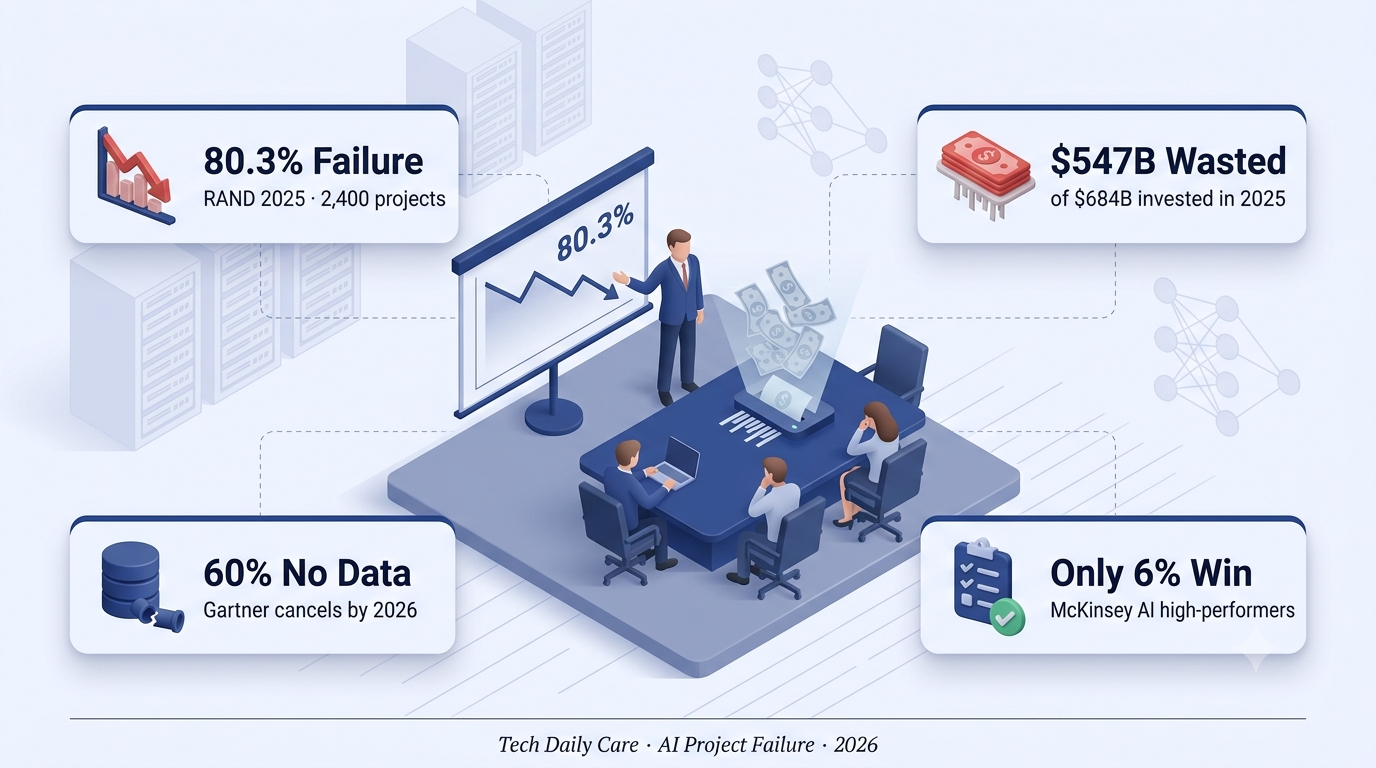
RAND says 80.3%. MIT NANDA says 95%. Gartner says 60%. The failure numbers depend on how you count, but the money is the same: $547 billion of $684 billion invested in 2025 went nowhere.
The number keeps changing. RAND says 80.3%. MIT NANDA says 95%. McKinsey says 73%. Gartner says 60%. Every big consulting firm has published a different AI project failure rate in the past 18 months, and every one of them is technically correct — they’re measuring different things. RAND counts projects that failed to reach production. MIT counts GenAI pilots that produced zero measurable P&L impact. McKinsey counts projects that started without any agreed definition of success.
What isn’t in dispute is the money. In 2025, enterprises globally invested $684 billion in AI initiatives. By year-end, RAND’s tracking of 2,400+ projects concluded that more than $547 billion of that produced no measurable results. Not disappointing results. None. And the share of companies abandoning most of their AI initiatives jumped from 17% in 2024 to 42% in 2025, according to S&P Global Market Intelligence.
The reflex is to blame the technology. The models aren’t sophisticated enough. The vendors oversold capabilities. The economics don’t work. But the evidence tells a completely different story. Across every major study, AI project failure traces back to a small number of structural causes — most of them upstream of the model. This piece breaks down where the $547 billion actually went, why the same failure patterns keep repeating, and what the 6% of high-performing companies are doing differently.
Data Foundations Missing — Top AI Project Failure Driver
Gartner: 60% of AI projects will be cancelled through 2026 due to inadequate AI-ready data. The model was never the bottleneck. Data pipelines, quality gates, and governance were.
No Success Definition
McKinsey: 73% of failed AI projects had no agreed definition of success before the project started. Projects ship. No one checks whether it worked. Then they get quietly killed.
Leadership, Not Tech
VentureBeat/RAND: 84% of AI failures trace to leadership and process, not technology. 68% underinvest in foundations. 56% lose C-suite sponsorship within 6 months.
What Winners Do Differently
McKinsey: Only 6% of organizations are AI high performers with meaningful financial returns. They define success metrics upfront and work backward from production, not the model.
The Five Reasons AI Project Failure Actually Happens
Wrong Problem — The AI Solution Chasing a Problem
StrategyMost enterprise AI project failure starts before a single line of code is written. Leadership decides “we need an AI initiative” because competitors have one, then hunts for a problem to attach it to. The result is a technology-first project that answers a question nobody at the company was actually asking. A model that predicts customer churn perfectly is worthless if nobody in the org acts on churn predictions.
Deloitte and McKinsey both find that the highest-performing AI initiatives start with a specific business bottleneck — a decision that gets made too slowly, a process that costs too much, a customer signal that gets ignored — and work backward. The AI is the tool, not the objective.
Data Foundation Wasn’t Ready
#1 KillerGartner projects that 60% of AI initiatives will be abandoned through 2026 due to inadequate AI-ready data. That number is not a technology limitation — it’s an infrastructure debt problem. The data exists somewhere in the company. It’s just siloed, undocumented, ungoverned, and full of quality issues nobody wanted to address until the AI team showed up.
Building the model without first building the data pipeline is the enterprise equivalent of buying a Formula 1 car and running it on gravel. Companies that succeed with AI invariably spent the first 6–12 months on data infrastructure, not model training. The famous 80% figure — that AI teams spend 80% of their time on data — is often quoted as a complaint. The winners quote it as the plan.
No Success Definition Before Build
#2 KillerAccording to McKinsey’s 2025 study, 73% of failed AI projects had no agreed definition of success before the project started. Meanwhile, projects with quantified metrics defined upfront achieve a 54% success rate. Projects without: 12%. The difference between success and failure is not the algorithm — it’s whether anyone wrote down what “success” means before the money got spent.
This isn’t just a documentation problem. Without a success definition, the project ships, no one checks whether it worked, and the initiative disappears into the “we tried AI once” category on the CIO’s slide deck. That’s how RAND ends up with 33.8% of projects abandoned outright and another 28.4% shipped but delivering zero value.
Executive Sponsorship Evaporated
#3 KillerVentureBeat’s synthesis of failure research found that 56% of failed AI initiatives lost their C-suite sponsor within six months of launch. AI projects have long timelines — sometimes 12 to 24 months from concept to measurable value. Executive attention has a much shorter half-life. When the original sponsor leaves, gets reorganized, or moves on to a shinier initiative, the project loses air cover and dies of political neglect.
The pattern is so consistent that RAND explicitly flags it as one of the top three failure modes, alongside data and problem definition. This is why McKinsey’s high-performer research finds that CEO-level ownership of AI initiatives correlates more strongly with success than any technology decision.
Production Infrastructure Was an Afterthought
Silent KillerMachine learning models trained in Jupyter notebooks are not products. They’re demos. Getting a model from demo to production requires a full MLOps stack — CI/CD for models, feature stores, monitoring for drift, versioning for data and models, retraining pipelines, and integration with the actual business systems that will consume the predictions. Companies that treat this as “we’ll figure it out after the model works” account for a significant chunk of the 48% of projects that Gartner says never make it out of prototype.
Modern MLOps tooling — MLflow, Kubeflow, Weights & Biases, Vertex AI, SageMaker — has matured enough that this is a solved problem in principle. In practice, most enterprises still discover the production gap only after the model is done, at which point the timeline doubles and the budget doesn’t.
80.3% of enterprise AI projects fail to deliver their intended business value. Twice the failure rate of conventional software.
Which Industries Are Losing the Most on AI Project Failure
How the 6% of Winners Beat AI Project Failure
They Define Success Before Build, Not After Ship
54% vs 12%The single strongest predictor of AI project success in McKinsey’s data is a written, quantified success definition agreed by business and technical leadership before any development begins. Projects with this achieve a 54% success rate. Projects without it: 12%. That’s a 4.5x difference driven by one document.
They Fix Data Infrastructure Before Models
Foundation FirstEvery study consistently identifies data readiness as the #1 differentiator. Gartner defines AI-ready data as data aligned to specific use cases, actively governed at the asset level, supported by automated pipelines with quality gates, managed through live metadata, and continuously quality-assured. Most enterprises have none of those things when they start their first AI project. The 6% are the ones who spent 6–12 months building that foundation first.
They Start Narrow and Scale After Proof
Crawl-Walk-RunAmazon didn’t launch AI with Alexa. It launched with book recommendations in 2003, then expanded outward from there. Anthropic and OpenAI didn’t launch with agentic systems. They launched with narrow-focused chat interfaces. The winners start with a single, measurable, narrow problem where success is provable in 90 days, then scale. The failure mode is starting with “AI transformation” as the scope.
They Invest in MLOps From Day One
Production-ReadyCompanies using mature MLOps practices are demonstrably more likely to move models from prototype to production. The stack has matured: MLflow for experiment tracking and model registry, Kubeflow for orchestration, Weights & Biases for experiment management, Vertex AI or SageMaker for managed pipelines. The high performers built this in from the start rather than bolting it on after the model was done.
They Build for Continuous Retraining, Not One-Shot Deployment
Living SystemModels degrade. Data patterns shift. A recommendation model trained on 2024 data will not perform well on 2026 users. The high-performing AI teams treat models as living systems that require monitoring for accuracy drift, automated retraining pipelines, and human review of performance over time. Set up alerts for when model accuracy drops below thresholds. Have a plan for what happens when it does.
The failure is almost never the model. It is data readiness, workflow integration, and the absence of a defined outcome before build starts.
- Written success definition — a quantified business metric, agreed by both business and technical leadership, before any code is written.
- Data readiness audit — documented data lineage for every field the model will use, plus quality gates and governance in place.
- 90-day first milestone — a measurable win achievable within one calendar quarter, not a 24-month “AI transformation.”
- Named production engineering lead — someone who owns the path from Jupyter notebook to running system in production.
- Executive sponsor with P&L ownership — not IT infrastructure. Someone whose numbers are directly affected by whether this works.
- MLOps stack selected — MLflow, Kubeflow, or equivalent, before the first model is trained. Not after.
- Monitoring and retraining plan — before launch, not “we’ll figure that out later.”
⚠️ Red Flags That Predict AI Project Failure
1. “Leverage AI to…” as the project charter opener — technology-first framing, no defined business problem.
2. No P&L owner in the sponsor group — if only IT is on the sponsor list, the project has no path to real business validation.
3. Timeline in years, not quarters — 18+ month projects lose executive sponsorship at a 56% rate before they can ship.
4. Success measured in model accuracy — accuracy is a means, not an end. Business impact is what actually matters.
5. Production is “next quarter’s problem” — if MLOps isn’t scoped from day one, plan for the timeline to double.