
Moonshot Kimi K3 Accused of Stealing Anthropic, White House Says
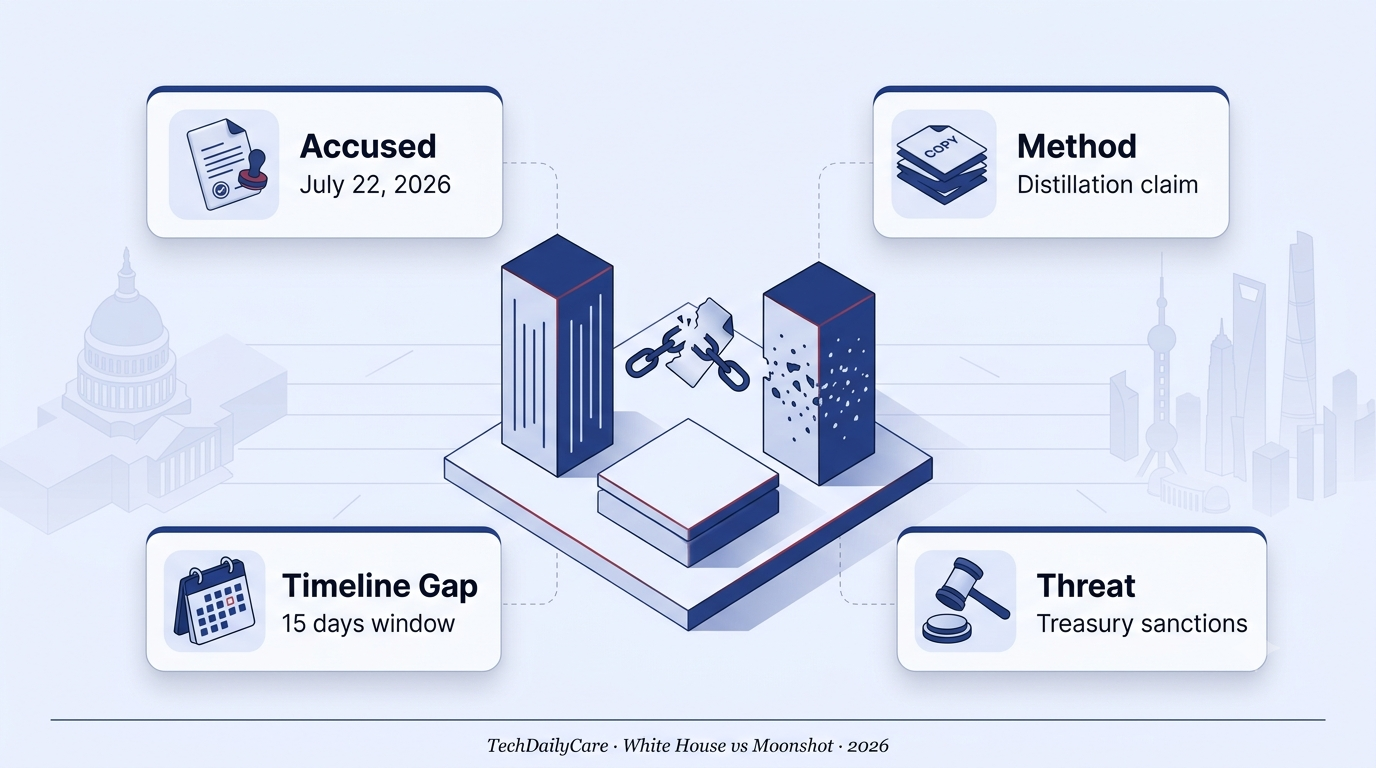
OSTP Director Kratsios called it “large-scale, covert industrial distillation.” Treasury threatened sanctions. Researchers noticed the window is 15 days. Here’s exactly what the Moonshot Kimi K3 accusation covers and where the evidence sits.
The accusation arrived before the evidence. On Wednesday, July 22, Michael Kratsios — Director of the White House Office of Science and Technology Policy and the Trump administration’s top AI adviser — posted on X that Beijing-based Moonshot AI had “distilled Anthropic’s Fable” model to build its new Kimi K3 system. In the same post, Kratsios alleged that Moonshot developed “a sophisticated internal platform to conduct large-scale distillation against U.S. models, allowing them to quickly switch between multiple methods of access to avoid detection,” and separately claimed the company had accessed Nvidia GB300 systems through Thailand. Treasury Secretary Scott Bessent, speaking on Fox Business the day before, said the administration could sanction Chinese AI models found to have been built through IP theft. That is the Moonshot Kimi K3 accusation, laid out in full.
The technical response was immediate and skeptical. Elie Bakouch, a researcher at Prime Intellect, posted the timing objection everyone else then rallied around: “There are only 15 days between fable 5 ban removal and kimi K3 release. I don’t think claiming that K3’s performance comes from fable distillation (even if they did it) makes sense technically.” Dean Ball, OpenAI’s head of strategic futures, said publicly he did not believe K3’s performance could be “explained away by distillation or anything like that.” Braden Hancock — Laude Institute researcher and co-founder of Snorkel AI — told TechCrunch that training a model as strong as K3 on Fable 5 outputs in that window would be “almost impossible.” Even a Moonshot employee, Randy Xian, replied on X: “Yes, Fable went public on July 1 and K3 launched on July 15. We trained a brand new frontier model in JUST 15 DAYS. Guinness World Record stuff.”
Then the story got harder to dismiss. Ryan Greenblatt, Chief Scientist at Redwood Research, ran a cross-entropy comparison of raw text responses across models using data from a benchmark he already operates. His finding, posted this week: Kimi K3 identifies as “Claude” disproportionately often when asked about its identity, and sometimes as “Claude 4.5” specifically — a behavior no actual Claude model exhibits. That is not proof of Fable 5 distillation. It is statistical evidence of Claude-family behavior baked into K3 somewhere, from some source, at some volume. The Moonshot Kimi K3 claim, in other words, may be wrong about which model and which timeline, and right about the underlying pattern. Both things can be true.
Moonshot Kimi K3 post · July 22
OSTP Director publicly alleged large-scale industrial distillation of Anthropic Fable 5. Post claimed Moonshot ran a “sophisticated internal platform” to evade detection. No public evidence attached.
Bessent · sanctions on the table
Treasury Secretary Scott Bessent said on Fox Business the administration could sanction Chinese AI models built through IP theft, and add firms to the Entity List. No formal proceedings announced.
Researchers: timeline impossible
Bakouch (Prime Intellect), Ball (OpenAI), Hancock (Laude), Lambert (AI2) all publicly questioned the 15-day distillation window. Ryan Greenblatt (Redwood) posted statistical evidence pointing at Claude family exposure regardless.
K3 open weights · July 27
Moonshot is scheduled to release Kimi K3 model weights and technical report on July 27. Once weights are public, no export control or sanction can reach them. That is what makes this policy timing so acute.
Exactly what the Moonshot Kimi K3 accusation covered
Kratsios’s post, word for word
StatementMichael Kratsios’s July 22 X post is the primary document driving the entire dispute. The full statement contains three specific claims. First: “We have information that Moonshot AI distilled Anthropic’s Fable for the development of its K3 model.” Second: Moonshot ran “a sophisticated internal platform to conduct large-scale distillation against U.S. models, allowing them to quickly switch between multiple methods of access to avoid detection.” Third, added separately, that Moonshot has acquired servers equipped with Nvidia’s GB300 system and has accessed similar systems in Thailand — a specific allegation about export control evasion tied to the same investigation.
Kratsios drew an explicit distinction that matters for what comes next. “Legitimate AI distillation used to create smaller, more efficient models plays a vital role in this open innovation ecosystem,” he wrote. “However, large-scale, covert industrial distillation aimed at stealing proprietary U.S. technology and undermining American research is unacceptable.” That framing sets up the policy path. The White House is not trying to outlaw distillation as a technique — it is used constantly by frontier labs to compress models. The White House is trying to establish that unauthorized bulk querying of a frontier lab’s models to train a competitor is IP theft, and therefore actionable under existing trade authorities. This is where Bessent’s sanctions threat plugs in.
The Anthropic backstory that made this possible
ContextThe Moonshot Kimi K3 accusation did not come from nowhere. In February 2026, Anthropic itself publicly claimed that Chinese firms — specifically naming Moonshot AI, DeepSeek, and MiniMax — had systematically queried its models using IP addresses and metadata patterns Anthropic said were “distinct from normal usage.” Anthropic asked the US government to act. Kratsios’s July 22 post is, in a real sense, the government finally acting on that February request, framed around a specific new event (K3’s release) rather than the general pattern Anthropic had flagged five months earlier.
The Fable 5 timeline complicates the case. Anthropic launched Fable 5 on June 9, 2026. Under new US export controls, Anthropic was forced to disable Fable 5 and Mythos 5 globally in mid-June. Anthropic re-released both on July 1 after export controls were adjusted. Kimi K3 launched roughly fifteen days later. Anthropic’s February complaint concerned Claude access generally, not Fable 5 specifically — Fable 5 did not exist yet in February. The February evidence supports a history of alleged extraction behavior; it does not retroactively prove that Fable 5 outputs, specifically, trained K3. That distinction is doing more work in this story than most coverage acknowledges.
Why the 15-day window is the whole argument
TimelineThe technical objection every serious researcher raised in the 48 hours after Kratsios’s post lands on one number: fifteen days. A 2.8-trillion-parameter mixture-of-experts model is not built by scraping a few weeks of chatbot answers. It requires an enormous pretraining run, complex data pipelines, MoE routing experiments, failure recovery, evaluation infrastructure, and reinforcement learning post-training runs. That work does not compress into two weeks between an API becoming available and a competitor model shipping. Moonshot’s Attention Residuals research was already public in March. Moonshot has said an early K3 checkpoint was doing kernel-optimization work during late development, suggesting the model was already deep into training long before Fable 5’s July 1 re-release.
Nathan Lambert, an AI researcher at the Allen Institute for AI, put the technical case bluntly on a recent podcast: replicating Fable-level capabilities would likely require reinforcement learning at scale, “potentially tens of millions of agents grading model responses.” Running that through a frontier lab’s API would be “insanely expensive” and time-bottlenecked. Supervised fine-tuning — the simpler form of distillation — is what mainstream discourse envisions when it hears “distillation,” but Lambert notes its benefits are diminishing as models grow more complex. If Moonshot did anything to K3 with Fable 5 outputs in the 15-day window, it was targeted post-training on specific behaviors, not the base capability that made K3 competitive in the first place.
The accusation may be wrong about
which model and which timeline
and right about the pattern.
The Greenblatt data that makes the Moonshot Kimi K3 case harder
K3 identifies as Claude, in statistically significant volume
DataThree days before Kratsios’s post, Ryan Greenblatt — Chief Scientist at Redwood Research — published a cross-entropy comparison of raw text responses from numerous frontier models on X. His methodology used data from a benchmark suite he already runs, with statistical analysis assisted by Fable itself. The finding: Kimi K3 identifies itself as “Claude” disproportionately often when prompted about its identity. Sometimes K3 identifies specifically as “Claude 4.5,” a naming pattern actual Claude models do not exhibit. The distribution is statistically significant. Random noise does not explain it. The full analysis is published on Typebulb.
What Greenblatt’s data does not do: prove Fable 5 distillation, prove a training-data source, or prove any specific IP theft mechanism. What it does do: establish that K3 has Claude-family behavior baked in at some depth, from some training exposure to Claude outputs, at some volume large enough to leave statistical fingerprints. This is exactly the kind of pattern the February Anthropic complaint predicted. It is not exactly the pattern the July 22 White House post described. The intellectually honest read — which is neither the White House’s nor the Chinese state media’s — is that Greenblatt’s evidence supports investigating the underlying allegation while making the specific Fable 5 claim harder to defend on its own terms.
What Moonshot has said and not said
ResponseMoonshot’s public response has been calibrated. The company had not directly addressed the White House accusation on the record by July 24 morning. Employee Randy Xian’s sarcastic X reply — “We trained a brand new frontier model in JUST 15 DAYS. Guinness World Record stuff” — represents the informal Moonshot position: mocking the timeline as physically implausible without directly denying any specific distillation activity. The formal response is likely to arrive alongside the July 27 open-weights release, which will include Moonshot’s own technical report explaining K3’s architecture and training pipeline. That report is the document that will either substantiate or contradict Moonshot’s implicit denial.
Kimi K3’s open-weight release date matters enormously for the policy question. Once model weights are published to a public repository, they cannot be recalled. Any US export control, entity-list addition, or sanctions ruling arriving after July 27 addresses future Moonshot behavior — not the existing model. Every enterprise, developer, and researcher globally will have permanent access to K3’s parameters from Sunday onward, and can run them on any hardware anywhere. This is why the timing of Kratsios’s accusation matters: the administration had exactly five days to establish a policy position on K3 before the model itself moved beyond policy reach.
⚠️ What the Moonshot Kimi K3 claim has not shown
1. No public evidence for the specific July 22 allegation. Kratsios’s X post did not provide data, methodology, forensic analysis, or documentation for how the US government determined Fable 5 outputs entered K3 training. The post asserts information; it does not publish it.
2. The Nvidia GB300 Thailand claim is separate and unrelated. The allegation that Moonshot accessed banned Nvidia hardware through Thailand is a distinct investigation from the distillation claim. Bundling them into a single accusation X post makes the case rhetorically stronger but conflates two different enforcement questions.
3. Anthropic has not publicly commented on the July 22 post. The company that would be most directly affected by proven Fable 5 distillation — and whose February 2026 evidence provides the foundation for the accusation — did not issue a public statement supporting or opposing Kratsios’s framing.
4. No enforcement action has been announced. Bessent’s sanctions threat and Kratsios’s accusation are political statements. No Entity List addition, no formal Treasury investigation, no export-control ruling has been publicly documented targeting Moonshot as of July 24 morning.
Why the Moonshot Kimi K3 fight matters beyond one model
Open weights are the structural problem
PolicyThe Moonshot Kimi K3 dispute is a proxy for a policy question the US does not have a good answer to: what do you do about open-weight frontier models released by adversary jurisdictions? Once Kimi K3’s parameters ship on July 27, the model can be downloaded by any developer anywhere, run on any hardware, and modified freely. No API restriction reaches it. No firewall stops the download. No export control applies to a file already outside US customs jurisdiction. Anthropic and OpenAI keep their frontier models behind APIs precisely so US law can meaningfully govern access. Moonshot’s decision to publish weights is a decision to remove the model from the reach of any single government.
US export controls on Anthropic Fable 5 and Mythos 5 in June — the same controls that forced the mid-June global disable — were supposed to constrain Chinese access to frontier US AI. The observed result was different. Demand shifted toward Chinese open-source alternatives, benefiting Moonshot, DeepSeek, and MiniMax in the exact 30-day window when Fable 5 was inaccessible. Every enterprise buyer who could not access Claude in June had a strong incentive to evaluate a Chinese open-weight alternative that would still be available in July. Export controls did not slow Chinese AI. They accelerated Chinese open-source adoption in Western enterprise stacks by removing the competition.
The industry is quietly converging on provenance
StandardsThe most interesting industry response to the Moonshot Kimi K3 dispute is not on Twitter. It is happening inside frontier labs. OpenAI, Anthropic, and Google began sharing intelligence earlier in 2026 to detect coordinated distillation attempts against their models — cross-referencing rate limiting patterns, query fingerprints, and unusual usage clusters that individual labs would miss. Terms of service across all three companies now explicitly prohibit training competing models on outputs. Query pattern detection has tightened significantly across the industry. None of that stops distillation. But it makes bulk extraction harder to conduct without leaving forensic traces, which is what makes future accusations more evidentially defensible than the current one.
The deeper answer that experts keep pointing at is technical provenance: cryptographic watermarking of model outputs that survives fine-tuning and pretraining. Google DeepMind’s SynthID and Anthropic’s constitutional AI framework both include watermarking research components. Neither is deployed at the scale that would make bulk distillation detectable after the fact. If provenance standards existed, Kratsios could have posted forensic evidence rather than an accusation. Because they do not, the current dispute reduces to statistical fingerprints (Greenblatt’s Claude-identification data), timeline arguments, and political will. This is the industry’s next multi-year engineering problem, and it is much harder than any single lab wants to admit.