
AI Just Broke the Internet Again, 5 Shakeups That Moved Real Markets
How AI broke the internet in 2026: Musk’s $150B trial loss, Anthropic passing OpenAI at $965B, xAI merging into SpaceX at $1.25T, and the tokenmaxxing bubble finally deflating.
The first half of 2026 has already produced more concentrated capital movement in AI than the entire decade before it. Within a single 60-day window between April and June, Anthropic hit a $965 billion valuation and filed to go public. OpenAI followed with its own IPO filing at $852 billion. Elon Musk lost a $150 billion lawsuit against Sam Altman in a jury verdict that took less than two hours. And Musk’s xAI merged into SpaceX at a combined $1.25 trillion valuation — the largest merger in corporate history. This is how AI broke the internet in 2026.
None of those events happened in a vacuum. Each one is a way AI broke the internet again in 2026, and together they’ve fundamentally rewired the AI industry map. Anthropic overtook OpenAI. Musk lost the war he started. Public markets are about to receive their first-ever trillion-dollar tech IPOs. And underneath all of it, the “spend at any cost” tokenmaxxing era that fueled these valuations quietly started to collapse in June, as enterprise customers pivoted toward cheaper open-weight alternatives.
This is the actual 2026 AI news roundup — not the vague “5 tools you must try” blogosphere version, but the specific corporate events with named executives, real dollar figures, and material market impact. Here are the five ways AI broke the internet in 2026, why they happened, and what they’ve already changed.
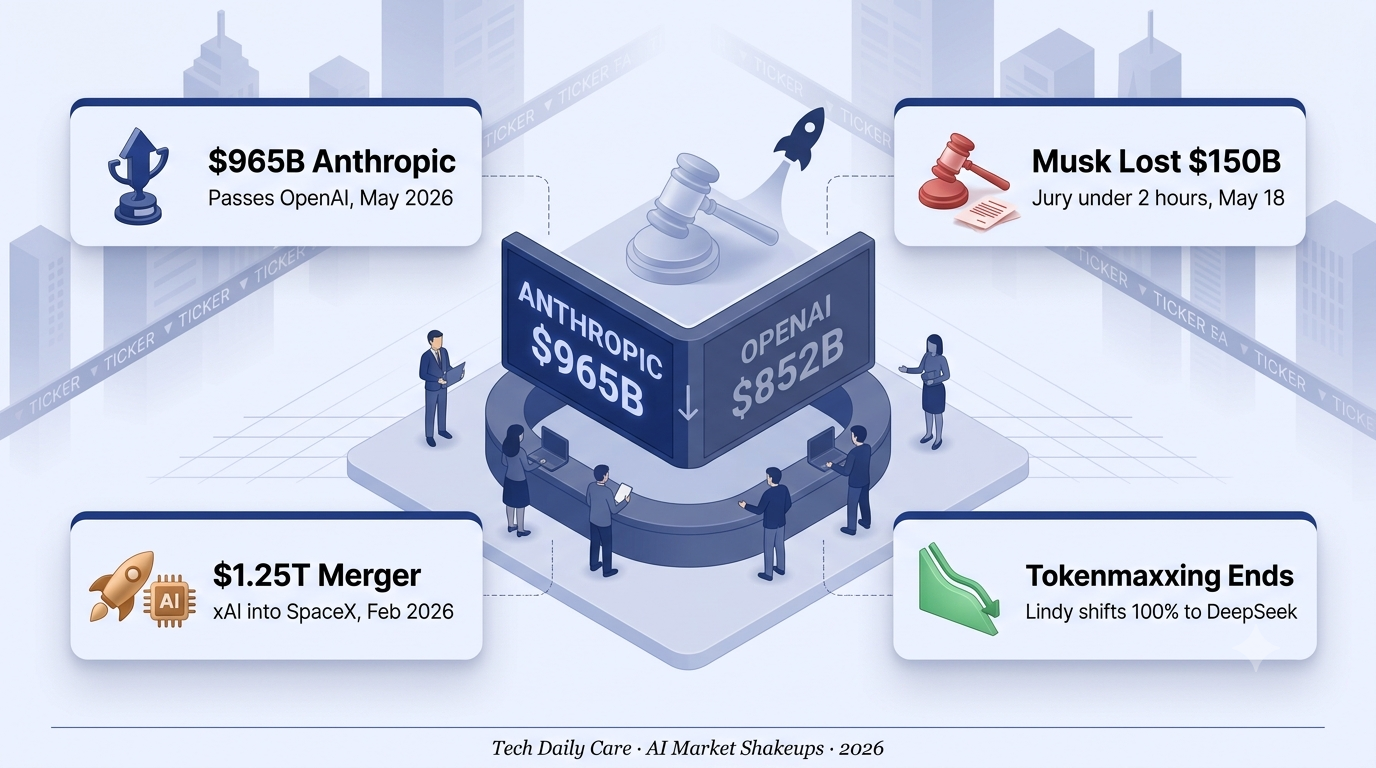
Anthropic Passed OpenAI
$965B vs $852B. The Claude maker’s revenue run rate hit $47B — up from ~$1B fifteen months earlier. Silicon Valley’s most valuable AI startup is no longer ChatGPT’s parent.
Musk Lost His $150B Suit
Jury took under two hours to dismiss all claims on statute of limitations grounds. Altman testified. So did Nadella. Musk vowed to appeal to the 9th Circuit.
xAI Absorbed by SpaceX
February merger created a $1.25T combined entity — the largest merger in corporate history. SpaceX IPO now targeting $1.75T valuation with $75B raise.
Tokenmaxxing Era Ending
Enterprise CTOs like Lindy’s Flo Crivello moving 100% of Claude traffic to DeepSeek. The spend-at-any-cost model is giving way to efficiency-first sourcing.
The 5 Ways AI Broke the Internet in 2026
Anthropic Hit $965B and Passed OpenAI — May 28, 2026
Silicon Valley’s Top AI CompanyOn May 28, Anthropic announced a $65 billion Series H at a post-money valuation of $965 billion — surpassing OpenAI’s $852 billion valuation from a March 2026 round. The financing was led by Altimeter Capital, Dragoneer, Greenoaks, and Sequoia. Just three days later, on June 1, Anthropic filed its confidential S-1 with the SEC, targeting a public listing as soon as October 2026.
What made the leap remarkable: Anthropic went from roughly $1 billion in annual recurring revenue to a $47 billion ARR in fifteen months — the fastest revenue scale in software history. Claude’s growth was heavily driven by the coding developer segment (Claude Code, Cursor integrations) and enterprise Cowork adoption. Meanwhile, Anthropic passed OpenAI in ARR in April 2026, per CNBC reporting: $30B vs $25B run rate.
Musk Lost the $150B Lawsuit Against Altman — May 18, 2026
Verdict in Under 2 HoursAfter 11 days of testimony in Oakland federal court, a nine-member jury unanimously dismissed all of Elon Musk’s claims against OpenAI, Sam Altman, Greg Brockman, and Microsoft — in under two hours of deliberation. The jury found Musk’s 2024 filing exceeded the statute of limitations. Musk had sought disgorgement of up to $150 billion in profits, dismissal of Altman and Brockman, and the dismantling of OpenAI’s for-profit entity.
Testimony included Altman, Brockman, Microsoft CEO Satya Nadella, and Musk himself. Internal 2017 emails showed Brockman privately writing that OpenAI’s leadership “was not committed” to the nonprofit structure. OpenAI’s lawyers characterized the entire suit as Musk retaliating after losing an internal battle to fold OpenAI into Tesla in 2017–2018. Musk announced he would appeal to the 9th Circuit, calling the verdict “a technicality.”
xAI Merged Into SpaceX at $1.25T — February 2026
Largest Merger in HistoryIn February 2026, Musk merged xAI into SpaceX at a combined valuation of $1.25 trillion — the largest corporate merger ever completed. The move consolidated Musk’s private empire ahead of SpaceX’s own public listing, now targeting a $1.75 trillion valuation and a $75 billion capital raise. Reports peg the SpaceX IPO for as early as June 12, 2026, though the definitive date has been in flux.
The merger changes competitive dynamics materially. xAI’s Grok model gains SpaceX’s cash reserves and infrastructure. Meanwhile, SpaceX’s public-market pitch becomes an AI-plus-space story rather than a pure launch business, which is likely to command a higher multiple. Combined with Anthropic’s $965B and OpenAI’s $852B pipeline, the AI IPO cycle is now on pace to bring more than $3.8 trillion in AI-linked market cap to public markets by year-end.
Anthropic and OpenAI Filed IPOs One Week Apart — June 1 and June 8
Dot-Com Level ConcentrationAnthropic filed its S-1 with the SEC on June 1, 2026. OpenAI followed on June 8. Combined with SpaceX’s expected filing later in the year, these three companies alone represent approximately $3.8 trillion in market capitalization heading to public markets in a single 2026 window. Renaissance Capital data shows total US IPO proceeds year-to-date sitting at $28.4 billion — a figure that will be dwarfed if all three complete their listings.
Gartner analyst Eric Goodness told CNBC the Anthropic filing “will not only reprice private competitors, but also provides insight to every enterprise attempting to value and price the future cost of intelligence in their company.” This is the first true public-market benchmark for what a frontier AI lab is actually worth. It will define enterprise AI budget math for years.
Tokenmaxxing Started to End, AI Broke the Internet’s Own Bubble — June 2026
Efficiency Over SpendIn late June, CNBC reported that Lindy CEO Flo Crivello switched 100% of his company’s traffic from Anthropic’s Claude models to DeepSeek — a Chinese open-weight lab producing much cheaper alternatives. “We did it, and you could see that cost curve go down, like, crash to the ground,” Crivello told CNBC. The story was a signal, not an outlier: enterprise CTOs are pivoting from spend-at-any-cost tokenmaxxing to efficiency-first model sourcing.
This is the first structural pressure on both Anthropic’s and OpenAI’s revenue curves. Both companies have been the principal beneficiaries of enterprises treating LLM inference as essentially unlimited. If a meaningful share of that traffic reroutes to open-weight alternatives — DeepSeek, Meta’s Llama family, Mistral, Cohere — the exponential ARR growth that justified $965B valuations becomes harder to sustain.
The 2026 window either becomes the most consequential IPO cycle since the dot-com era, or the most expensive lesson in narrative-versus-fundamentals that public markets have ever taught.
How AI Broke the Internet in Ways the Coverage Missed
Big Tech’s Capex Commitment Passed $725 Billion Annually
Under-coveredWhile AI news cycles focused on OpenAI vs Anthropic, the hyperscalers quietly committed to more than $725 billion in annual capital expenditure on AI infrastructure across Microsoft, Alphabet, Amazon, and Meta. That’s more than the entire annual revenue of Microsoft in 2020. The compounding effect: Anthropic’s and OpenAI’s growth is partly a downstream consequence of Big Tech having already prepaid the compute they’ll need. The IPOs monetize infrastructure that hyperscalers built.
OpenAI’s CFO Publicly Warned It Isn’t Ready to Go Public
Buried SignalThe Information reported in May 2026 that OpenAI CFO Sarah Friar told internal stakeholders “OpenAI isn’t ready to be a public company.” The Wall Street Journal separately reported that OpenAI had missed internal revenue targets for 2026. Neither story derailed the IPO filing — but both raise the question of whether the market is being sold a company that isn’t operationally ready for the disclosure and predictability requirements of public equity.
DeepSeek’s Real Enterprise Traction Is Bigger Than Reported
Cost Curve StoryThe Lindy migration to DeepSeek was one company. But conversations with mid-market CTOs suggest at least a dozen well-known enterprise AI-native companies have quietly shifted meaningful traffic away from Anthropic and OpenAI to DeepSeek or open-weight Llama variants in the past six months. This isn’t yet reflected in the frontier lab revenue disclosures — but it will be by the second IPO earnings call, if not the first.
We did it, and you could see that cost curve go down, like, crash to the ground.