
The AI Paradox, GitLab Says 79% Code Faster But Nothing Ships Faster
Harris Poll surveyed 1,528 developers in six countries. Productivity gains are real. Delivery speed hasn’t moved. Governance is falling behind.
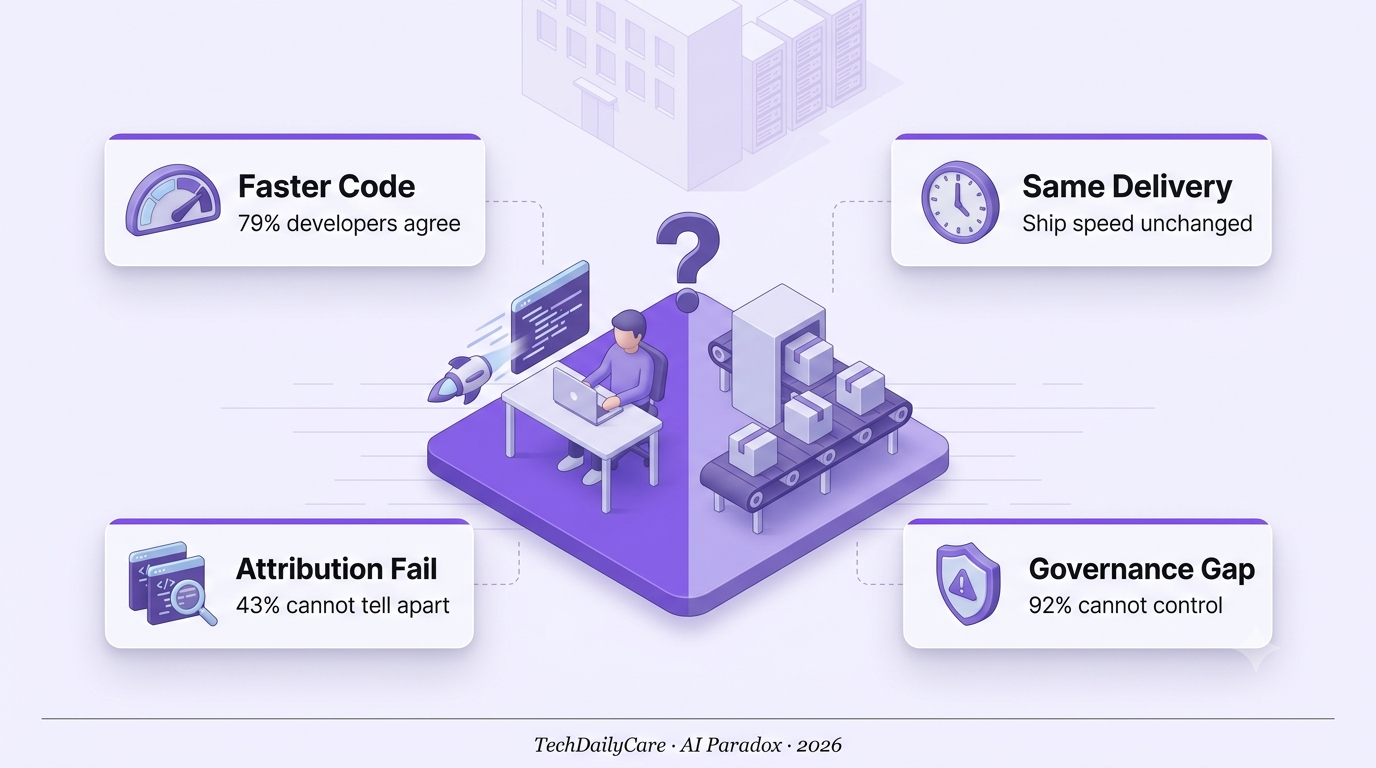
The AI Paradox is now a documented phenomenon. GitLab published its 2026 AI Accountability Report on June 23, based on a Harris Poll survey of 1,528 developers and technology buyers across six countries. The headline finding: 79% of developers say individual productivity rose with AI, but the overall software delivery process has not accelerated at anywhere near the same pace. GitLab named this gap the AI Paradox, and the data behind it is the most detailed picture yet of what happens after the adoption honeymoon ends.
The productivity numbers are real. 78% report faster code writing and committing. 73% say overall code quality has improved. 60% say AI coding return on investment has exceeded expectations. 91% of organizations use two or more AI coding tools in production, and 54% use three or more. On the input side, AI coding tools have delivered exactly what the vendors promised. On the output side, the picture is different, and getting harder to spin.
The bottleneck moved. 85% of respondents agree that AI has shifted the constraint from writing code to reviewing and validating it. 84% agree the biggest challenge with AI-generated code is governing what happens to it after creation. 82% say AI-generated code risks creating a new form of technical debt that organizations are not prepared to manage. The friction never disappeared — it relocated downstream to code review, security scanning, compliance checks, and deployment gates that were never sized for a 78% jump in incoming code volume.
And the accountability piece is where the AI Paradox gets uncomfortable. 92% of respondents report some form of governance challenge with AI-generated code. 43% cannot reliably distinguish AI-generated code from human-written code inside their own codebases. 87% are confident their team could determine within 24 hours whether AI code contributed to a production incident — but 34% of organizations that actually had an incident could not make that determination. Here is what the AI Paradox looks like inside real engineering organizations, why productivity gains have not translated to shipping speed, and what teams are starting to do about it.
Why does more code mean same delivery?
Code generation sped up, but code review, security scanning, testing, compliance, and deployment did not. The pipeline downstream of the developer is now the constraint, not the developer.
What kind of technical debt is this?
82% of respondents say AI code creates a new form of technical debt organizations are not prepared to manage. 43% can’t distinguish AI code from human code in their own repos, which makes the debt hard to even measure.
Do teams actually know what shipped?
87% say they could trace an AI-code incident within 24 hours. Among organizations that had a real incident, only 34% could actually do it. The confidence gap is 53 percentage points.
Who benefits from fixing this?
Governance platforms (GitLab itself, Semgrep, Endor Labs) and observability vendors are the near-term winners. 98% of surveyed organizations plan to allocate budget to AI code governance in the next 12 months.
The 79% Number Is The Whole Point
HeadlineThe AI Paradox rests on one gap. 79% of developers surveyed agree individual productivity has improved with AI coding tools. But the overall software delivery process has not accelerated at anywhere near the same pace. This is not a small discrepancy or a rounding error — it is the defining pattern of AI coding adoption in 2026, and it now has an industry-standard name attached to it.
GitLab is the vendor that put a label on the trend, but the underlying pattern shows up in almost every enterprise engineering post-mortem this year. Companies deploy Cursor, Claude Code, or GitHub Copilot. Developers report satisfaction and faster individual output. Then the leadership team looks at deployment frequency, lead time for changes, and DORA metrics broadly — and finds that nothing at the team or organization level actually shipped faster.
That is the exact shape of the AI Paradox. The 79% is what individuals feel. The delivery flatness is what customers see. And the gap between those two numbers is where budget arguments, executive skepticism, and this year’s second wave of AI coding tooling investment all collide.
Where The Bottleneck Actually Moved
Diagnosis85% of respondents agree AI has shifted the bottleneck from writing code to reviewing and validating it. This is the mechanical explanation for the AI Paradox: the total work of shipping software is a pipeline, and speeding up one stage does not speed up the pipeline unless the downstream stages can absorb the higher volume.
Code review is the most obvious constraint. A senior engineer who used to review 400 lines of human-written code per day now sees 800-1,200 lines of AI-augmented code from the same team. The reviewer’s throughput did not increase. Their attention span did not increase. What increased is the volume they have to make sense of, which means either slower review cycles, shallower review, or a growing review backlog.
Security scanning and compliance validation face the same problem. AI-generated code can pass syntax and unit tests while embedding subtle vulnerabilities or license-attribution issues that require deeper human inspection. When the input volume triples but the review capacity does not, the queue depth grows. Deployment gates then wait on approval that has queued up further upstream.
The 43% Attribution Problem
GovernanceHere is the finding that should worry engineering leaders most. 43% of respondents say they cannot reliably distinguish AI-generated code from human-written code within their own codebases. If nearly half of an organization cannot tell which lines were produced by an AI model, the entire framework of code review, security auditing, and post-incident forensics becomes harder to run.
GitLab frames AI accountability around three questions any organization should be able to answer about any line of AI-generated code: where did it come from, what was it meant to do, and who is responsible for it once it’s in production. For the majority of surveyed organizations in 2026, the honest answer to those questions is: we don’t know. Not because the answer is hidden, but because no infrastructure was built to record it.
The attribution problem gets worse over time. AI code accumulates in the codebase without provenance tags. Six months later, when a bug shows up in production, the team can no longer reconstruct which model produced which snippet, which prompt was used, or even which developer accepted the suggestion. 83% of respondents identify AI-generated code accumulation as a risk to manage now. 44% call it a top technology risk.
The 87% Confidence, 34% Reality Gap
TrustThe most unsettling number in the AI Paradox report is the confidence gap. 87% of respondents said they were confident their team could determine within 24 hours whether AI-generated code had contributed to a production incident. Among the subset of organizations that had actually experienced such an incident in the past year, only 34% could actually make that determination in that window.
That is a 53 percentage-point gap between what engineering leaders think their teams can do and what they can actually do when the incident lands. It matches the pattern seen in disaster recovery and security posture surveys for years — organizations overestimate their operational readiness for events they have not stress-tested. AI code incidents are just the newest category of event most teams have not yet had to trace.
This gap has practical consequences for CISOs and heads of engineering trying to build an accurate risk picture. Board reports based on team-level confidence surveys will overstate operational readiness. Actual incident response, once it happens, exposes the gap immediately. GitLab’s argument is that this confidence-reality delta is itself a component of the AI Paradox: the illusion of control makes the governance problem harder to prioritize until an incident forces it.
Why AI Adoption Outran The Policies
TimingThe AI Paradox is a governance problem, not a technology one. 80% of respondents said their organization adopted AI coding tools faster than it developed the policies to govern them. This is the operational root cause of the gap. Tool procurement can be signed off by an engineering manager. Policy development requires legal, security, compliance, and engineering leadership to align, which takes months longer than any tool rollout.
The imbalance shows up everywhere in the enterprise adoption cycle from 2024 through 2026. Developers install Cursor or Claude Code inside a two-week evaluation. IT approves the SSO configuration in a week. Meanwhile, the policy work — data retention rules, model-choice guardrails, IP-attribution tracking, prompt-history preservation, incident-response procedures — takes six months to draft, another six months to circulate, and often lands after the tools are already load-bearing.
This gap between adoption speed and policy speed is the operational engine of the AI Paradox. GitLab’s report argues the fix requires making governance native to the platform layer rather than a separate policy artifact. If the tooling captures provenance, approval, and accountability metadata by default, the policy work catches up faster because the substrate already exists.
What Real Teams Are Starting To Do
ResponseThe AI Paradox has produced a distinct response pattern in engineering organizations that have hit it. 98% of surveyed organizations report plans to allocate budget to AI code governance in the next 12 months. That is not a soft signal — it is the largest budgetary shift toward a single new category of tooling since the DevSecOps consolidation cycle of the late 2010s.
The concrete moves fall into three buckets. First, provenance metadata at commit time — recording which model produced code, which prompt was used, and which developer accepted the suggestion. Second, staged deployment gates specifically for AI-heavy changes, with mandatory human review thresholds calibrated to how much AI-generated code is in the diff. Third, incident-response playbooks updated to include AI code traceability as a first-order question rather than an afterthought.
Vendors moving into this space include GitLab itself, plus Semgrep, Snyk, Endor Labs, and observability platforms adding AI code lineage features. The governance-tool category was essentially unstaffed 18 months ago. In mid-2026, it is on almost every enterprise engineering roadmap, driven directly by teams recognizing they are living inside the AI Paradox and cannot budget-argue their way past it any longer.
Adoption of these tools is still uneven. Large enterprises with dedicated platform teams are moving first, deploying governance overlays across GitHub Enterprise, GitLab, and self-hosted mono-repos. Mid-market engineering orgs are watching to see which vendor pattern wins before committing. And startup engineering teams, which produce some of the highest AI code volume per developer in the industry, are the segment most likely to hit the AI Paradox hardest when their first serious compliance audit lands and the accountability questions arrive without answers.
Where did this code come from? What was it meant to do?
Who is responsible for it once it’s in production?
- Instrument provenance at commit time — Record model name, prompt hash, accepting developer, and review status for every AI-assisted commit. Retrofit is significantly harder than doing this by default.
- Right-size code review capacity — If AI raised code output 30-50%, review throughput needs to grow proportionally. Otherwise, the review queue becomes the ship-speed bottleneck the AI Paradox describes.
- Add staged deployment gates for AI-heavy diffs — Diffs with more than a threshold percentage of AI-generated lines get mandatory extra human review. This matches oversight to actual risk.
- Run tabletop incident exercises — Simulate an AI-code production incident. Test whether the team can actually answer the three accountability questions in 24 hours under controlled conditions.
- Track DORA metrics alongside individual productivity — Lead time, deployment frequency, and change failure rate expose the AI Paradox faster than developer-satisfaction surveys.
- Update incident-response playbooks — Include AI code traceability as a first-order question. Add prompt history preservation and model-attribution steps to the standard post-mortem template.
- Budget for governance tooling in FY26 — 98% of surveyed organizations are doing this. The category-winning vendors are still being sorted out, but the underlying spend is committed.
⚠️ Four AI Paradox Traps To Avoid
1. Mistaking developer satisfaction for shipping speed. The 79% productivity finding is real, but it is a leading indicator, not a delivery outcome. If DORA metrics have not moved after AI rollout, the AI Paradox is present regardless of how positive the developer survey looks.
2. Treating attribution as an academic problem. The 43% who cannot distinguish AI code from human code inside their own repos are one production incident away from a governance crisis. Post-incident is the worst time to retrofit provenance tracking.
3. Buying more AI tools before fixing the pipeline. 54% of organizations already use three or more AI coding tools. Adding a fourth tool without addressing downstream review capacity just widens the bottleneck the AI Paradox is describing.
4. Assuming the confidence surveys are accurate. The 87% who say they can trace incidents in 24 hours, versus the 34% who actually did it during a real event, is a warning about how much operational confidence to place in unverified self-reporting.
Individual developers are more productive.
The overall software delivery process has not accelerated at the same pace.