
Amazon Trainium Just Cracked $20B, Nvidia Has a Real Rival
$225B in contracted commitments, Anthropic 5GW, OpenAI 2GW, and a Trainium3 rack that ties Nvidia’s Blackwell NVL72. Here’s what Amazon Trainium actually changes for the AI silicon race.
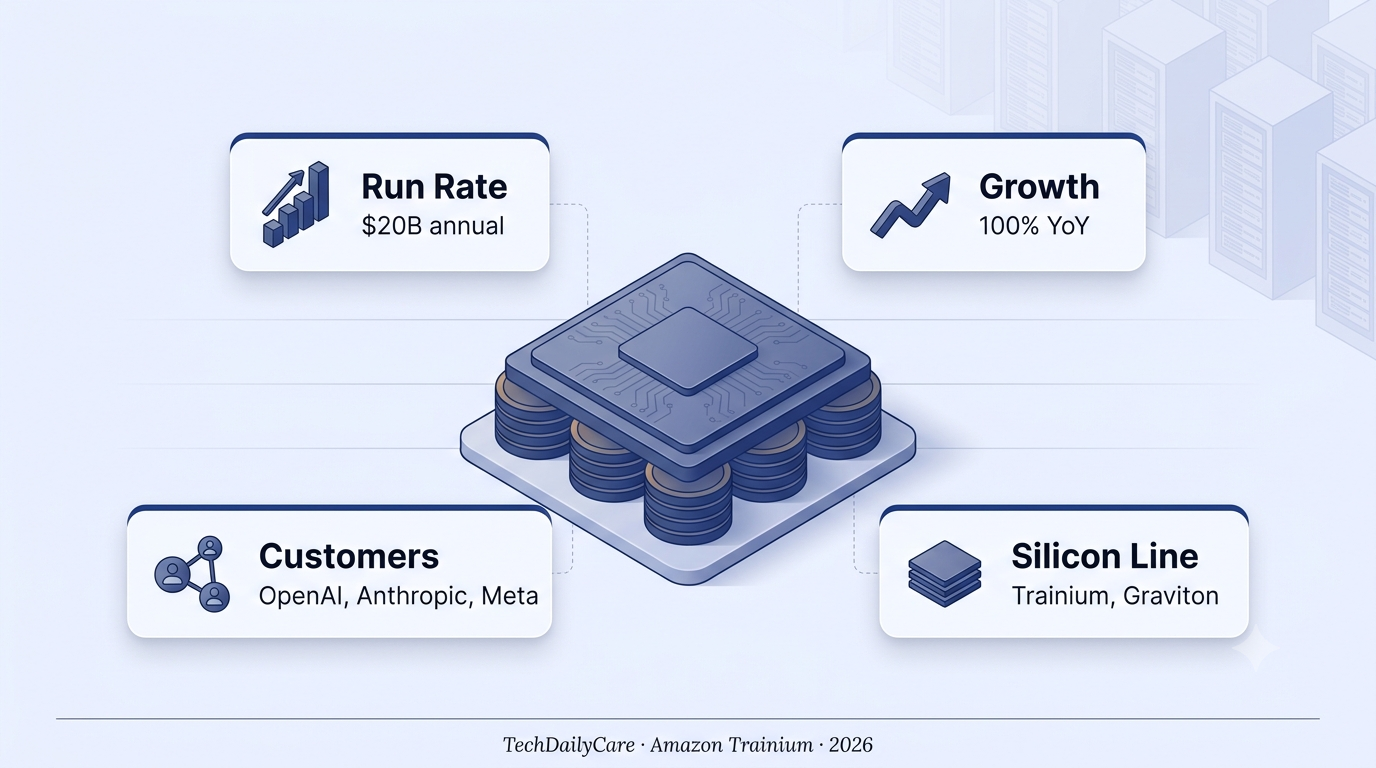
Here’s the sentence CEO Andy Jassy actually said on Amazon’s April 29 earnings call: Amazon’s custom silicon business “is now one of the top three data center chip businesses in the world.” AMZN barely moved. Analysts published note after note about AWS growth reaccelerating to 28% and Trainium2 selling out, and the market gave the stock a shrug. Three months later, on July 19, the numbers Jassy attached to that sentence started to land. Amazon Trainium — the AI accelerator line that most people had not thought of as a serious Nvidia rival — is running at a $20 billion annual pace with $225 billion in future revenue commitments already booked.
The scale is doing work most enterprise buyers have not yet processed. Two-plus million AI chips deployed by AWS in the past twelve months. Anthropic anchoring a multi-year, multi-gigawatt deal tied to over $100 billion in committed AWS spend and up to 5 GW of Trainium capacity. OpenAI on a separate deal for roughly 2 GW. Meta and Uber signed. Trainium2 supply, per Jassy, is essentially sold out. Trainium3 started shipping in early 2026 and reached rack-scale parity with Nvidia’s Blackwell NVL72 — 144-chip UltraServer configurations delivering about 362 MXFP8 PFLOPs at the rack level, tied with Nvidia’s ~360 PFLOPs — at a total cost of ownership one analyst estimated at roughly 50% lower.
The strategic picture matters more than any single number. In the same week Huawei publicly demonstrated the Atlas 950 SuperPoD in Shanghai — a rack-scale AI system built with zero Nvidia parts — Amazon Trainium confirmed that the Nvidia-alternative story is not just a Chinese export-controls response. It is also the US hyperscaler answer to a compute market where every training run routed through in-house silicon is a training run Nvidia does not book. Frontier labs that used to have exactly one path to trillion-parameter compute now have three: Nvidia, Amazon, or Huawei depending on jurisdiction. That is the market Nvidia’s next earnings call has to price in.
$20B run rate · Q1 2026
Announced on Amazon’s April 29 earnings call. Combined Trainium, Graviton, and Nitro. Triple-digit YoY growth. 40% sequential Q1 growth. Would equal ~$50B if operated as a merchant chip company.
$225B committed · Trainium-led
Multi-year revenue commitments already contracted. Anthropic anchors with up to 5 GW capacity and $100B+ in AWS spend. OpenAI signed for roughly 2 GW. Meta and Uber also committed.
Trainium3 ships, Trainium4 pre-orders
Trainium2 essentially sold out. Trainium3 shipping since early 2026 with most supply reserved. Trainium4 already has substantial pre-orders roughly 18 months ahead of wide release.
Blackwell parity at rack scale
Trainium3 144-chip UltraServer delivers ~362 MXFP8 PFLOPs, tied with Nvidia’s Blackwell NVL72 (~360 PFLOPs). One analyst estimated TCO roughly 50% lower at rack level.
How Amazon Trainium got to $20B without anyone noticing
The chip business hiding inside AWS
StructureThe reason Amazon Trainium‘s scale surprised the market is structural: Amazon has never reported custom silicon revenue as a separate SEC line item. The $20 billion figure Jassy disclosed on the April 29 earnings call represents internal transfer pricing to AWS — chips Amazon designs, manufactures via TSMC, and deploys inside its own data centers rather than selling to external customers. That means the number is a management-reported metric rather than an audited merchant revenue print, which is exactly why it took three months for the analyst community to fully absorb what Jassy actually said.
What made the disclosure believable was the customer book behind it. Amazon has locked in over $225 billion in Trainium revenue commitments from Anthropic, OpenAI, Meta, Uber, and others. Anthropic’s contribution alone — a multi-year, multi-gigawatt deal reportedly tied to over $100 billion in committed AWS spend and up to 5 GW of Trainium capacity — is larger than most public semiconductor companies’ annual revenue. When customers commit that scale of contracted forward demand, the current $20 billion internal run rate is not a top; it is the floor Jassy is building from.
Why Anthropic anchored the deal
CustomerThe single most important commitment behind Amazon Trainium‘s numbers is Anthropic. The two companies’ relationship — anchored by Amazon’s $8 billion equity investment in Anthropic and Anthropic’s commitment to make AWS its “primary training partner” — has become the largest AI infrastructure deal outside of OpenAI’s Stargate. Anthropic’s up-to-5-GW Trainium capacity commitment means roughly the power output of five large nuclear reactors dedicated to training and inference on Amazon-designed silicon. That is not a hedge. That is a full-stack bet.
Why Anthropic said yes matters beyond the numbers. Fortune’s July 2 reporting confirmed Anthropic is now generating $47 billion in annualized revenue — passing OpenAI on the revenue side even before its own IPO — with Claude Code as the main growth engine. That much revenue at that much scale needs Trainium-tier compute economics to sustain margins. Nvidia Blackwell at Nvidia margins would put the Claude Code business under margin pressure that Amazon’s ~50% lower TCO simply removes. Anthropic did not choose Trainium out of loyalty. It chose it because the unit economics on training and inference stopped working any other way.
Trainium3 caught Nvidia at rack scale
SiliconPer-chip, Trainium still trails Nvidia flagship silicon. Where Amazon Trainium caught up is at rack scale, and rack scale is what enterprise buyers actually deploy. The Trainium3 144-chip UltraServer configuration delivers approximately 362 MXFP8 PFLOPs at rack level — statistically tied with Nvidia’s Blackwell NVL72 rack at ~360 PFLOPs. That parity is what changed the conversation. When two systems produce the same throughput and one costs roughly half as much to operate over three years, the enterprise procurement math stops being close.
Amazon is also willing to be candid about the trade-off. Jassy said explicitly that Trainium2 delivers “about 30% better price-performance than comparable GPUs” — a claim independently reported by multiple outlets covering the earnings call. The 30% price-performance edge on Trainium2 becomes closer to a 2x TCO edge on Trainium3 at rack scale, which is the kind of gap that moves training-run allocation decisions immediately rather than gradually. Trainium4 pre-orders, tracking roughly 18 months before wide availability, suggest hyperscaler customers are already pricing in that trajectory.
Frontier labs used to have one path
to trillion-parameter compute.
Now they have three.
What Amazon Trainium’s scale means for Nvidia
Amazon is still Nvidia’s largest customer
ContradictionThe most misread part of the Amazon Trainium story is the assumption that Amazon is defecting from Nvidia. It is not. AWS remains one of Nvidia’s largest single customers, still buys flagship H100 and Blackwell chips in volume, and charges roughly a 30% premium on Nvidia-based instances in its own cloud versus Trainium-based ones. Amazon profits as both Nvidia customer and Nvidia competitor — and that dual position is more honest about how the compute market actually works than the “AWS killed Nvidia” narrative some analysts have tried to construct.
The strategic point is different. Every Trainium-based workload Amazon serves internally is one that would otherwise route through Nvidia inventory Amazon would have had to buy. Nvidia’s total addressable market inside AWS has a natural ceiling now — the size of workloads Amazon cannot or will not run on its own silicon. That ceiling is not zero (CUDA ecosystem, model portability, developer preference all keep Nvidia demand real) but it stopped being open-ended in Q1 2026, and the $225 billion Trainium commitment backlog is what pins that ceiling in place.
The Huawei parallel is the market signal
GlobalRead the Amazon Trainium disclosure against last week’s Huawei Atlas 950 debut in Shanghai and the pattern becomes unmistakable. In the same seven-day window: China publicly demonstrated a rack-scale AI system built with zero Nvidia parts (8,192 Ascend chips per SuperPoD, targeting Q4 2026 delivery); Amazon confirmed its US-built silicon business is running at $20 billion with $225 billion contracted; and both stories share the same underlying market message. Frontier compute is no longer a Nvidia monopoly. It is a three-vendor market where jurisdiction dictates which vendor you can even buy from.
US hyperscalers cannot buy Ascend under current export controls, and Chinese hyperscalers cannot buy H100 under the same rules. But Alibaba, Baidu, and Tencent now have Huawei; Anthropic, OpenAI, Meta, and Uber now have Trainium; and everyone still buys Nvidia when nothing else will do. The Nvidia moat that mattered most in 2023 and 2024 — the CUDA software ecosystem — remains real. The Nvidia moat that mattered second most — being the only vendor with rack-scale flagship silicon — cracked in Q1 2026 and is now visibly cracked in both hemispheres.
⚠️ Amazon Trainium claims that still deserve independent verification
1. The $20B is internal transfer pricing, not audited merchant revenue. Amazon has not disclosed silicon revenue as a separate SEC line item. Jassy’s figure represents chips deployed inside AWS, not chips sold to third parties. The audited GAAP number does not exist.
2. The $225B commitment number is contracted, not recognized. Multi-year AI infrastructure commitments have historically been renegotiated as customer needs shift. Anthropic’s 5-GW figure, for example, ramps over years rather than landing in one quarter.
3. Rack-scale parity claims are Amazon-published. The Trainium3 144-chip UltraServer at 362 MXFP8 PFLOPs versus Blackwell NVL72 at ~360 PFLOPs is close, but real-workload throughput on production training runs depends heavily on framework, model architecture, and network topology. Independent MLPerf-style verification is limited.
4. TCO comparisons vary widely by workload. The “roughly 50% lower TCO at rack level” number comes from a single third-party analyst estimate. Actual TCO depends on training-run duration, utilization rates, power costs, and data-center location. Treat it as directional, not exact.
What Amazon Trainium’s trajectory changes from here
Merchant sales as the next unlock
StrategyThe single most-watched question hanging over Amazon Trainium after the July 19 disclosure wave is whether Amazon will start selling Trainium to external customers outside AWS. Jassy’s own $50 billion standalone estimate implicitly frames the question — if the chip business were a merchant vendor selling to third-party data centers, its revenue potential would already put it in the top five silicon companies globally. Amazon has hinted at potential Trainium sales to third-party data centers but has not committed to a timeline, and internal reporting suggests the company is weighing whether external sales would cannibalize AWS’s own competitive positioning.
Broadcom’s success at custom silicon partnerships is the model to watch. Broadcom generates roughly $12 billion in AI-related custom silicon revenue serving Google’s TPU program, Meta’s MTIA line, and reportedly OpenAI. Amazon has the internal silicon design capability (Annapurna Labs, acquired in 2015 for $350 million, now the engine of the entire Trainium line), the customer relationships already established through AWS, and the fabrication access via long-term TSMC capacity commitments. That combination could potentially let Amazon skip Broadcom’s middleman role entirely and go direct to enterprise customers. Whether Jassy pulls that trigger — and whether TSMC’s advanced node capacity through 2028 permits — becomes the decision that determines whether Amazon Trainium stays a $50B latent business or becomes a real one competing head-on with Broadcom for the same custom-silicon dollars.
The capex bill behind the growth
MoneyAmazon’s Amazon Trainium ramp is not free. The company’s 2026 capital expenditure is projected to hit roughly $200 billion — the largest single-year capex commitment in corporate history — and free cash flow has consequently plummeted approximately 95%. A recent $25 billion bond offering was 2.48 times oversubscribed with an interest coverage ratio of 35x, giving Amazon comfortable balance sheet room to keep funding the chip and data center buildout. But the near-term optics on cash conversion are ugly, and analysts covering AMZN have started asking harder questions about when the capex peak actually arrives.
The counter-argument, and the one Jassy has now made repeatedly across three consecutive earnings calls, is that Amazon is “not investing $200 billion on a hunch.” The Amazon Trainium $225 billion in contracted commitments is the direct answer to why the capex bill is worth writing. Every dollar of Trainium capex is backed by contracted forward revenue from customers whose alternative is buying Nvidia chips Amazon would also have to buy. Amazon is essentially paying itself to displace a portion of the Nvidia purchases it would otherwise make — and the customer contract book confirms that trade works. On the balance sheet side, the recent $25 billion bond issuance oversubscribed at 2.48x with a 35x interest coverage ratio confirms institutional debt markets are underwriting the capex thesis at spreads inside investment-grade tech peers.