
Nightmare Eclipse Just Dropped Their
Ninth Windows Zero-Day
LegacyHive landed hours after July’s biggest Patch Tuesday ever. It works on fully patched Windows. The researcher is a former Microsoft engineer, and the feud with MSRC is now four months old and getting louder.
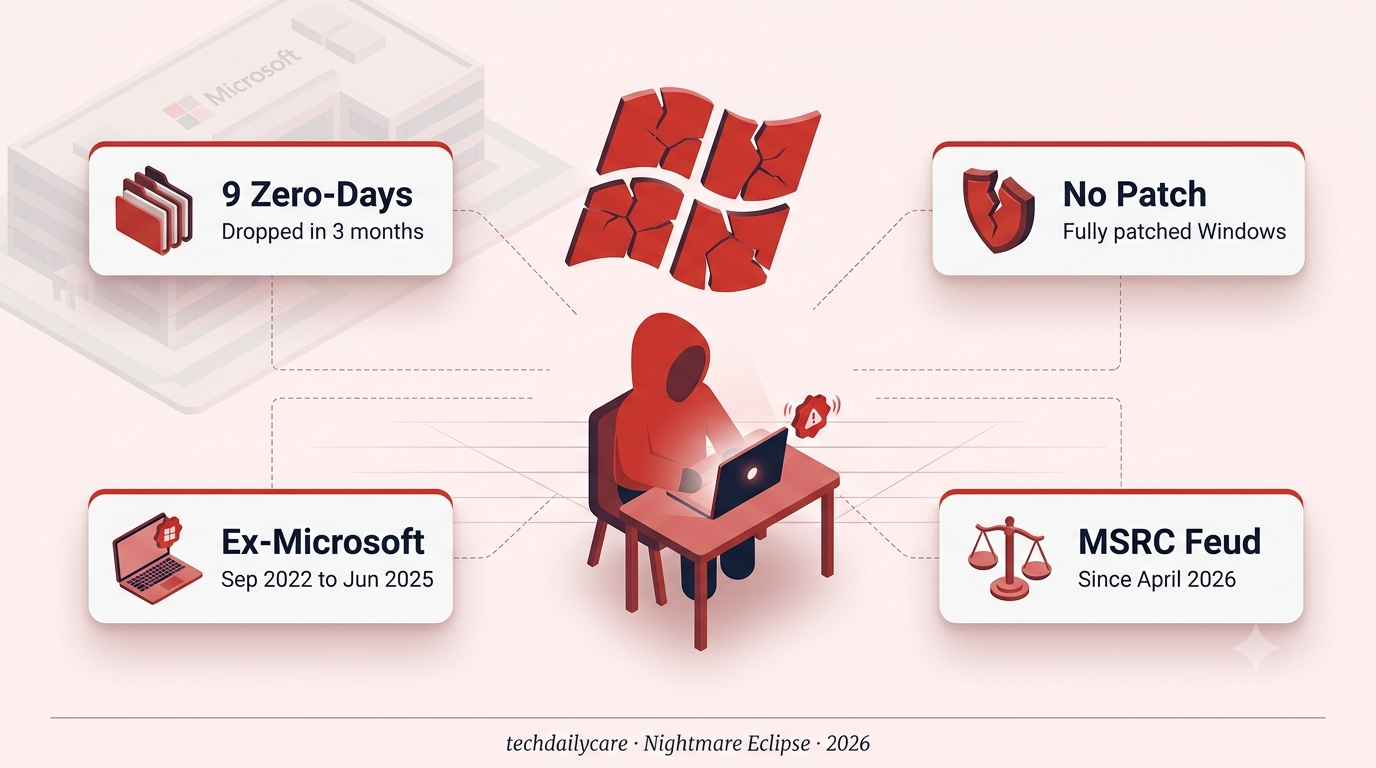
The Nightmare Eclipse feud started with a bug report and turned into a nine-exploit run. Microsoft’s July 14, 2026 Patch Tuesday was the largest ever, fixing 622 unique CVEs. Within hours of that release, the security researcher known as Nightmare Eclipse — also tracked as Chaotic Eclipse or Dead Eclipse — published LegacyHive, a Windows User Profile Service privilege-escalation exploit that works on machines with every July patch installed. It was the ninth Windows zero-day the researcher had dropped since April, no CVE, no vendor coordination, no fix available.
The identity behind the handle is the part that changed the story. According to investigative reporting from The Register and Brian Krebs, Nightmare Eclipse is a former Microsoft security employee who worked at the company from September 2022 through June 2025. The dispute with Microsoft Security Response Center opened in April 2026 over how earlier reports had been handled — credit disputes, bounty handling, and what the researcher characterizes as a communication breakdown. The result has been a public campaign that Barracuda and Cyderes both flag as behavior more consistent with an operator building a toolkit than a researcher publishing bug reports.
The nine exploits — BlueHammer, RedSun, UnDefend, YellowKey, GreenPlasma, MiniPlasma, RoguePlanet, GreatXML, and LegacyHive — target components Microsoft explicitly asks customers to trust: Defender, BitLocker, CTFMON, and the User Profile Service. Several have shown up in real attacks with Russian-geolocated infrastructure before Microsoft could ship a fix. Here is what the Nightmare Eclipse campaign actually looks like, why LegacyHive matters even with its stripped proof-of-concept, and what Microsoft’s response reveals about how the modern vulnerability disclosure process is breaking down at the seams.
Who is Nightmare Eclipse?
An anonymous researcher, reportedly a former Microsoft security engineer who worked at the company from September 2022 through June 2025. Also tracked as Chaotic Eclipse and Dead Eclipse. Blog domain includes “666” and “deadeclipse”.
What is LegacyHive?
A Windows User Profile Service (ProfSvc) arbitrary hive load privilege-escalation flaw. Loads other users’ registry hives, including administrators’. Works on fully patched Windows 10, 11, and Server through 2022 with July 2026 updates applied.
Why is this a real problem?
Several earlier Nightmare Eclipse exploits — including some observed on Russian-geolocated infrastructure — were used in actual attacks before Microsoft shipped fixes. Each drop puts Windows systems in a live exploitation window with no vendor patch available.
What is Microsoft doing?
Microsoft has published its own blog on “uncoordinated” vulnerability disclosure, and reporting indicates the company has raised the possibility of legal action. Patches for prior exploits typically arrive within weeks. LegacyHive is currently under active investigation by MSRC.
Inside the Nightmare Eclipse Playbook
Nine exploits, three months, one pattern
CadenceNightmare Eclipse’s release schedule reads more like a product launch calendar than a security research pipeline. BlueHammer and RedSun landed in April 2026. UnDefend, YellowKey, and GreenPlasma dropped through May. MiniPlasma, RoguePlanet, and GreatXML came out across June. LegacyHive followed on July 14. Nine Windows zero-days in roughly three months, an average of one new exploit every ten days at peak cadence, all published without coordinated disclosure to Microsoft.
The Hacker News, SecurityWeek, and Barracuda have all noted that the release rhythm itself is anomalous. Serious independent researchers rarely publish this frequently, and when they do, the exploits tend to be small variations on a single primitive. The Chaotic Eclipse set spans several distinct Windows subsystems, which either points to years of accumulated pre-departure research being drawn down publicly or to an unusual level of ongoing capability.
Targets are Microsoft’s trust anchors
Target selectionCyderes senior vice president Brian Hussey framed the target selection sharply in a statement to The Hacker News. “NightmareEclipse has shipped nine tools in three months, every one aimed at a feature Microsoft tells customers to trust: Defender, BitLocker, CTFMON. That pattern reads like an operator building a toolkit, not a researcher publishing bug reports.” The exploit list is not a random sampling of Windows attack surface — it is a deliberate assault on the specific components enterprises are told to rely on for endpoint defense, disk encryption, and input security.
The choice matters for the political story around the campaign. Bugs in obscure subsystems generate technical discussion. Bugs in Defender and BitLocker generate headlines, procurement questions, and awkward conversations with regulators. The target selection appears calibrated to maximize the reputational cost of each release, not just its technical severity.
Some exploits ran in real attacks first
Confirmed impactNot every release in this campaign is a theoretical PoC. Barracuda’s profiling report notes that exploits published in this series have been observed in threat activity linked to Russian-geolocated infrastructure. Multiple prior drops — including BlueHammer, RedSun, and UnDefend — were reportedly exploited in the wild before Microsoft shipped fixes. The pattern is publish, observe attacks in the exposure window, then wait for MSRC to catch up.
That means the Nightmare Eclipse question is not purely about vulnerability disclosure ethics. It is about the operational cost of the exposure windows the campaign creates. Every ten-day gap between publication and patch is a window where Windows systems are vulnerable to whichever actors saw the drop and moved fastest. Some of those actors have already moved.
LegacyHive is stripped, but real
Latest dropThe July 14 LegacyHive release breaks from the earlier pattern in one specific way. The researcher published a “stripped” proof-of-concept — code that demonstrates the bug is real but has been reduced to prevent immediate mass exploitation. The researcher’s own note on the release said the original PoC did not require additional user credentials and was not limited to the “usrclass.dat” hive. “Any hive could be loaded using this vulnerability, but you would need some brain cells to make the PoC do it.”
The stripped format changes the impact model. LegacyHive as published requires an attacker who already has access to the target system, valid user credentials, and a third username whose registry hive can be mounted. That combination is not internet-exploitable. It is a post-compromise tool — useful for an attacker already inside the network who wants to escalate to another user’s context, particularly an administrator’s.
The MSRC feud is now public
Disclosure breakdownThe dispute between the researcher and Microsoft Security Response Center broke into public view in April 2026 and has escalated with each subsequent drop. Chaotic Eclipse’s stated position, laid out across the deadeclipse666.blogspot.com blog, is that prior reports were mishandled, researcher credit was not given, and bounty decisions were made in bad faith. Microsoft, in a rare public response, published a blog on “(un)coordinated” vulnerability disclosure noting that none of the released exploits — RedSun, UnDefend, BlueHammer, YellowKey, GreenPlasma, MiniPlasma — were reported through the company’s official channels prior to being made public.
SOCFortress reporting, drawing on The Register and Brian Krebs investigations, added another layer. Microsoft has reportedly raised the possibility of criminal prosecution. GitHub and GitLab repositories hosting Chaotic Eclipse’s PoCs have been repeatedly taken down. In response, the researcher has moved code distribution to a self-hosted platform at projectnightcrawler.dev. Every takedown escalates the visibility of the next drop.
That pattern reads like an operator
building a toolkit, not a researcher
publishing bug reports.
Why Nightmare Eclipse Reshapes the Microsoft Security Story
An ex-insider is a different threat model
Insider dimensionThe Register and Brian Krebs both reported that this actor is a former Microsoft security employee who left the company in June 2025. If accurate, that changes the threat model in a way no external researcher can match. An ex-insider has seen the internal codebase, understands MSRC’s triage process, knows which teams own which components, and — critically — has an informed intuition for where the untested attack surface lives. Every subsequent zero-day drop draws on that context.
Microsoft’s own risk register has to account for this differently than it would a hostile external actor. External researchers get bugs the way outside people get bugs — through fuzzing, reverse engineering, or lucky observation. An ex-insider gets bugs from having sat next to the people who wrote the code. The nine-exploit run in three months is consistent with the second model, not the first.
Patch tempo is losing to disclosure tempo
Timing gapMicrosoft continues to take several days to several weeks to ship fixes for the researcher’s disclosures. That is a reasonable pace for a normal vulnerability, and it is completely insufficient for an actor publishing new exploits every ten days. The math does not work — with a patch throughput measured in weeks and a disclosure throughput measured in days, the backlog only grows, and the exposure window widens with each drop.
The July 14 timing was itself a signal. Chaotic Eclipse published LegacyHive within hours of the July Patch Tuesday shipping, on the same day Microsoft closed 622 CVEs including two actively exploited zero-days in SharePoint and elsewhere. Publishing at that moment guaranteed the story landed inside the largest patching event of the year, ensuring maximum attention and forcing the SharePoint response cycle to compete with the LegacyHive response cycle for admin bandwidth.
The bounty system is the underlying failure
Structural issueWhatever the specific dispute between Nightmare Eclipse and MSRC turns out to have been, the campaign has surfaced a structural weakness in how vendors handle high-signal external researchers. Bug bounty programs are designed for volume — thousands of small reports, standard triage, predictable payouts. They are not well designed for the handful of researchers who find fundamental bugs in trust-anchor components and expect proportionate recognition and compensation.
When that mismatch produces a bad outcome for a high-signal researcher, the industry’s assumption has always been that reputation and the CVD norm would keep the disclosure controlled. Nightmare Eclipse is the counterexample. A researcher who has already decided the CVD contract is void has no institutional lever pulling them back toward coordinated disclosure. Every vendor with a bounty program is now living with that risk.
Defenders cannot wait for the CVE
Response postureThe practical implication for security programs is that the “wait for the CVE, then patch” model is losing time against the Nightmare Eclipse cadence and against similar disclosure patterns emerging elsewhere. Once a PoC is public, the exposure window opens immediately. Waiting for a CVE assignment or a KEV listing before triaging the exposure is the wrong posture for this class of drop, because both those signals arrive after the exploitation has already started.
Defensive programs adapting to the Nightmare Eclipse era are shifting toward compensating controls that do not depend on the specific bug being known. Endpoint detection that does not trust Defender exclusively. BitLocker configurations layered with additional integrity signals. User Profile Service hardening. Application allowlisting for high-value endpoints. Each control is independently valuable, and each becomes more valuable when the vendor’s patching cadence cannot keep up with a determined external publisher.
- Watchlist deadeclipse666.blogspot.com and projectnightcrawler.dev — the researcher’s blog and self-hosted PoC distribution platform
- Prioritize network detection independent of endpoint controls — assume Defender, BitLocker, and CTFMON may be undermined during any active zero-day window
- Harden user profile management — LegacyHive targets ProfSvc directly, and standard hardening guides reduce the impact even without a Microsoft patch
- Layer identity controls above endpoint trust — Conditional Access, session token anomaly detection, and administrator-account activity monitoring
- Track prior Nightmare Eclipse CVEs after they patch — several exploits including RedSun and UnDefend were eventually assigned CVE numbers, and those specific fixes should be verified as deployed
- Do not wait for CVE assignment on new drops — treat each Nightmare Eclipse publication as an active exposure window, not a future patching item
⚠️ Three Things This Story Is Not Yet
1. It is not a proven identity confirmation. The Register and Brian Krebs have both published investigative reporting linking Nightmare Eclipse to a former Microsoft engineer, but the researcher has not confirmed the attribution. Treat the ex-employee framing as strongly reported but not final.
2. It is not a claim that every drop is being exploited. Several Nightmare Eclipse exploits have been observed in real attacks. Not all of them. LegacyHive as published requires prerequisites that make immediate mass exploitation unlikely. The exposure window matters, but so does the specific technical shape of each drop.
3. It is not a resolved dispute. Microsoft’s public communications have signaled displeasure and referenced legal options. Nothing about the underlying disagreement over prior report handling has been settled. Expect further drops until the structural conflict is addressed one way or another.
Microsoft continues to take several days
or weeks to fix the disclosed flaws.
He still has the upper hand.